Categories
Uncategorized

Black History Month – Francis Bartels (1910-2010), inspirational Ghanaian educationalist

Born in Ghana, Dr. Francis Lodowic Bartels was educated at Cape Coast Methodist Primary School from 1915 and later at Mfantsipim School. With a King Edward VII scholarship he attended Westminster College, then in London, between 1931-35. He was in the second year of students who took a degree at the University of London (in his case Kings College), before a final year of teacher training.

Francis Bartels in Westminster College group photograph (detail), 1932
Westminster College Fourth Year group photograph, 1934

He returned to Ghana to teach at Mfantsipim School until 1945 (latterly as acting headmaster), when he left to train in England as a professional teacher. From 1949-1961 he was the first black African headmaster of Mfantsipim School, and was appointed O.B.E. in 1956.

An outstanding and innovative educator, among his many talented and influential pupils was Kofi Annan, later Secretary-General of the United Nations, who said of him:

Most of us can point to a teacher who changed our lives. In my case there can be no doubt that that teacher is Francis Bartels. Each day takes me a little further on the road he helped to pave. Each day I look back in gratitude….

I can remember his never-tiring efforts to broaden our horizons. To encourage us to open our eyes, speak our minds, and engage with the issues of the day and the world at large while never forgetting the traditions and values of our own society… he taught from the heart, not merely from books. He inspired thought and encouraged doubt, allowing us to discover ourselves in the process.

For Headmaster Bartels, education was about the formation of character rather than the mere transmission of knowledge. The mind was not a vessel to be filled, but a fire to be ignited.

Following increased involvement in international educational organisations, in 1961 he joined UNESCO (the United Nations Educational, Scientific and Cultural Organisation) becoming head of the Africa Division, then 1967-69 Adviser on African Education to the Assistant Director-General for Education. In 1969-70 he was Senior Lecturer at the University College of Nairobi, then in May 1970 was appointed Ghana’s Ambassador to Germany, in Bonn.

Following a coup in 1972 that appointment ended but he continued to be closely involved in UNESCO work for the remainder of his life. He was awarded an honorary degree of Doctor of Laws (LLD) by the University of Ghana in 1989. He lived in Paris, where he died on 20 March 2010, just one week after his 100th birthday.

Dr Peter Forsaith is Research Fellow at the OCMCH, and is currently cataloguing Dr Bartels’s papers which are among our collections

Categories
Uncategorized

Archives & Library – 1789 Wesley Letter Acquired

We’re delighted to announce that we have received the generous gift of an original John Wesley letter of 10 January 1789 to Walter Churchey of Brecon.

The letter was formerly in the custody of Greenock Methodist Church, and was first brought to light over 70 years ago by Oliver Beckerlegge as ‘A New Wesley Letter’ in the Proceedings of the Wesley Historical Society, vol. XXVII, part 4 (December 1949). Beckerlegge was a scholar and collector of early printed Bibles which are now in the collections of the University of Sheffield (https://www.sheffield.ac.uk/library/special/beckerlegge).

Beckerlegge described the letter as addressed to Walter Churchey, a lawyer and Methodist with whom Wesley carried on a considerable correspondence between 1770 and his death. The ‘Great man’ discussed by Wesley in the letter is the poet William Cowper, who (as Bickerlegge noted) had recently achieved fame with ‘The Task’

Since arriving at the Centre, conservation work has been undertaken on the letter including its removal from an old frame, and acid-free treatment to prevent the ink from damaging the eighteenth-century paper.

Images of the letter are now digitally available for the first time at OCMCH Digital Collections: https://flic.kr/p/2jzCMtz

Categories
Uncategorized

Research – Wesley Historical Society Essay Competition 2020

The Wesley Historical Society has announced a new prize competition for essays on any topic involving the history of Methodism in the British Isles. The competition is being held in association with the Oxford Centre for Methodism and Church History, Oxford Brookes University. Two prizes of up to £175 will be awarded, one for a Sixth Form pupil, and one for an undergraduate studying for a first degree. Where the standard of entries merits it, the prize money may be split.

Entries will be judged by a panel of historians of Methodism overseen by the Society’s President, Professor Edward Royle of the University of York. The judges are looking for essays which are well argued and presented, show an understanding of the values of Methodism, place Methodism firmly within its historical setting, and offer reflections with some relevance to present-day life in the British Isles.

Timetable: the competition opens for submissions on 1 June 2020, and closes on 1 October. The Society aims to announce the winner(s) on the Society’s website by 31 December.

Eligibility: for the Sixth Form prize, any pupil studying full-time in a Sixth Form in the UK at the time of entry; for the undergraduate prize, any undergraduate studying at a UK university. Competitors must be resident in the UK at the date of submission of their entry.

Number of entries: Only one entry is permitted per person.

Essay length: entries should be 1,500-2,500 words long, including footnotes, but excluding (required) bibliography.

Originality: each entry must be the original work of the entrant. All entries will be subject to checking for plagiarism, including by the use of Turnitin software. The Society recognises the difficulties of undertaking research in current circumstances, but there are rich resources available online, for example at these sites:

https://dmbi.online/

http://www.methodistheritage.org.uk/research-online-books.htm

https://wesleyscholar.com/

Acknowledgement of receipt and feedback: the Society will acknowledge receipt of entries, but is unable to provide feedback on individual entries.

Publication: The winning essays(s) will be published in the Society’s Proceedings; at the judges’ discretion, other essays may be published on the Society’s website.

How to enter: the essay and cover sheet (downloadable from the Society’s website) should be submitted as three separate files, sent to cnorris@brookes.ac.uk and copied to the teacher, lecturer or tutor who certifies the originality of the work. The cover sheet should be in PDF format, and the essay in both Word and PDF.

Enquiries: Please direct all enquiries concerning the competition to: Dr Clive Norris, Competition Secretary, at cnorris@brookes.ac.uk

Categories
Uncategorized

Digital – 3D Collections

The OCMCH has collaborated with Digital Services colleagues at Oxford Brookes University to create 3D models of objects from our collections, allowing researchers to manipulate and explore the items in 360° through RADAR, the university’s institutional repository.

The first digital model to be made available online is of a Coadestone bust of John Wesley, made in London in 1793. Named for it’s inventor, Eleanor Coade (1733-1821), this ‘artificial’ stone was first synthesised in c1770. Over the following decades her company produced hundreds of designs, including coats of arms, sculptures, and interior ornaments and mouldings. The frieze above Wesley’s House in London was also executed in this material.

You can explore this object by following this link;

https://radar.brookes.ac.uk/radar/items/03cf22dc-ff20-496e-884a-c6796211c1d2/1/

The 3D models of OCMCH objects were created by Learning Resources staff using photogrammetry. This process involves capturing images of an item from different angles and stitching together the photos to form a 3D shape. A large amount of overlap is required between each image to ensure accurate alignment, resulting in around 150 photos being required for each object. For smaller pieces, we place the item on a turntable which is rotated by a small amount after taking each image. With larger items, like the bust of John Wesley, we walk around the object to capture the image set. The advantages of photogrammetry for 3D model making include the ease of capturing the photos (any digital camera will do, including phones) and the photographic surface displayed on the final model, which makes for a very life-like virtual replica.

Gerard Helmich, Digital Services Developer at OBU

More objects from our collections will be available as 3D models soon. Follow the OCMCH on social media for the latest updates.

Categories
Uncategorized

Digital – Launch of Methodist Portrait Prints

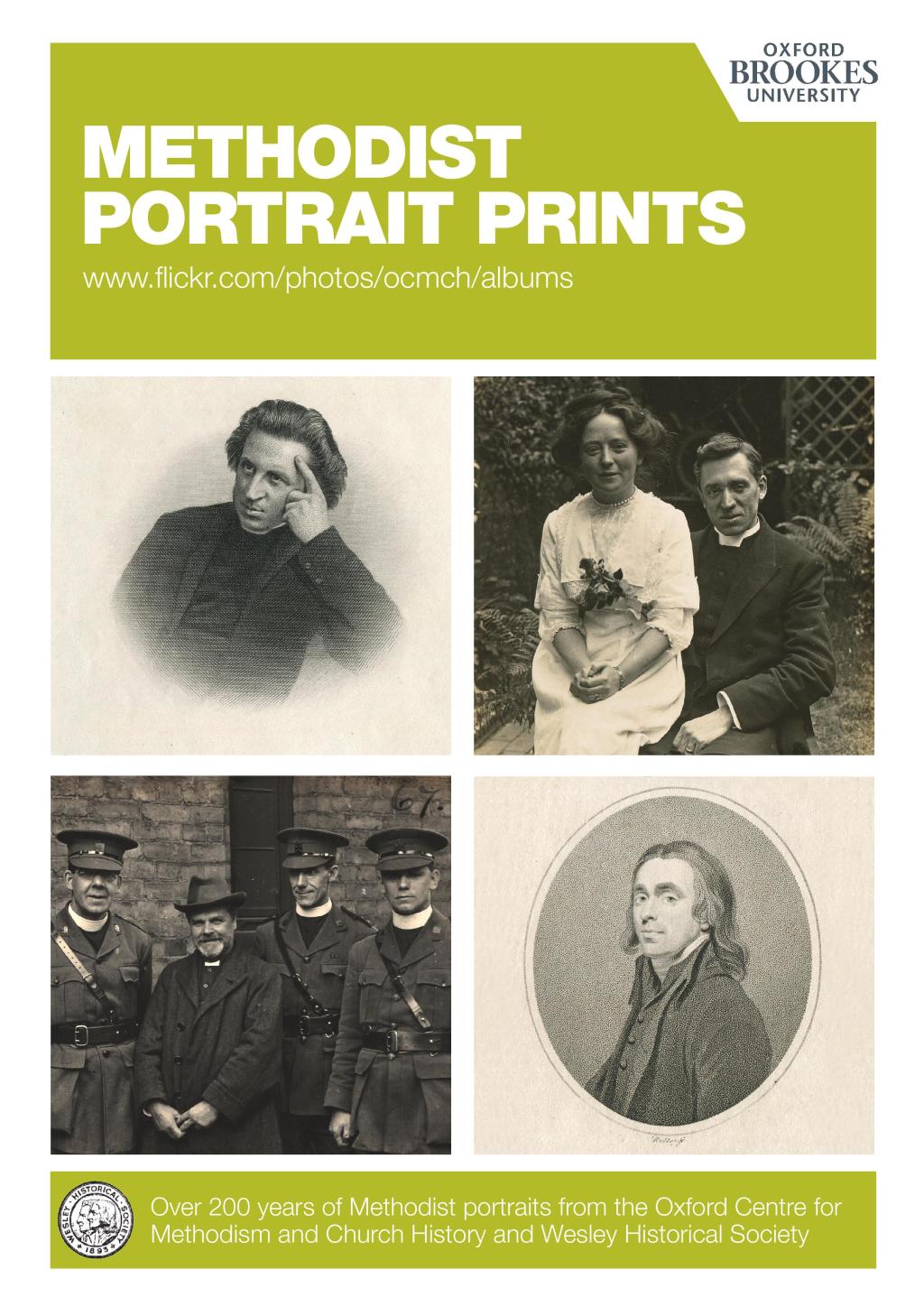
A4 Methodist portraits poster 19-page-001

New for December 2019, we’re excited to announce our latest major digitised resource for the study of Methodist heritage.

https://www.flickr.com/photos/ocmch/albums

Methodist Portrait Prints provides access to over 2,000 historic portraits dating from the eighteenth to the twentieth centuries. These images chart developments in engraving techniques, to the advent of photography, and beyond. This project draws from the collections of the Wesley Historical Society, and builds on the success of British Methodist Buildings – a digital resource released by the OCMCH in January 2019 that has since been viewed over 300,000 times in less than twelve months

Many of the images in Methodist Portrait Prints are derived from leading Methodist periodicals. From its first publication in 1778, the Arminian Magazine included portrait prints. The Magazine was the initiative and promotional vehicle of John Wesley. In 1798 it became the Methodist Magazine, adding ‘Wesleyan’ to the title from 1822-1932 (when the main British Methodist sub-denominations united), finally closing in 1969. Despite being priced cheaply to achieve wide circulation, the quality of some of the prints is high. These images were often cut out and framed, or mounted into albums, as mementos of the individuals depicted.

Methodist Portrait Prints launched in December 2019. For further updates follow this blog, or find us on Twitter @OCMCHBrookes.

Categories
Uncategorized

Digital – YouTube Channel Launch

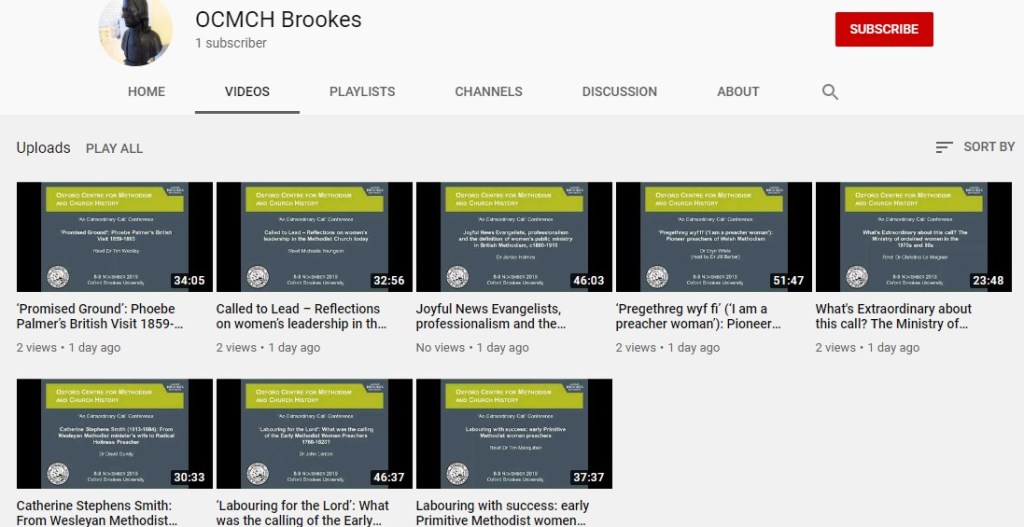
The OCMCH is delighted to announce the launch of our YouTube Channel, accessible here. Look out for recordings of conference papers, lectures, and digitised versions of audio-visual material from our collections.

YouTube Screenshot

This launch leads with recordings of a selection of papers from ‘An Extraordinary Call’, a conference on Methodist women preachers in Britain c1740 to the present was held at the Harcourt Hill Campus of Oxford Brookes University on 8-9 November 2019. This event brought together more than 80 people from around Britain, Europe, and the USA. The conference was hosted by the OCMCH, and arranged through the Wesley Historical Society and Susanna Wesley Foundation, being inspired by the 350th anniversary of her birth. Its particular focus was on women who preached, something which was constitutionally forbidden by the Wesleyan Church (except to other women) between 1803-1910.

79683406_565561400670420_3055530396839051264_n

Recordings are available of papers by Dr David Bundy, Dr Janice Holmes, Revd Dr Christina Le Moignan, Dr John Lenton, Revd Dr Tim Macquiban, Dr Eryn White, Revd Dr Tim Woolley, and the Revd Michaela Youngson.

Categories
Uncategorized

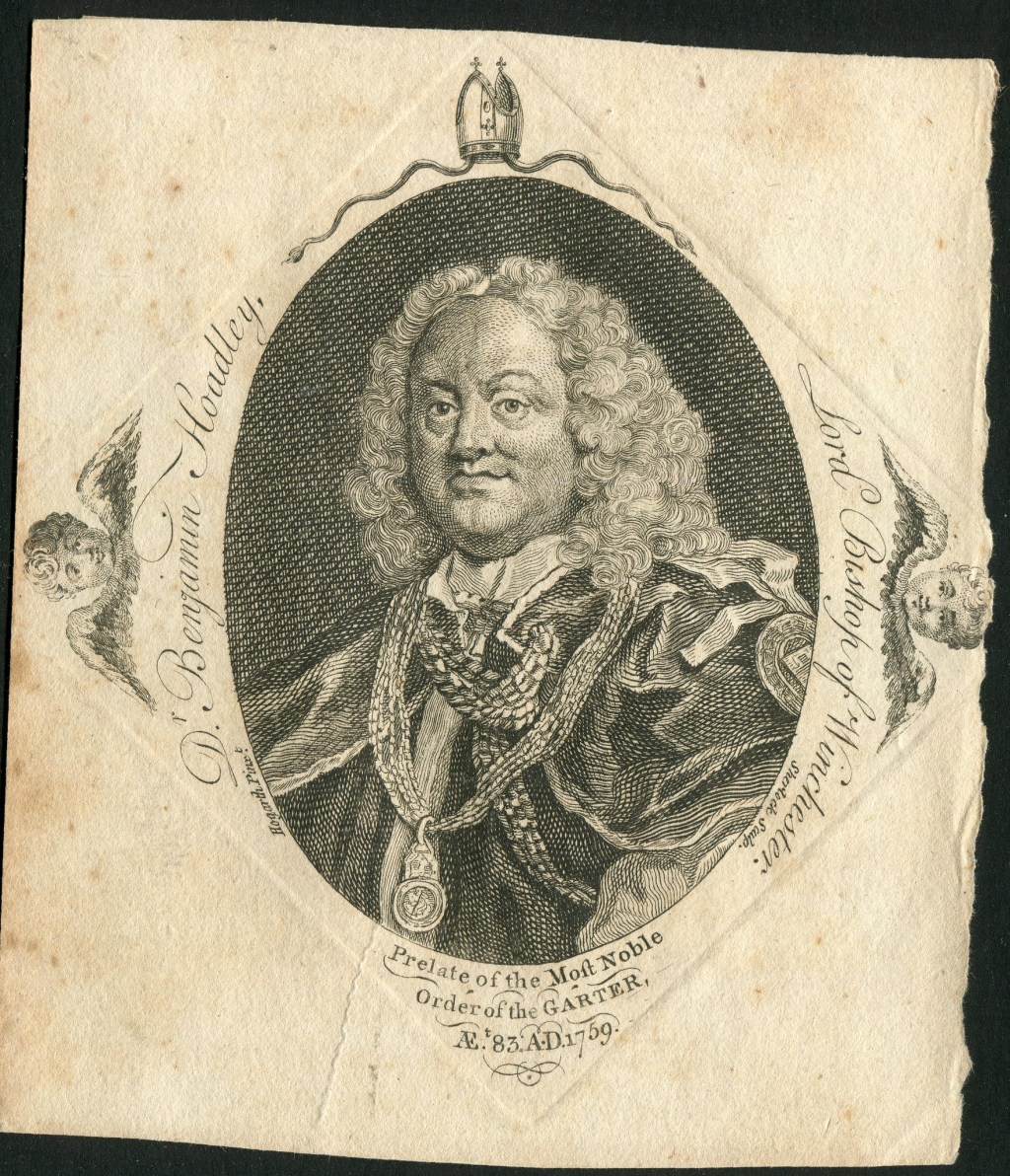
Archives & Library – UK Disability History Month: Bishop Benjamin Hoadly (1676-1761)

UK Disability History Month 2019 emphasises the roles of disabled leaders through history and their struggle for acceptance. In this blog post, Professor William Gibson puts the spotlight on an historical figure represented in our Digital Collections who embodies this guiding theme.

47410598992_d72432afe9_k
Benjamin Hoadly (1676-1761) https://flic.kr/p/2fevHjy

Benjamin Hoadly (1676-1761) is not widely known today, but three hundred years ago he instigated a religious controversy so great that it led to a five-year pamphlet war. The ‘Bangorian Controversy’ (named after Hoadly’s bishopric) focused on the issue of whether the Church could punish clergymen for their views. Hoadly argued it could not, stirring up a fierce debate prompting responses from clergy and lay persons around the country. What was more remarkable about Hoadly as a leading public figure of his time, was that he was disabled.

In 1692, while a student at Cambridge, Hoadly contracted smallpox. The illness was badly treated by an unskillful barber, and it was feared that Hoadly would lose his leg. Fortunately, Charles Barnard (a celebrated surgeon) saved the limb, but Hoadly was left physically disabled for the rest of his life. He used walking sticks in public, and crutches at home; and was forced to pray and preach kneeling on a stool or cushion to relieve strain on his weakened legs. Significantly for the period, this also prevented him from riding a horse. From the time of this illness, Hoadly never enjoyed good health. During his thirties it was feared that he was sinking into consumption. His insistence on taking the air in a chariot, however, which he did every day of his life, helped to keep the deadly respiratory complaint at bay.

Nevertheless, ill-health exerted an influence over much of Hoadly’s adult life. Writing in 1719 to Sarah, Duchess of Marlborough, Hoadly claimed that he had been so ill that his life had been in peril. The following year a bout of fever left Hoadly with red marks on his face so that he could not go out for a week. In 1717 he commented that he was ‘too ill to come out’ of his house, and he seems to have been plagued with colds and headaches. In 1731 he referred to the way he coped with his disability as ‘a man dragging life like a chain behind him’ and thereafter referred to life as ‘the chain.’ Later in life he often foiled requests for preferment on the grounds that he would not live long enough to redeem promises.

Hoadly’s disability was frequently used by his political and religious opponents to satirise him. In 1709, a print titled ‘Guess Att My Meaning’ depicted Hoadly as a follower of Oliver Cromwell, who is shown looking over his shoulder. Hoadly’s crutches are propped against the table, and the text refers to him as a ‘crooked stick’ and a ‘crippled priest’. In the same year, Hoadly (this time carrying a stick) featured in a print that accused him of attacking the Church. And in 1711, Hoadly was depicted with both a walking stick in his hand and a crutch at his feet in ‘The Apparition’.

Despite these deeply personal attacks, Hoadly’s disability did not prevent him from rising to the highest stations of the Church of England. He was a favourite of King George I, and was eventually appointed Bishop of Winchester – one of the most prestigious dioceses in eighteenth-century England and Wales. Remarkably, Hoadly lived until the age of 85 and was pugnacious and controversial to the end. Two years before his death, an attempt was made to defraud the Bishop of £3000, but Hoadly remained wily and sharp, proving in court that the man was a liar.

You can read more about Benjamin Hoadly’s life in William Gibson’s Enlightenment Prelate 1676-1761, Benjamin Hoadly (Cambridge: 2004)To learn about the guiding themes of UK Disability History Month 2019 visit https://ukdhm.org/

Categories
Uncategorized

Archives & Library – William Thomas Forshaw, V.C. (1890-1943)

The first official two-minute silence for Armistice Day was commemorated in London 100 years ago, on 11 November 1919. To mark this anniversary, this post explores the story of William Thomas Forshaw (1890-1943), thought to be the first teacher awarded the Victoria Cross during the First World War – and one of two Westminster College alumni to receive the highest and most prestigious British military honour.

Forshaw was baptised at the Wesleyan Methodist Chapel in Barrow-in-Furness on 23 April 1890, the eldest son of Thomas Forshaw, a head foreman at Vickers Shipyard. He was educated at Dalton Road Wesleyan School, Holker Street Boys School and Barrow’s Higher Grade School, before leaving to train as a teacher at Westminster College in London. On completing his course, Forshaw returned to his native North-West where he taught at Dallas Road School, Lancaster, and the North Manchester (prep) Grammar School.

Having enlisted in the Ashton Territorial Battalion of the Manchester Regiment, in March 1914 Forshaw was commissioned as a second-lieutenant and subsequently sailed to Egypt to continue his training and assist in the protection of the Suez Canal. After the Gallipoli landings in April 1915, Forshaw’s battalion were re-posted to the Peninsula. It was between 7-9 August of that year that Forshaw distinguished himself, leading a company in the defence of a key strategic position against waves of attacks by Turkish forces. Over the course of two days, Forshaw led by example, improvising bombs from jam jars and shrapnel which he lit with cigarettes he continually smoked throughout the assault. His citation for the Victoria Cross was published in the London Gazette of 9 September 1915,

When holding the north-west corner of the “Vineyard”, he was attacked and heavily bombed by Turks, who advanced time after time by three trenches which converged at this point, but he held his own, not only directing his men and encouraging them by exposing himself with the utmost disregard to danger, but personally throwing bombs continuously for 41 hours. When his detachment was relieved after 24 hours he volunteered to continue the direction of operations.

Three times during the night of 8th-9th August, he was again heavily attacked, and once the Turks got over the barricade, but, after shooting three with his revolver, he led his men forward and recaptured it.

When he rejoined his Battalion he was choked and sickened by Bomb fumes, badly bruised by a fragment of shrapnel, and could barely lift his arm from continuous bomb throwing.

It was due to his personal example, magnificent courage and endurance that this very important corner was held.

Stories of Forshaw’s gallantry were soon reprinted and circulated in the national and local press.[1] The Daily Record’s report on the actions of the ‘Teacher V.C.’ focussed on the transformative effect of war, stating that Forshaw’s example demonstrated that ‘what is potential in us is now emerging’

Teaching is about the last calling that one would imagine as demanding in man [sic] robustness of character and resourcefulness in conflict or competition, though the born teacher is a born disciplinarian[2]

Public notice of the award caused ripples of excitement among the staff and students of the institutions where Forshaw worked and had been a pupil – the honour of ‘V.C.’ was hastily added to the records of his former schools and colleges. And in the North-West, plans for grand civic presentations in Forshaw’s hometown of Barrow-in-Furness, Ashton-under-Lyme, Lancaster, and Manchester were on foot before his return to England.[3]

IMG_6061
Westminster College Archive. A/4/a/3, autograph book, 1908-1929

During September 1915, Forshaw received a flurry of telegrams of congratulations as he convalesced in Egypt recovering from his injuries. One was from Principal H. B. Workman of Westminster College, whose telegraph carried the acknowledgements of the institution to its former pupil. Workman also urged Forshaw to visit fifty-three Westminsterians in the Royal Fusiliers who had recently moved to Abbassia Camp in Cairo – which he duly attempted to do, but could not locate them.[4]

When sufficiently recovered, Forshaw left Alexandria on 26 September 1915 on a ship bound for England. One of his first engagements on his return was to visit Westminster College, where he stayed the night of 8 October and gave a short address to the students there. As detailed in the Monthly War Bulletin, Forshaw’s visit was ‘almost the last incident’ at the College in Horseferry Road prior to its temporary relocation to Richmond.

IMG_5988
Westminster College Archives. Westminster Training College Monthly War Bulletin, no. 12 (October 1915)

In his speech, Forshaw regretted the loss of W. G. Morris of the Liverpool Scottish who had been killed in action at Hooge on 16 June of that year. They were two of twenty-five men from their year group at Westminster who had joined the King’s Forces. Forshaw also cited his involvement in athletics at the College as preparation for his actions on the battlefield. He stated that he ‘owed everything’ to his instructor Leigh Smith who had taught him to throw a rugby ball, and attributed his act of bravery to his experiences in ‘rugger scrums’, and of throwing the weight at the London Inter-Collegiate Sports meetings. Indeed, Westminster’s Inter-Year Sports competition at Tufnell Park Athletic Ground on 15 February 1910 was remarkable insofar that two future Victoria Cross recipients raced one another in the final of the 100 yards – Donald Simpson Bell pipping his older compatriot on that occasion

IMG_6071 - Copy
Westminster College Archives. Programme, ‘Westminster Training College, Fifth Inter-Year Athletic Sports, Tuesday, February 15th, 1910’

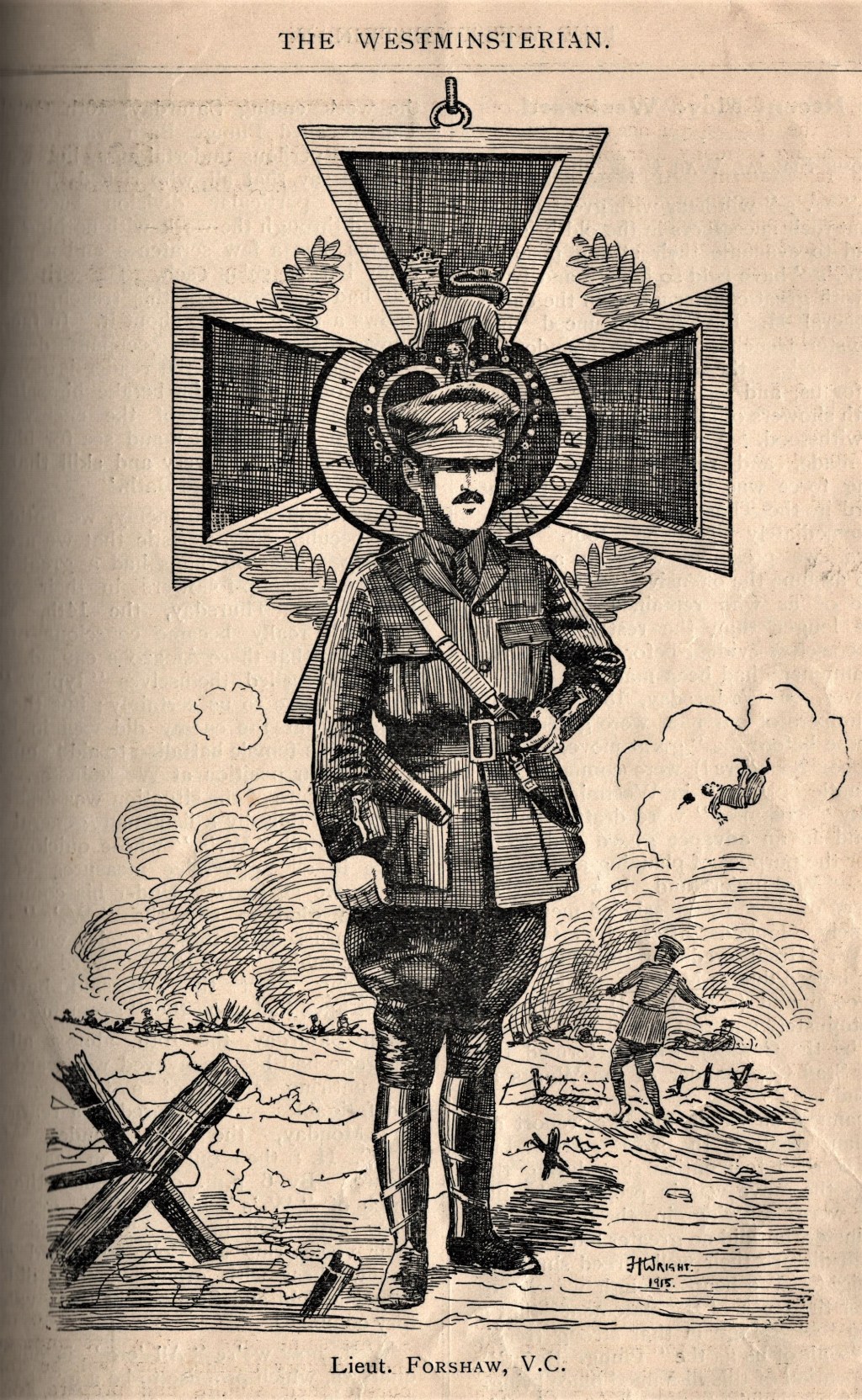
Forshaw’s stirring speech, struck through with allusions between warfare and collegiate athletics, clearly inspired the students at Westminster. Henry Wright (OW, 1914-1916) produced a striking sketch of Forshaw from life to commemorate the event. It was a matter of great pride to the College that Forshaw was the first teacher to be awarded the Victoria Cross, and the Westminsterian went as far as claiming that Forshaw had not fully realised the scale of his achievement until he ‘received the ovation at the College’.[5] As early as October 1915, the Governing Body discussed plans to erect ‘some permanent testimonial’ to Forshaw’s ‘great deed of endurance and daring’.[6] Their minutes recorded that ‘in the undying glory that he has won, Westminster College shares’.

Lt. Forshaw VC JPEG - Copy
Westminster College Archives. The Westminsterian, sketch of William Thomas Forshaw by Henry Wright

Greater accolades for Forshaw followed in his native North-West, but the Monthly War Bulletin reassured its readership of Westminsterians that ‘we are sure that he prizes most of all the affection and admiration of the members of his old College’. On 20 November 1915, Forshaw was again celebrated in London when the Westminster Club held a dinner in his honour at the Holborn Restaurant which was attended by over seventy alumni of the College. Toasts were led by Sir James Yoxall, Liberal MP for Nottingham West, General Secretary of the N.U.T., and fellow Westminsterian.

On 5 February 1916, Forshaw married Sadie Mollie Lee-Heppel, a nurse, at Barnet Registry Office.[7] And in 1917, he continued his military career by transferring to the 76th Punjabis, Indian Army, taking part in several campaigns before his retirement from the army in 1922. A further stint in the RAF Educational Service in Egypt followed, before Forshaw finally returned to England in 1925. His re-entry into teaching was not easy, however, and he was bankrupted attempting to establish his own preparatory school in Suffolk. This disappointment led to a change in career, and Forshaw subsequently joined the Gaumont-British film company.[8]

44962949675_589afc47ec_o
Westminster College Archives. A/4/a/i, Roll of Men in the King’s Forces

During the Second World War, Forshaw was a major in the 11th City of London (Dagenham) Battalion of the Home Guard, and was eventually relocated to Holyport, Berkshire, as an evacuee. It was at his home there that he died aged 53, on 26 May 1943. In contrast to the adulation he had received thirty years earlier, the Westminster Club Bulletin for September 1943 carried only a brief obituary recounting the actions for which he received the Victoria Cross.[9] In the wider press, Forshaw’s passing was reported in rather caricatured terms; the death of the ‘Cigarette V.C.’[10]

It is unknown whether Westminster College ever fulfilled their intentions to memorialise Forshaw, but there is evidence that they were interested in buying his replacement V.C. medal when it was offered for sale in 1964. Alongside Barrow Grammar School, the College eventually conceded to the 9th Battalion, Manchester Regiment, who secured the medal for £1150.

Forshaw was buried in an unmarked grave in Touchen End, near Maidenhead. It was not until 1994 that a headstone was placed in the churchyard marking his final resting place. Other civic memorials for Forshaw have followed, ensuring that his achievements will live on in popular memory for many years to come.

Many of the OCMCH’s wartime records are freely-accessible on our Digital Collections page at https://www.flickr.com/photos/ocmch

[1] Second Supplement to the London Gazette, Of Tuesday, the 7th of September, 1915 (London: 9 September 1915).

[2] Daily Record and Mail (Glasgow: 11 September 1915).

[3] The Globe (London: 5 October 1915).

[4] OCMCH. Westminster College Archives, Westminster Training College Monthly War Bulletin, no. 12 (October 1915)

[5] OCMCH. Westminster College Archives, The Wesminsterian (November 1915)

[6] OCMCH. Westminster College Archives, A/2/a/1, Governing Body minute book, 1909-1920

[7] http://www.rbwm.gov.uk/search/fkac/person.asp?i=231&c=p&s=w

[8] http://www.vconline.org.uk/william-t-forshaw-vc/4586728354

[9] OCMCH. Westminster College Archives, Westminster Club Bulletin (September 1943)

[10] The Liverpool Echo (Friday 28 May 1943)

Categories
Uncategorized

Archives & Library – US Civil Rights campaigner visits Westminster College, 1965

Julian Bond and Martin Luther King in 1966
Julian Bond and Dr Martin Luther King cast their ballots to fill Bond’s vacant seat in the U.S. House of Representatives in Atlanta on 23 February 1966. Image from USA Today.

This October, Oxford Brookes University is celebrating Black History Month. A recent discovery in the Centre’s archives reveals that at the height of the US Civil Rights Campaign a lecture by activist Julian Bond made a profound impact on the students of Westminster College in Oxford.

Julian Bond (1940-2015) first met Dr Martin Luther King in 1960. Shortly after, he became communications director for the Student Nonviolent Coordinating Committee (SNCC); one of the major American Civil Rights movements of the 1960s. Their activism contributed to the passage of the Civil Rights Acts of 1964, and the Voting Rights Act of the following year. This latter legislation was signed by President Lyndon B. Johnson on 6 August 1965, and prohibited racial discrimination in voting. Within months a quarter of a million new black voters were registered in the USA.

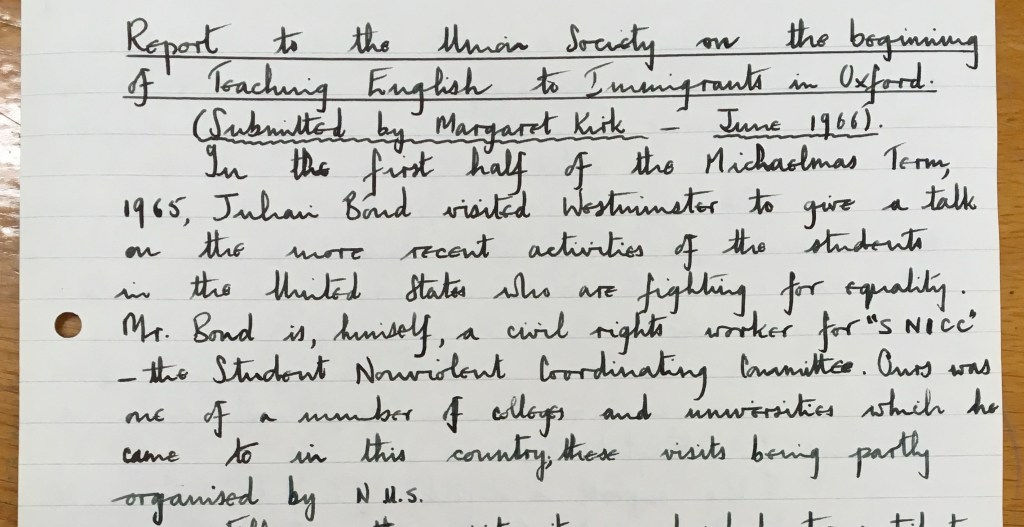
Newcastle Journal - Thursday 18 November 1965-page-001In the summer of 1965 Julian Bond (then twenty-five) was one of eleven black candidates elected to the Georgia House of Representatives. On the back of this political victory, Bond and his wife Alice embarked on a six-week lecture tour of England, comprising around fifty speaking engagements on the subject of ‘The Political Background to Civil Rights and Non-violent Resistance’ (left: advert in Newcastle Journal, 18 November 1965). One of the stops on that tour was Westminster College – now, the Harcourt Hill campus of Oxford Brookes University. The impact of Bond’s lecture was reported by Union Society president Kenneth Oldfield in The Westminsterian magazine,

All who heard Mr. Bond’s lecture were moved and impressed by his attitude and character, and all gained a new outlook on the problem of colour prejudice. So often the student is guilty of much theoretical talk without any related practical action

Whilst the student body of Westminster College was overwhelmingly white, they were clearly enthused by Bond’s lecture and motivated to contribute towards social justice in their own city. Westminster was a Methodist teacher training college, so in correspondence with the Oxford Committee for Racial Integration and the Oxford Education Committee, the students organised themselves to provide additional tuition to children of local immigrant families (and some adults). Building on the message of Bond’s lecture, by June 1966 it was reported that over fifty students had been involved in the scheme and the Union Society believed that they were ‘leading the country in this work’.

IMG_9574 - Copy

On Sunday 20 October, Oxford Brookes Union is screening ‘Selma’, a 2014 film that chronicles the 1965 Selma to Montgomery voting rights march led by Dr. Martin Luther King. For more information about Black History Month at Brookes visit https://www.brookes.ac.uk/staff/human-resources/equality-diversity-and-inclusion/black-history-month/

Categories
Uncategorized

Archives & Library – Westminster College Chapel Silver

The OCMCH is currently celebrating the 60th anniversary of the arrival of Westminster College students at their new buildings in Oxford, now the Harcourt Hill campus of Oxford Brookes University. As part of these commemorations we have selected highlights from the Westminster College archives to showcase in physical displays and a digital exhibition.

The chapel at Harcourt Hill was not only central to the plan of Westminster College’s new site in Oxford, but was also the focal point of students’ religious life. The former Westminster College chapel silver comprises two chalices and patens, a box, and a jug – six items in total. The date marks reveal that these pieces were created between 1946 and 1965, confirming that they all originate from the time of Westminster College in both London and Oxford.

More remarkable, however, is that these pieces all feature the same hallmark; a stylised ‘GMC’ in an oval. This shows that they were produced by the same silversmith over a twenty year period. George Matthew Clark (1887-1981) attended Westminster College from 1905 to 1907. Later, he had a successful career as a teacher in Kent, and there is a cassette tape of his reminiscences in the Westminster College archives.

‘In the late 30s he established a department of Metalwork in his school which drew much interest from the local authority and was subsequently the template from which other departments stemmed’

Robert Clark (son), Obituary, Westminster Club Bulletin, June 1981

The identification of Clark as the maker of the former Westminster College chapel silver demonstrates the lasting attachment felt by Old Westminsterians toward their former College. This is particularly apparent in the inscription to the larger paten of 1958, which was donated by the class of 1907.

WESTMINSTER COLLEGE. [on reverse] THIS CHALICE & PATEN/ARE THE GIFT OF WESTMINSTER MEN OF 1907/AS A TOKEN OF THEIR LOVE AND LOYALTY. [by hallmarks] G.M.CLARK 1907 fecit

An exhibition in celebration of #WCO60 is on display at the Oxford Brookes Harcourt Hill campus, and can also be accessed at https://www.flickr.com/photos/ocmch/albums