
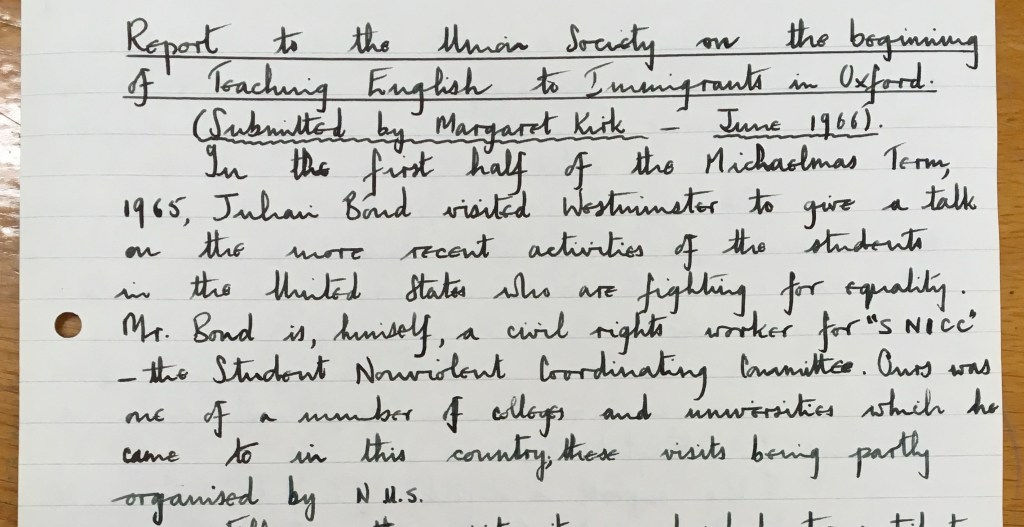
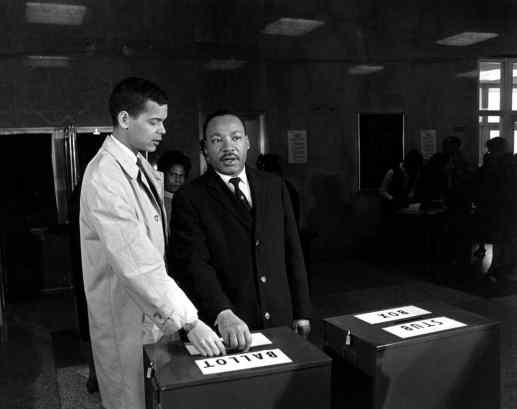
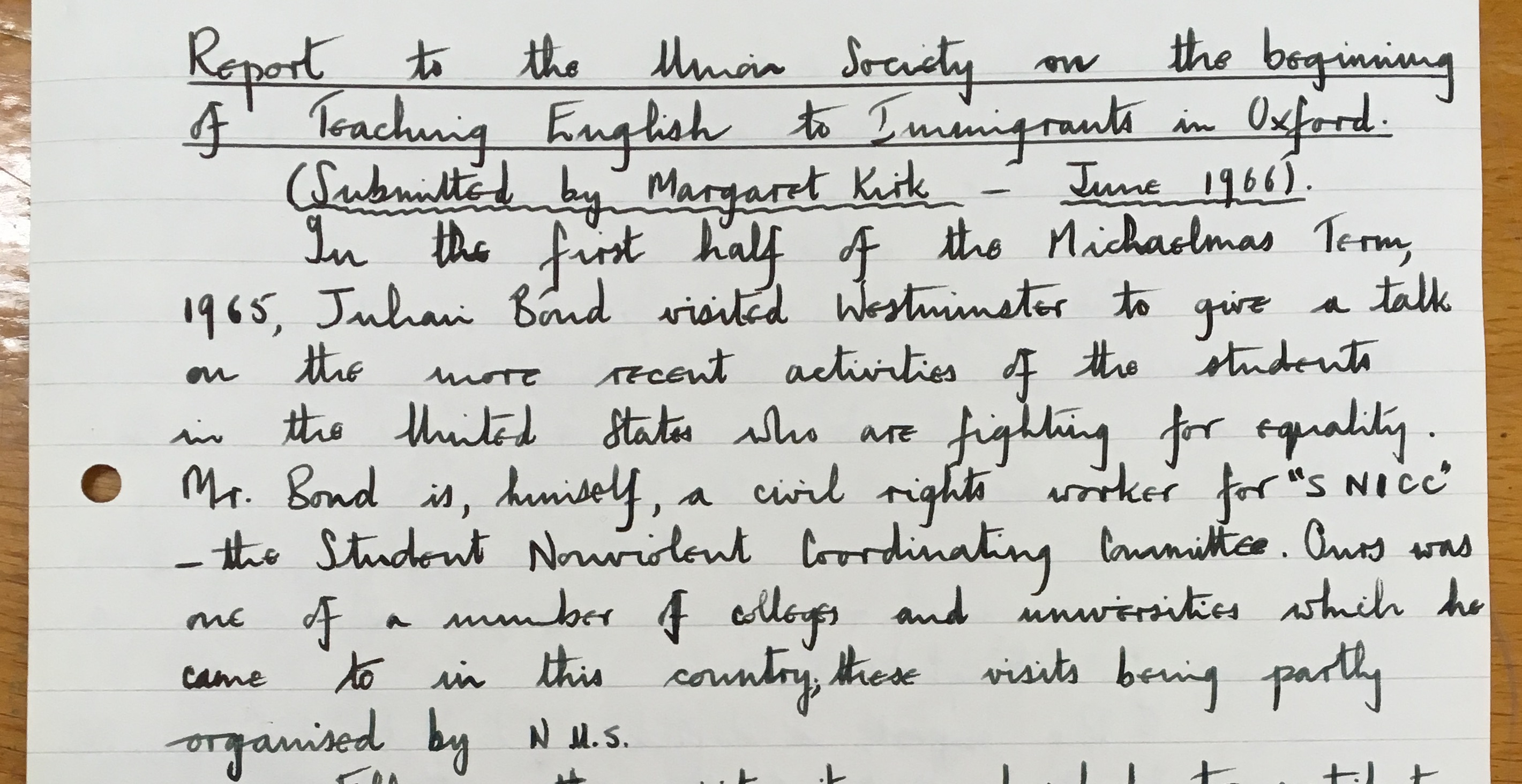
This October, Oxford Brookes University is celebrating Black History Month. A recent discovery in the Centre’s archives reveals that at the height of the US Civil Rights Campaign a lecture by activist Julian Bond made a profound impact on the students of Westminster College in Oxford.
Julian Bond (1940-2015) first met Dr Martin Luther King in 1960. Shortly after, he became communications director for the Student Nonviolent Coordinating Committee (SNCC); one of the major American Civil Rights movements of the 1960s. Their activism contributed to the passage of the Civil Rights Acts of 1964, and the Voting Rights Act of the following year. This latter legislation was signed by President Lyndon B. Johnson on 6 August 1965, and prohibited racial discrimination in voting. Within months a quarter of a million new black voters were registered in the USA.
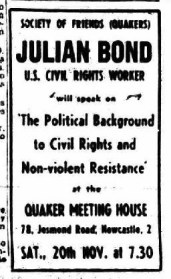 In the summer of 1965 Julian Bond (then twenty-five) was one of eleven black candidates elected to the Georgia House of Representatives. On the back of this political victory, Bond and his wife Alice embarked on a six-week lecture tour of England, comprising around fifty speaking engagements on the subject of ‘The Political Background to Civil Rights and Non-violent Resistance’ (left: advert in Newcastle Journal, 18 November 1965). One of the stops on that tour was Westminster College – now, the Harcourt Hill campus of Oxford Brookes University. The impact of Bond’s lecture was reported by Union Society president Kenneth Oldfield in The Westminsterian magazine,
All who heard Mr. Bond’s lecture were moved and impressed by his attitude and character, and all gained a new outlook on the problem of colour prejudice. So often the student is guilty of much theoretical talk without any related practical action
Whilst the student body of Westminster College was overwhelmingly white, they were clearly enthused by Bond’s lecture and motivated to contribute towards social justice in their own city. Westminster was a Methodist teacher training college, so in correspondence with the Oxford Committee for Racial Integration and the Oxford Education Committee, the students organised themselves to provide additional tuition to children of local immigrant families (and some adults). Building on the message of Bond’s lecture, by June 1966 it was reported that over fifty students had been involved in the scheme and the Union Society believed that they were ‘leading the country in this work’.
On Sunday 20 October, Oxford Brookes Union is screening ‘Selma’, a 2014 film that chronicles the 1965 Selma to Montgomery voting rights march led by Dr. Martin Luther King. For more information about Black History Month at Brookes visit https://www.brookes.ac.uk/staff/human-resources/equality-diversity-and-inclusion/black-history-month/
 Westminster College Oxford - Research
Leave a comment