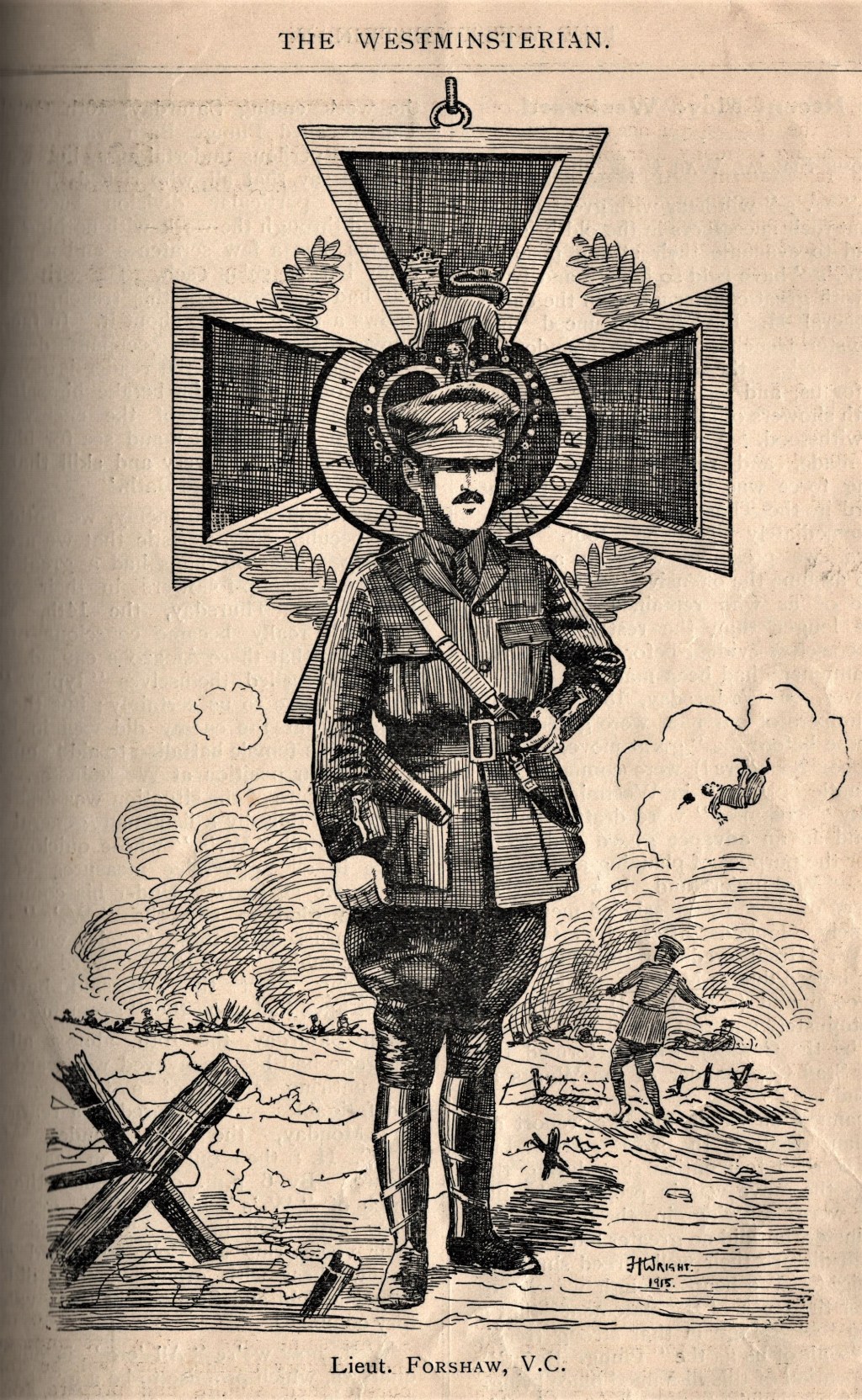


The first official two-minute silence for Armistice Day was commemorated in London 100 years ago, on 11 November 1919. To mark this anniversary, this post explores the story of William Thomas Forshaw (1890-1943), thought to be the first teacher awarded the Victoria Cross during the First World War – and one of two Westminster College alumni to receive the highest and most prestigious British military honour.
Forshaw was baptised at the Wesleyan Methodist Chapel in Barrow-in-Furness on 23 April 1890, the eldest son of Thomas Forshaw, a head foreman at Vickers Shipyard. He was educated at Dalton Road Wesleyan School, Holker Street Boys School and Barrow’s Higher Grade School, before leaving to train as a teacher at Westminster College in London. On completing his course, Forshaw returned to his native North-West where he taught at Dallas Road School, Lancaster, and the North Manchester (prep) Grammar School.
Having enlisted in the Ashton Territorial Battalion of the Manchester Regiment, in March 1914 Forshaw was commissioned as a second-lieutenant and subsequently sailed to Egypt to continue his training and assist in the protection of the Suez Canal. After the Gallipoli landings in April 1915, Forshaw’s battalion were re-posted to the Peninsula. It was between 7-9 August of that year that Forshaw distinguished himself, leading a company in the defence of a key strategic position against waves of attacks by Turkish forces. Over the course of two days, Forshaw led by example, improvising bombs from jam jars and shrapnel which he lit with cigarettes he continually smoked throughout the assault. His citation for the Victoria Cross was published in the London Gazette of 9 September 1915,
When holding the north-west corner of the “Vineyard”, he was attacked and heavily bombed by Turks, who advanced time after time by three trenches which converged at this point, but he held his own, not only directing his men and encouraging them by exposing himself with the utmost disregard to danger, but personally throwing bombs continuously for 41 hours. When his detachment was relieved after 24 hours he volunteered to continue the direction of operations.
Three times during the night of 8th-9th August, he was again heavily attacked, and once the Turks got over the barricade, but, after shooting three with his revolver, he led his men forward and recaptured it.
When he rejoined his Battalion he was choked and sickened by Bomb fumes, badly bruised by a fragment of shrapnel, and could barely lift his arm from continuous bomb throwing.
It was due to his personal example, magnificent courage and endurance that this very important corner was held.
Stories of Forshaw’s gallantry were soon reprinted and circulated in the national and local press.[1] The Daily Record’s report on the actions of the ‘Teacher V.C.’ focussed on the transformative effect of war, stating that Forshaw’s example demonstrated that ‘what is potential in us is now emerging’
Teaching is about the last calling that one would imagine as demanding in man [sic] robustness of character and resourcefulness in conflict or competition, though the born teacher is a born disciplinarian[2]
Public notice of the award caused ripples of excitement among the staff and students of the institutions where Forshaw worked and had been a pupil – the honour of ‘V.C.’ was hastily added to the records of his former schools and colleges. And in the North-West, plans for grand civic presentations in Forshaw’s hometown of Barrow-in-Furness, Ashton-under-Lyme, Lancaster, and Manchester were on foot before his return to England.[3]

During September 1915, Forshaw received a flurry of telegrams of congratulations as he convalesced in Egypt recovering from his injuries. One was from Principal H. B. Workman of Westminster College, whose telegraph carried the acknowledgements of the institution to its former pupil. Workman also urged Forshaw to visit fifty-three Westminsterians in the Royal Fusiliers who had recently moved to Abbassia Camp in Cairo – which he duly attempted to do, but could not locate them.[4]
When sufficiently recovered, Forshaw left Alexandria on 26 September 1915 on a ship bound for England. One of his first engagements on his return was to visit Westminster College, where he stayed the night of 8 October and gave a short address to the students there. As detailed in the Monthly War Bulletin, Forshaw’s visit was ‘almost the last incident’ at the College in Horseferry Road prior to its temporary relocation to Richmond.

In his speech, Forshaw regretted the loss of W. G. Morris of the Liverpool Scottish who had been killed in action at Hooge on 16 June of that year. They were two of twenty-five men from their year group at Westminster who had joined the King’s Forces. Forshaw also cited his involvement in athletics at the College as preparation for his actions on the battlefield. He stated that he ‘owed everything’ to his instructor Leigh Smith who had taught him to throw a rugby ball, and attributed his act of bravery to his experiences in ‘rugger scrums’, and of throwing the weight at the London Inter-Collegiate Sports meetings. Indeed, Westminster’s Inter-Year Sports competition at Tufnell Park Athletic Ground on 15 February 1910 was remarkable insofar that two future Victoria Cross recipients raced one another in the final of the 100 yards – Donald Simpson Bell pipping his older compatriot on that occasion

Forshaw’s stirring speech, struck through with allusions between warfare and collegiate athletics, clearly inspired the students at Westminster. Henry Wright (OW, 1914-1916) produced a striking sketch of Forshaw from life to commemorate the event. It was a matter of great pride to the College that Forshaw was the first teacher to be awarded the Victoria Cross, and the Westminsterian went as far as claiming that Forshaw had not fully realised the scale of his achievement until he ‘received the ovation at the College’.[5] As early as October 1915, the Governing Body discussed plans to erect ‘some permanent testimonial’ to Forshaw’s ‘great deed of endurance and daring’.[6] Their minutes recorded that ‘in the undying glory that he has won, Westminster College shares’.

Greater accolades for Forshaw followed in his native North-West, but the Monthly War Bulletin reassured its readership of Westminsterians that ‘we are sure that he prizes most of all the affection and admiration of the members of his old College’. On 20 November 1915, Forshaw was again celebrated in London when the Westminster Club held a dinner in his honour at the Holborn Restaurant which was attended by over seventy alumni of the College. Toasts were led by Sir James Yoxall, Liberal MP for Nottingham West, General Secretary of the N.U.T., and fellow Westminsterian.
On 5 February 1916, Forshaw married Sadie Mollie Lee-Heppel, a nurse, at Barnet Registry Office.[7] And in 1917, he continued his military career by transferring to the 76th Punjabis, Indian Army, taking part in several campaigns before his retirement from the army in 1922. A further stint in the RAF Educational Service in Egypt followed, before Forshaw finally returned to England in 1925. His re-entry into teaching was not easy, however, and he was bankrupted attempting to establish his own preparatory school in Suffolk. This disappointment led to a change in career, and Forshaw subsequently joined the Gaumont-British film company.[8]

During the Second World War, Forshaw was a major in the 11th City of London (Dagenham) Battalion of the Home Guard, and was eventually relocated to Holyport, Berkshire, as an evacuee. It was at his home there that he died aged 53, on 26 May 1943. In contrast to the adulation he had received thirty years earlier, the Westminster Club Bulletin for September 1943 carried only a brief obituary recounting the actions for which he received the Victoria Cross.[9] In the wider press, Forshaw’s passing was reported in rather caricatured terms; the death of the ‘Cigarette V.C.’[10]
It is unknown whether Westminster College ever fulfilled their intentions to memorialise Forshaw, but there is evidence that they were interested in buying his replacement V.C. medal when it was offered for sale in 1964. Alongside Barrow Grammar School, the College eventually conceded to the 9th Battalion, Manchester Regiment, who secured the medal for £1150.
Forshaw was buried in an unmarked grave in Touchen End, near Maidenhead. It was not until 1994 that a headstone was placed in the churchyard marking his final resting place. Other civic memorials for Forshaw have followed, ensuring that his achievements will live on in popular memory for many years to come.
Many of the OCMCH’s wartime records are freely-accessible on our Digital Collections page at https://www.flickr.com/photos/ocmch
[1] Second Supplement to the London Gazette, Of Tuesday, the 7th of September, 1915 (London: 9 September 1915).
[2] Daily Record and Mail (Glasgow: 11 September 1915).
[3] The Globe (London: 5 October 1915).
[4] OCMCH. Westminster College Archives, Westminster Training College Monthly War Bulletin, no. 12 (October 1915)
[5] OCMCH. Westminster College Archives, The Wesminsterian (November 1915)
[6] OCMCH. Westminster College Archives, A/2/a/1, Governing Body minute book, 1909-1920
[7] http://www.rbwm.gov.uk/search/fkac/person.asp?i=231&c=p&s=w
[8] http://www.vconline.org.uk/william-t-forshaw-vc/4586728354
[9] OCMCH. Westminster College Archives, Westminster Club Bulletin (September 1943)
[10] The Liverpool Echo (Friday 28 May 1943)
 Westminster College Oxford - Research
Leave a comment