Categories
Uncategorized

Women’s History Month – Rev Miriam Moul Reflects on Women in Ministry

Rev Miriam Moul at Westminster Chapel, Harcourt Hill

As Methodist Ministers often do, I’d like to begin with a quote from one of Charles Wesley’s well-known hymns – O thou who camest from above. Wesley writes ‘Jesus, confirm my heart’s desire to work and speak and think for thee. Still let me guard the holy fire and still stir up thy gift in me.’

As a female Methodist Minister, I’m often struck by the stories of those female ‘pioneers’ within Methodism. From the great Susanna Wesley to today’s presbyteral and diaconal colleagues, all have sought to ‘guard the holy fire’ and through working, speaking, and thinking for Jesus, have used their gifts in innumerable ways. They have sought to fulfil their callings to serve God and the people called Methodists. Amidst many and varied obstacles within the patriarchal system these women stepped forward, pioneering a way for those like me in the future.

So to my story: I grew up on the Isle of Wight, and didn’t encounter a female Minister until my early 20s. Growing up week by week in my local Methodist Church, I heard women preach and teach as Local Preachers. Seeing women leading worship was a common experience for me, part of what was normal at church. Yet that didn’t extend to female Ministers. In my consciousness churches were led by men. I knew that there were women ministers, but the lack of a visible female leader in my own context was stark. My main frame of reference was watching reruns of The Vicar of Dibley, seeing many of the humorous scenarios that Geraldine Granger experienced, and the genuine discrimination she faced. Encountering my first female minister opened for me a new way of seeing my burgeoning sense of call to ministry. Ordained ministry had always seemed beyond the realm of possibility, until I saw someone like me, in a collar, presiding at the sacraments, pastorally caring, leading. Suddenly there appeared a role model, someone who made me believe that what I felt called to might actually be possible.

After two years at The Queen’s Foundation in Birmingham, I entered the itinerant ministry as a Probationer Presbyter in 2015, more than 40 years after women were first ordained as Presbyters (Ministers) in the Methodist Church. Much has changed, and for the better, I’m certain. My Methodist cohort in training was approximately 80% female, most of whom were coming from established careers and having had families. In my probationer’s appointment in Kent, I was the first woman presbyter that one of the churches I served had experienced. As a woman, both young and single, I think there was some scepticism about the new ‘young lady minister.’ Some Vicar of Dibley-like moments materialised as I was introduced to the local community. These included multiple invitations to Christmas dinner in my first year – I only accepted one and there was not a Brussel sprout in sight! I could never tell whether being described as a ‘breath of fresh air’ was a positive thing or whether ‘you’re not much like your predecessor’ had any loaded meaning other than, ‘you’re not a middle-aged man.’ The public perception of clergy as male, white, middle-aged, middle-class, is reinforced in television and film and throughout the media. There is still work to be done in challenging this perception.

The Methodist Church has come far in its journey towards gender equality, but it is vital to recognise how far we have yet to travel towards full inclusion of God’s diverse and beautiful humanity. Throughout generations of Methodism, women have had to prove that they were not only as good at preaching as men, but better, in order to be valued. Women in ministry have had to weather the storms of overt and casual sexism. Women have faced many obstacles to being fully valued as Ministers in their own right, rather than supporting players. In early Methodism, female preaching was seen as disruptive, perhaps it is time to redouble our efforts to again disrupt the accepted order in seeking justice and solidarity for all. Not only gender equality, but for all those who continue to be underrepresented in the life of the church, whose voices and experiences have been silenced, people of colour, those who live with disabilities, those who live with mental health issues, those who belong to the LGBTQ+ community and many more.

To conclude I’d like to share one of many positive and joyful stories of my own ministry in the Methodist Church. I had led a large funeral for a much loved member of a village community. People from across the village and the wider town community had attended. After the service I was ‘working the room’ chatting to people. A rather strident looking gentleman approached and said “I’m a Catholic.” Immediately I wondered where this conversation was going to go. I felt my defences rise as I waited for the next sentence. To my utter surprise, the next words uttered were “If all women ministers are like you, I must write to the Pope and tell him we need to ordain women.”  I remember standing open-mouthed for what felt like minutes. To have my ministry valued by someone who would traditionally have opposed it because of my gender was an experience I’ll never forget.

I hope that in the years to come we will continue working towards gender equality and the full inclusion of all peoples in the life of the Church, that all who feel called as beloved children of God, will be able to work, speak and think for Jesus.   

Rev Miriam Moul

Miriam is Methodist Chaplain in the Multifaith Chaplaincy Team at Oxford Brookes University. For more information about International Women’s Day at Brookes, click here.

Categories
Uncategorized

Women’s History Month – Margaret Birchall, Southlands College student in the early 1870s

In 1873, Margaret Birchall received the news that she had been placed 86th in the 1st Class in the results of the Queen’s Scholarship Examination.[1] After a five-year apprenticeship as a pupil-teacher at the Windsor Street Wesleyan and Sunday School, Toxteth, Liverpool, the results of this examination qualified her to take up a place at a teacher training college on a grant if her circumstances allowed.[2] They clearly did, as she was also informed that she should enter Southlands College on 7 February, where she studied between 1873 and 1874.

Windsor Street Wesleyan and Sunday School, Toxteth, Liverpool (photo credit: Helen Watt)

Born in 1852, Margaret was the daughter of James Birchall, who ended his time working for the London and North-Western Railway as Outdoor Superintendent of the Goods Station, Park Lane, Liverpool, and his second wife, Margaret, née Sayer. It is not known when the family had become members of the Methodist Church, but they had certainly done so by 1850, when the couple’s second-eldest daughter was baptised in the local Wesleyan Methodist Chapel.[3]

Hudson Family Collection. Postcard of Southlands College, Battersea, 19th cent.

Therefore, it was probably only natural that Margaret should attend Southlands Training College, founded on 26 February 1872 only around a year before her entrance, as a Methodist teacher training college for women.[4] As the college was then in Battersea, it must have been a big step to travel from Liverpool to London to take up her place.

Westminster College Archives. Wesleyan Education Committee register of teachers (extract, 1873)

Nevertheless, it so happened that John Newton Hudson (1853-1933), a fellow pupil-teacher in Liverpool and her future husband, had been appointed Second Master at Kentish Town Wesleyan School in 1871. He was to stay there until 1874, so that the couple were in London at the same time while she was at college. Also, it is clear that her time at Southlands must have been very important to her, as she kept several items relating to her course and companions there.[5] These include her books of lecture notes on Theology; Domestic Economy, and Paraphrase, as well as books of maps relating to the British Isles and the world, extremely carefully produced, with accompanying details.

Hudson Family Collection. World geography exercise book, 1874 (OCMCH Digital Collections)

Besides these, she retained her ‘Friendship’ Album, containing many inscriptions and drawings by fellow students, including an entry by Rev. G. W. Olver, Principal of Southlands College. Besides a picture of Rev. Olver given to Margaret in 1874, her family photograph album contains many carte de visite-style photographs of young women, probably also dating from the 1870s. Since many were taken at the London Stereoscopic and Photographic Company, which had studios in Regent Street and Cheapside, these images may prove to be portraits of some of those fellow students.

Photograph of the Rev. G. W. Olver, c1874 (OCMCH Digital Collections)

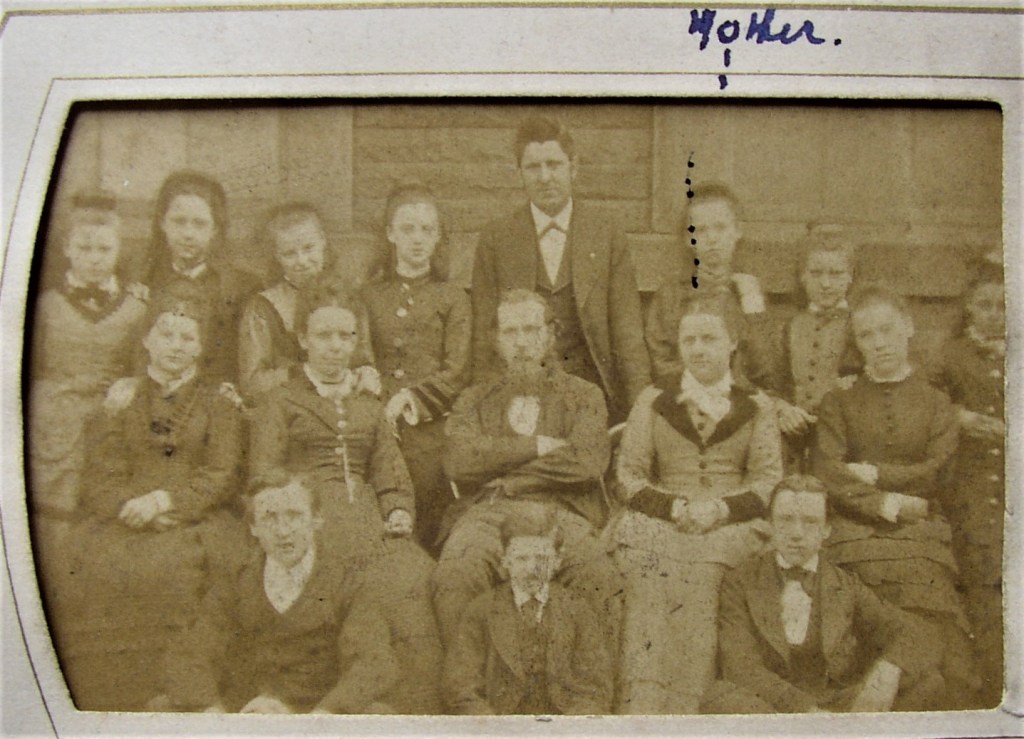
After finishing her training in London, Margaret returned to the north-west. By December 1874, she had passed her probation as a teacher at Mount Pleasant Wesleyan Infant School, Bacup, near Rochdale in Lancashire, and was headmistress there for more than two years.[6] Another family photograph album includes a picture of her, identified by her daughter, Marian Hudson (also a teacher), in a group portrait, perhaps dating from that her time.

Group photograph including Margaret Birchall, c1870s (photo credit: Helen Watt)

While she was still teaching, Margaret kept a diary with entries dating between 1876 and 1877.[7] From these notes, we gain an impression of her life as a teacher, including her satisfaction that ‘all my girls got excellent again’ (entry for 4 February 1877) and her growing relationship with John. We can also see something of her spiritual development, showing perhaps how hard she was on herself in trying to live an upright, Christian life. Also mentioned in the diary are various family members, including her parents and all but one of her sisters: Sarah; Mary; Caroline (Carrie), and Alice, as well as John’s step-sister, Annie Reynolds.

Margaret Birchall Diary, 1876-7 (OCMCH Digital Collections)

However, a connection with Southlands College also appears, as the last note (entry for 5 February 1877) records receiving a postcard for her birthday (the previous October) from Rev. Olver, with a touching reference from the Bible to Numbers VI, 24; 26 (‘The Lord bless thee, and keep thee:’ and ‘The Lord lift up his countenance upon thee, and give thee peace.’).

The diary also notes that Margaret covenanted at Mount Pleasant Wesleyan Chapel in Bacup in 1877. After her marriage to John in April of that year, Bacup is where they made their first home, with John as Headmaster of Bacup Britannia Wesleyan School for the first eleven years of their time there.

Postcard of Mount Pleasant Wesleyan Chapel, Bacup, Lancashire, 19th cent. (photo credit: Helen Watt)

On her marriage, Margaret did not entirely give up teaching, as she taught women in the Sunday School at Mount Pleasant, and was also at one time or another a Junior Class Leader; member of the Leaders’ Meeting; Bacup Circuit Stewardess, and member of the War Relief Committee during the First World War.[8] She may also have kept in touch with at least one friend from Southlands, as can be seen in a letter received from her in 1888.[9]

Hudson family group photograph, 1927 (photo credit: Helen Watt)

Except for a few years in Padiham, Margaret and John continued to live in Bacup with their growing family for a further period until John’s retirement in the early 1920s. They then moved to Manchester where they can been seen in a family photograph taken to celebrate their Golden Wedding Anniversary in 1927. They are surrounded by their five surviving children, three of whom were also teachers, and the remaining two, a Methodist Minister and a doctor respectively. Also present were their two daughters-in-law, one of whom had also been a teacher, and their four young grandchildren. Later, these children would include a Methodist Minister; a Methodist Missionary in China, and a piano teacher. Sadly, Margaret died of a stroke a few months after the anniversary. Although an enduring memory of her was that ‘her influence was always on the side of righteousness’, as Mrs Hudson, she was also remembered with respect and affection in the Bacup Circuit as well as in the town.[10]

Helen Watt, February 2022


[1] Now part of the Hudson Family Collection at the OCMCH.

[2] Jenny Keating, ‘Teacher training – up to the 1960s’, History in Education Project, Institute of Historical Research, University of London, December 2010, available via the website of the IHR web archives https://archives.history.ac.uk/history-in-education/ (accessed 19 Feb 2022).

[3] Baptism of Mary Birchall, 29 December 1850, in the records of Mount Pleasant Wesleyan Methodist Church/Pitt Street Wesleyan Methodist Church, available at https://www.findmypast.co.uk/transcript?id=PRS%2FLIVERPOOL%2FBAP%2F1062357 (accessed 19 Feb 2022).

[4] See the history of the college, available at https://www.roehampton.ac.uk/colleges/southlands-college/history/ (accessed 19 Feb 2022).

[5] Now part of the Hudson Family Collection at the OCMCH.

[6] Parchment certificate of Margaret Birchall in the Hudson Family Collection; Obituary, Mrs Hudson (née Maggie Birchall), 1873-74, from the dates, perhaps in a publication of Southlands College.

[7] Also preserved among the family papers, with later entries by Marian Hudson dating from 1966.

[8] Obituary.

[9] Now part of the Hudson Family Collection at the OCMCH.

[10] Ibid.

The Hudson Family Collection is currently being catalogued and at the Centre. Some items from this collection can be accessed online at OCMCH Digital Collections. For more information about International Women’s Day at Oxford Brookes University, click here.