Categories
Uncategorized

Black History Month – the Methodist Church and Historic Links to Transatlantic Slavery

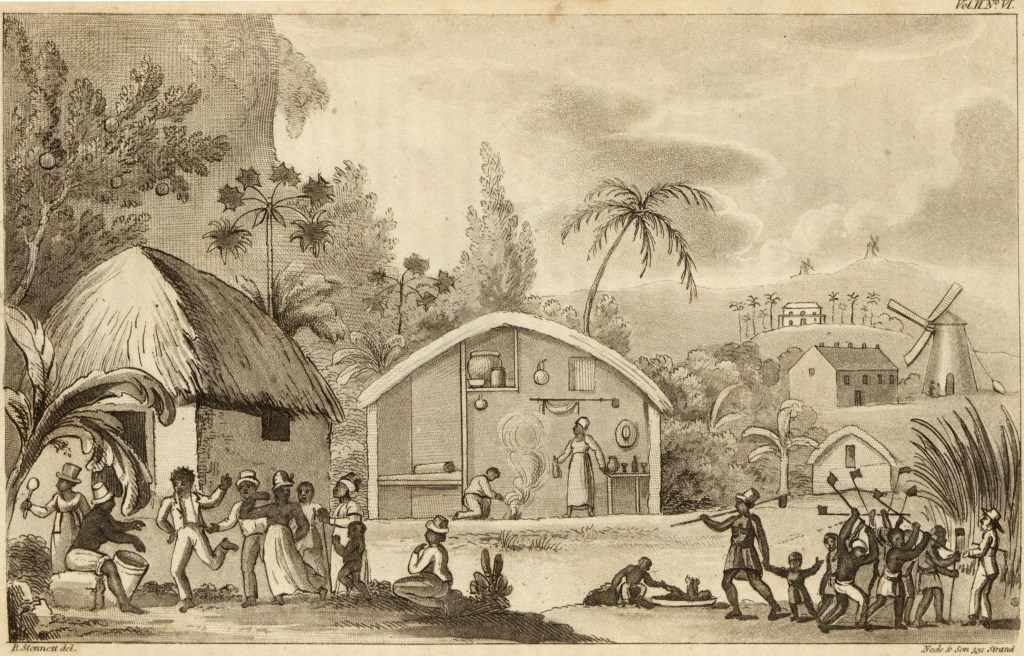
Plantation Scene and Slave Houses, Barbados, 1807-08 (Slavery Images)

Clive Norris, a historian of Methodism who works with the Oxford Centre for Methodism and Church History, has been asked by the Methodist Church of Great Britain to investigate its historic links with the enslavement of Africans.

It is at first sight an odd request, for two reasons.

First, John Wesley (1703-91), who is widely recognised as the founder of Methodism, was an active campaigner for the abolition of enslavement. Lying on his deathbed, he asked a friend to read to him from the autobiography of Olaudah Equiano, formerly an enslaved African himself, a publication to which Wesley had subscribed.[1] And the last of his letters which has survived, written a week before he died, was to fellow-abolitionist William Wilberforce, and urged him to continue his ‘glorious enterprise in opposing that execrable villainy, which is the scandal of religion, of England, and of human nature. . . Go on, in the name of God and in the power of His might, till even American slavery (the vilest that ever saw the sun) shall vanish away before it.’[2] Second, Methodists were typically artisans and other working people; few would have the means to invest in trafficking enslaved Africans or in Caribbean sugar estates. The movement was financed primarily by the regular giving of its members, and the going rate was a mere penny a week, perhaps £5 today.

Olaudah Equiano/Gustavas Vassa, 1791 (Slavery Images)

However, we cannot escape the fact that the transatlantic trade in enslaved Africans was a significant component of the eighteenth-century British economy, comprising as it did the ‘triangular trade’ between Africa, the Americas and the homeland; the extensive production of cotton and other commodities on plantations worked by enslaved Africans; and the many industries in Britain which depended on these activities for their raw materials or markets. Overall it is estimated that ‘economic activities equivalent to around 11% of British GDP were directly involved in or associated with the American plantation complex.’[3] 

One early stronghold of Methodism was Bristol, which was a major port serving the triangular trade. Bristol became involved in the transatlantic trade in enslaved Africans in 1698, when the London-based Royal African Company lost its monopoly of the English trade with West Africa.[4] Between 1698 and 1807 Bristol merchants financed at least 2,060 voyages to Africa merchants, most before 1750;[5] between 1756 and 1786 Bristol sent 588 slave ships to Africa, though the rising port of Liverpool sent 1,858.[6] Between 1698 and 1807 it is estimated that Bristol slaving ships carried some 587,000 abducted Africans to the Americas, of whom 486,000 (82.8 per cent) survived the Atlantic crossing. This represented around one-sixth of the British empire’s slave trade, and Bristol was probably the third largest Atlantic slave port.[7]

The tentacles of the trade reached into every corner of Bristol’s economy. Bristol’s merchants financed the voyages of the ships which abducted thousands of men, women and children from Africa, and took them to the Americas to be worked to death. Bristolians captained the ships and provided their crews. Bristol shipwrights built and maintained the vessels, local dockers manned the port, and local traders furnished the food and other supplies.[8] Bristol coffee houses hosted endless business meetings; local people also worked as builders and tradesmen, servants, and in many other ways to service the slave trade indirectly. And crucially, Bristol banks such as the ’Old Bank’ on George Street financed the slave trade and the wider commercial life of the city. As one historian has observed: ‘In the period of Bristol’s greatest prosperity, few of its citizens did not have some connection, direct or indirect, with slaving ventures.’[9] It seems likely, therefore, that—even if many had principled objections—some of the 750 or so members of Bristol’s Methodist society had links with the trafficking and subsequent exploitation of enslaved Africans, and Clive is exploring this possibility.

Establishing the facts will be challenging but it is of course only part of the story. It immediately prompts the questions: why did people act as they did and how should we respond to that? Take for example, Sir Philip Gibbes (1731-1815), a prominent Barbados slaveholder with Bristol connections. He was widely admired for his piety and humanity. In his autobiography, Equiano described him as ‘a most worthy and humane gentleman’ who ‘saves the lives of his negroes, and keeps them healthy, and as happy as the condition of slavery can admit’.[10] John Wesley counted him as a friend.[11] Gibbes sought to provide for the spiritual welfare of his enslaved workers but only in a strictly limited way. Thus he encouraged the saying of grace before their breakfast (‘bless our labours . . . grant that this present meal may convey to our bodies nourishment and health, and to our minds gratitude and love’); but not before lunch, which would be too disruptive to the working day.[12] Hero or villain? The answer is that the eighteenth century was an age of complexity, contradiction, and confusion, much like our own.


[1] Journal and Diaries VII (1787-1791) [vol. 24 of The Works of John Wesley], ed. W. Reginald Ward and Richard P. Heitzenrater (Nashville, TN: Abingdon Press, 2003), 348. 

[2] John Wesley to William Wilberforce (24 February 1791), The Letters of the Rev. John Wesley, A.M., ed. John Telford, 8 vols (London: Epworth Press, 1931), VIII:265.

[3] Klas Rönnbäck, “On the economic importance of the slave plantation complex to the British economy during the eighteenth century: a value-added approach,” Journal of Global History 13 (2018), 327.

[4] David Richardson, The Bristol Slave Traders: a collective portrait (Bristol: Historical Association, Bristol Branch, 1985), 1.

[5] David Richardson, “Slavery and Bristol’s ‘golden age’,” Slavery & Abolition 26, no. 1 (2005), 36.

[6] C. M. MacInnes, Bristol and the Slave Trade (Bristol: Historical Association, Bristol Branch, 1968), 6.

[7] Richardson, ‘Slavery and Bristol’, 36, 38.

[8] Richard B. Sheridan, “The Commercial and Financial Organization of the British Slave Trade, 1750-1807,” Economic History Review New Series, Vol. 11, no. 2 (1958), 249. There was a trend over time for enslaved Africans increasingly to be sold on credit; the slavers returned home in ballast, while the planters marketed their sugar and tobacco directly; ibid., 252.

[9] C. Duncan Rice, The Rise and Fall of Black Slavery (London and Basingstoke, 1975), 131.

[10] Olaudah Equiano, The Interesting Narrative of the Life of Olaudah Equiano, or Gustavus Vassa, the African. Written by Himself, Fourth Edition, Enlarged, 2 vols. (London: Printed for, and sold by the Author, 1789), I:210.

[11] John A. Vickers, ‘The Gibbes Family of Hilton Park: an unpublished correspondence of John Wesley’, Methodist History, vol. 4 (1968), 43-61. 

[12] Philip Gibbes, Instructions for the Treatment of Negroes (London: Shepperson and Reynolds, 1786, reprinted with additions 1797), 79-81.

Categories
Uncategorized

Publication – latest title from OCMCH Reprints

Today sees the publication of the second title from OCMCH Reprints, a series of publications which draws on the historical collections of the Oxford Centre for Methodism and Church History to provide high quality reproductions of out-of-copyright books that are scarce, inaccessible, or otherwise unavailable in digital formats elsewhere.

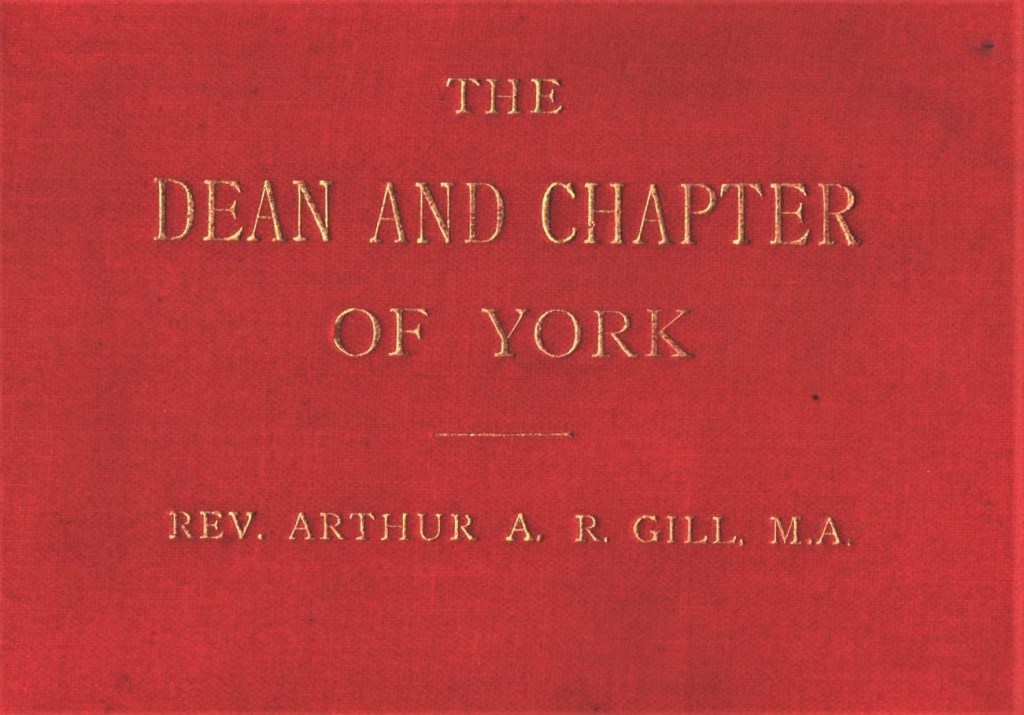
This reprint volume compiles two works by the Rev. Arthur A. R. Gill (1868-1937); The Archdeacons of the Diocese of York, and The Dean and Chapter of York, both originally published in 1915 and long since out of print.

A native of Devon, these works were compiled when Gill was vicar of Market Weighton in the East Riding of Yorkshire, a living he held from 1910 to 1925. He was subsequently appointed to All Saints, Pavement, and St. Saviours in York, and he was made a canon of the cathedral there in 1932. Gill’s historical interests found outlets through his membership of the Yorkshire Archaeological Society, and he was a contributor to the East Riding Antiquarian Society’s transactions. His writings are now preserved in York Minster Archives.

The works presented here represent an early attempt to compile an authoritative list of the dignitaries of the cathedral of York, occasionally peppered with Gill’s characteristic remarks. Against the entry for the last Treasurer of York (the post was dissolved under Henry VIII), he notes that ‘as the Treasures had been filched, there was no need for a Treasurer’.

The volumes were originally published by St. William’s Press in Market Weighton, the printing works of local the Catholic Reformatory School. In the 1890s, the boys of the school produced over a million pamphlets a year from their presses.

‘The Archdeacons of the Diocese of York; with, The Dean and Chapter of York’ is available now to purchase in paperback and hardback. Click here to order.

Categories
Uncategorized

Research – Seely and Paget project newsletter

Alongside English Heritage and other partners, Dr Peter Forsaith and Tom Dobson of the OCMCH are leading on a project to celebrate the centenary of Seely and Paget, architects. From the 1920s to the 1960s, the partnership of John Seely (later 2nd Baron Mottistone) and Paul Paget was notable for their close personal relationship as well as for their architectural work. Their melding of traditional and new styles and materials was already becoming unfashionable at the time, and was eclipsed by the modernity of the 1960s onwards. This work is now being re-evaluated, however, including viewing them as early practitioners of conservation architecture. 2026 marks the 100th anniversary of the partnership’s registration with R.I.B.A., and will be a focal point for many of the project’s outcomes.

Download the project newsletter, now:

Seely and Paget, Architects – issue 1 (March 2022)
Seely and Paget, Architects – issue 2 (September 2022)

Categories
Uncategorized

Black History Month – Peering into a life’s work: the Francis L. Bartels Collection

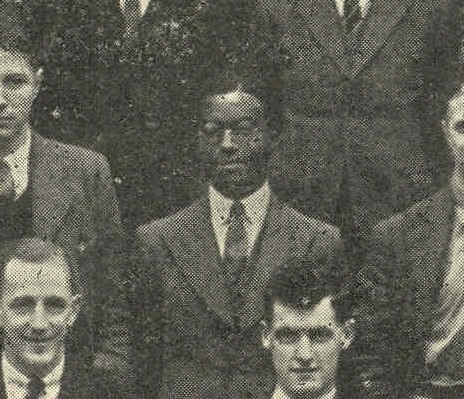
Westminster College Archives. Fourth Year group photograph, 1934 (detail)

Much progress has been made in the Francis L. Bartels Collection since last October’s post. My contribution was discussed as a potential task back in January 2020 as I was about to embark on a placement module in my second year as an Undergraduate, though in the end I worked on a different project – until the placement was cut short. When the first lockdown hit, I still had five weeks left with the Centre. Though I was not penalised in the marking of the module, I certainly felt I had left something unfinished, and yearned to return to the archive to carry out further work. After graduating this July, I reached out to Tom Dobson, to inquire about the possibility of a further voluntary placement over the summer. Throughout August, I listed approximately 600 individual items for the collection.

Dr Peter Forsaith has already discussed Dr Bartels’s biographical details in a previous post at length, for me to repeat them here would be superfluous – I shall instead discuss the impression of Bartels that listing his personal papers has left me.

An incredibly diligent man with a profound attention to detail, many of the documents within the collection are extensively annotated front and back.

Bartels would pass on notes regarding speeches and reports regularly, suggesting changes in phrasing here and there, or provide unrestrained critique if the document in question did not meet his exacting standards.

Peering into Dr Bartels’s collection of newspaper clippings, we may discover a different side of the man. Of the pages he’d kept from The Listener, for example, the majority are printed sermons by Gerald Priestland,[1] indicating an enduring interest in questions of religion and spirituality.

This notion is further reinforced by Bartels’s membership of the Society for African Church History.

The existence of the collection itself also betrays a lot about Bartels. While the original organisation of the collection may have suffered as a result of storage and transport before it made its way to the OCMCH, Bartels clearly had a system in mind as he saved various documents and organised them within it. Correspondence, conference materials, newspaper clippings, and other publications are all collected and labelled in various folders according to their relation to either specific events or broader themes. This is not a collection of all the papers that had been found among Bartels’s effects upon his death, but a system he had evidently been curating throughout his whole life. It is difficult to put into words what it feels like to peer into a life’s work.

Indeed, listing the documents has been more akin to trying to reconstruct a catalogue following the original’s destruction. Dr Forsaith’s ambition is to organise the collection so that were Bartels still alive today, he should still be able to find a specific document in it. This is a worthy goal.

Michael Orsovszki

MA History student at Oxford Brookes


[1] Quaker and BBC religious affairs correspondent between 1977 and 1982

Categories
Uncategorized

Archives & Library – Bryony Rose reflects on her time volunteering with the OCMCH

Bryony Rose, History of Art at Oxford Brookes University, volunteer with the Oxford Centre for Methodism and Church History in 2021.

During the final semester of my third (final) year at Oxford Brookes, studying History of Art, I undertook a month’s worth of volunteering for Peter and Tom at the OCMCH. It had been something that I was keen to carry out ever since I visited the Centre at Brookes’ Harcourt Hill Campus, during a second year module, looking at gallery curation.

I was intrigued by the different collections housed and wanted to broaden my knowledge of how these collections were run, stored, looked after and used by research fellows and groups. After months of email correspondence, and after the opportunity was put on hold due to the coronavirus pandemic, it wasn’t until my final few weeks of university that I got the chance to begin my placement.

My role over the four weeks was to produce condition reports for two collections housed at the OCMCH: The Methodist Church House Collection and the Bletchley Park College/Lady Spencer Churchill College Collection. My job was to record any damage to the artworks and their frames. It was a very intricate procedure, and I had to ensure I handled these pieces carefully as many were very delicate. The overall experience in handling these goods and looking intently for any damage was priceless – I consider myself extremely lucky as I doubt any other art institution would give this role so freely to a volunteer to carry out. As well as helping out Peter and Tom, I’m excited to have added another ‘string to my bow’ of experience in the art historical field to further aid me in finding a career in this sector following my graduation this summer.

I really enjoyed my volunteering and it was a shame to begin the placement so late into the university term. I would urge anyone to seek out a volunteering placement. Not only does it widen your knowledge of a particular field of work, the opportunity to connect with new people is invaluable.

Categories
Uncategorized

Fellows – Lizzie Barratt, Visiting Research Fellow 2020-21

Lizzie Barratt, Visiting Research Fellow at the Oxford Centre for Methodism and Church History for 2020-21.

As a recent graduate in History of Art and English I have been so excited to have taken up a fellowship with the OCMCH this year. My time as a Visiting Fellow is centred around the artist, poet, and essayist James Smetham, as part of the Centre’s programme to mark the bicentenary of his birth in September 2021.

Smetham was a unique and intriguing figure, a devout Methodist residing on the fringes of the Victorian art scene. The work he left behind is rich and vibrant to study, variable both stylistically and in subject matter. The question of how Smetham ‘fitted’ within the movements of the contemporary art world has been of particular interest to me as an art history enthusiast, as he was friendly with many Pre-Raphaelite figures, and many of his works echo Pre-Raphaelite motifs. However, much also diverts, Smetham’s work often more expressionistic and inward-looking, as well as flip-flopping stylistically in an attempt to create commercially successful works in line with the latest trends.

However, Smetham never fulfilled his artistic ambitions, his life ending in a silent collapse of mental health – some commentators citing his Methodist faith and way of life as grounds for his failure to reach artistic success and mental stability. Questions surrounding the relationships between Smetham’s art, religion and mental health are extremely complicated, and yet seem unavoidable when discussing the artist. Whilst a form of religious melancholia and self-deprecation in his aim towards spiritual growth are undeniably present in Smetham’s personal writings, to view Methodism as a wholly negative influence appears reductionist. Faith and religious wonder also provided joy and artistic inspiration, Methodism and art thus both simultaneously guiding and tormenting him. A non-monolithic and open-ended exploration of these three aspects (religion, art and mental health) and how they intertwined in the artist’s life have been at the forefront of this project – a challenging but important lens through which to better understand Smetham’s work.

The outcome of my fellowship so far has been an introductory online exhibition. It has been challenging to introduce such a complicated figure in a way that does his work justice and speaks to viewers today, but I am extremely proud of what we have produced. Using the Centre’s archive to research for this has been a highlight. The collection of artworks, but also the array of Smetham’s personal musings, letters and ‘squarings’ (which have especially captivated me!) have been an indispensable resource in ‘getting to know’ the artist. Engagement with the collection is something I have continued to enjoy as I have embarked upon transcribing one of the volumes of letters and memoranda. With galleries, museums, and libraries closed for much of last year, I have felt so lucky to be able to continue to engage in art-historical research and study works first-hand. I am extremely grateful to all at the centre for this opportunity, which has given me incredible new experiences and skills that I will take with me on my Masters and beyond – and I can’t wait to keep working on Smetham!

Categories
Uncategorized

Research – Wesley Historical Society Essay Prize Competition 2021

The Wesley Historical Society is delighted to announce its 2021 prize competition for essays on any topic involving the history of religion in the British Isles since 1700. The competition is being held in association with the Oxford Centre for Methodism and Church History, Oxford Brookes University. Two prizes of up to £250 will be awarded, one for a Sixth Form pupil, and one for an undergraduate studying for a first degree or a graduate studying for a masters degree. Where the standard of entries merits it, the prize money may be split.

Entries will be judged by a panel of historians overseen by the Society’s President, Rev. Dr Tim Macquiban. The judges are looking for essays which are well argued and presented, and which display both understanding of religion and sensitivity to its social, economic and political context. Essays need not focus on Methodism.

Timetable: the competition is now open for submissions, which must reach the competition office (email address below) by 1 October. The Society aims to announce the winner(s) on the Society’s website by 31 December.

Eligibility: for the Sixth Form prize, and any pupil studying full-time in a Sixth Form in the UK at the time of entry; for the student prize, any undergraduate or masters student studying at a UK university. Competitors must be resident in the UK at the date of submission of their entry.

Number of entries: Only one entry is permitted per person.

Essay length: entries should be 1,500-2,500 words long, including footnotes, but excluding (required) bibliography.

Originality: each entry must be the original work of the entrant. All entries will be subject to checking for plagiarism, including by the use of Turnitin software. The Society recognises that not all entrants will be able to undertake archival research, but draws attention to online resources such as these:

https://dmbi.online/

http://www.methodistheritage.org.uk/research-online-books.htm

https://wesleyscholar.com/

Acknowledgment of receipt and feedback: the Society will acknowledge receipt of entries, but is unable to provide feedback on individual entries.

How to enter: the essay and cover sheet (downloadable from the Society’s website) should be submitted as three separate files, sent to cnorris@brookes.ac.uk, and copied to the teacher, lecturer or tutor who certifies the originality of the work. The cover sheet should be in PDF format, and the essay in both Word and PDF.

Enquiries: Please direct all enquiries concerning the competition to cnorris@brookes.ac.uk .

For further information see: http://www.wesleyhistoricalsociety.org.uk/essay.html

Categories
Uncategorized

Archives & Library – LGBTQ+ History Month 2021

“Sexuality is God’s good gift to all persons”[1]

“The Joy of human sexuality as God’s gift and the place of every human being within the grace of God”[2]

Two fairly similar statements made by two Methodist churches. The first by the United Methodist Church, the second by the Methodist Church of Great Britain. On the nature of sexuality, and that it is within God’s gift, these two churches agree. Beyond this, the two stances could not be more different. For LGBT+ History Month 2021, this blog posts traces the attitude of the Methodist Church in Britain, using material from across our collections to see how they have adapted with the times, from a place of disapproval, to a place of acceptance within the Church.

The attitudes of both churches stems from the Bible which, it was argued, has some very clear teachings on homosexuality. The Book of Romans (1:26-7) describes homosexuals as ‘shameless’.  1 Corinthians (6:9-10) lists homosexuals alongside thieves and murderers. The Book of Leviticus (18:22 and 20:13) refers to acts of homosexuality as ‘an abomination’, and even goes as far as to state that anyone caught committing an act of homosexuality should “surely be put to death”. The problem faced by many, however, is that the Bible also argues that all of mankind is made in the image of God, and that God loves everyone.

Homosexuality was partially de-criminalised in Britain in 1967. This partial decriminalisation allowed for ‘acts of homosexuality’ to occur in private, and only between two adults over the age of 21. A step towards equality, but not yet equal. The law continued to change, albeit it slowly. In 2001, laws regarding the legal age of consent were adjusted so that there was parity, regardless of gender or sexuality. In 2004, LGBT+ couples were granted the right to a civil partnership. Finally, in 2013, the ‘Marriage (Same Sex Couples) Act’ allowed LGBT+ couples to marry. Changes within the Methodist Church have been slower, and do not yet fully permit equality.

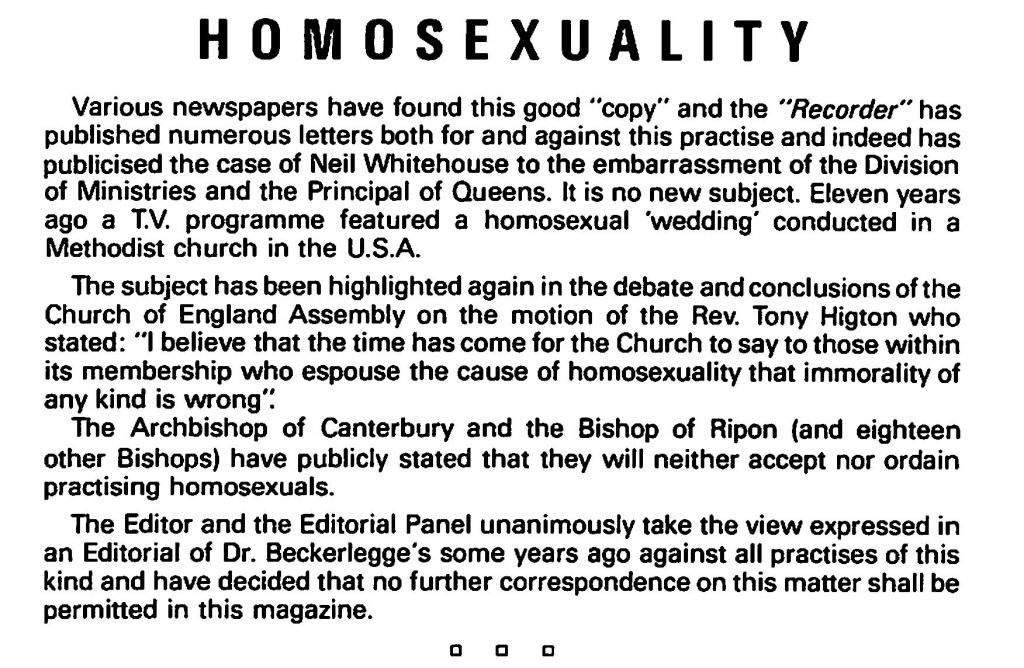
Among the more vocal opponents of LGBT+ rights were members of the Voice of Methodism movement, who expressed their views through the association’s magazine which was published from 1964-1996. Their complaints included that in light of the 1986 Education Act schools would have the right to ‘promote wrong views of sex education and the family’ (December 1987), and further discussion of ‘practices of this kind’ was banned (March 1988). This statement held firm throughout the rest of the magazine’s run, apart from in reference to decisions made at Methodist Conference. Following a report at the 1990 Conference, the magazine went so far as to remark that they believed that ‘the business of ‘human sexuality would be an unfortunate interlude happily forgotten in Methodist history’. This was far from the case.

Voice of Methodism Magazine (December 1987)
Voice of Methodism Magazine (March 1988)

The primary evidence of a shift in Methodist attitudes towards accepting LGBT+ individuals can be seen from the early 1990s.[3] In 1993, Conference formally accepted a set of resolutions which would shape Methodist policy over the decades that followed. The Derby Resolutions, as they came to be known, affirmed ‘the joy of human sexuality as God’s gift and the place of every human being within the grace of God.’ They went on to state that ‘a person shall not be debarred from the church on the grounds of sexual orientation in itself,’ and that ‘Conference recognizes, affirms and celebrates the participation and ministry of lesbians and gay men in the church.’ These resolutions finished by stating that ‘Conference calls on the Methodist people to begin a pilgrimage of faith to combat repression and discrimination, to work for justice and human rights and to give dignity and worth to people whatever their sexuality’. These resolutions accepted the LGBT+ community and separated the Methodist Church from the traditional view of homosexuality as a sin. A later letter from the President of Conference, Rev. Brian Beck, also stated that ‘homosexual orientation of itself is [not] a sinful state’. The Derby Resolutions did, however, state that Conference reaffirmed ‘the traditional teaching of the Church on human sexuality; namely chastity for all outside marriage and fidelity within it’.

This remained the official attitude of the Methodist Church throughout the 1990s, and into the twenty-first century. In 2019, the Methodist Church published the report of its Marriage and Relationships Taskforce. This taskforce had been appointed to review, and update, the attitude of the Church towards marriage and relationships. The resolutions of this report, therefore, would be the first changes to the Church’s position since 1993. Resolution 10/8 promises the greatest change, stating that ‘The Conference consents in principle to the marriage of same-sex couples on Methodist premises throughout the Connexion and by Methodist ministers’. 

Whether this ‘in principle’ decision becomes actuality remains to be seen, with the final vote on this report (and its resolutions) due at this year’s Conference (June – July 2021). Regardless, an ‘in principle’ acceptance of LGBT+ marriages on Methodist premises, and by Methodist preachers, shows just how far acceptance and equality within the Methodist Church has grown in the past half a century. The Methodist Church is also the only Church in Britain to, even hesitantly, accept the proposal of LGBT+ marriage. Conversely, the United Methodist Church has stated that ‘sexual relations are affirmed only with the covenant of monogamous, heterosexual marriage’, finishing its statement by reaffirming that ‘The United Methodist Church does not condone the practice of homosexuality and considers this practice incompatible with Christian teaching’, [4] demonstrating the distance on this issue between two of the leading Methodist bodies either side of the Atlantic.

LGBT+ History Month provides a time, a space, and a platform for us all to recognise the history of the LGBT+ community. For more information about events at Oxford Brookes University this month visit https://www.brookes.ac.uk/staff/human-resources/equality-diversity-and-inclusion/lgbtq–history-month/


[1] https://www.umc.org/en/what-we-believe/umc-topics/social-issues/human-sexuality

[2] https://www.methodist.org.uk/downloads/ne_derbyresolutionsmethrec_130207.pdf

[3] https://www.methodist.org.uk/downloads/ne_derbyresolutionsmethrec_130207.pdf

[4] https://www.umc.org/en/content/the-nurturing-community#human-sexuality

Categories
Uncategorized

J. H. Rigg bicentenary (1821-2021): Westminster College’s formative principal

200 years ago, on 16 January 1821, a boy was born in the Orphan House in Newcastle-upon-Tyne to a Wesleyan minister, Rev. John Rigg and his wife Annie McMullen. This child went on to be a leading Wesleyan educator, minister, author and editor: Rev. Dr. James Harrison Rigg.

Rev. Dr. J. H. Rigg, Principal of Westminster College, 1868-1903

J. H. Rigg was educated, and then taught, at Kingswood School near Bristol, before teaching elsewhere, offering for the Wesleyan ministry in 1845. After twenty years serving in the circuits, he was appointed Principal of the Wesleyan Normal Institute in Westminster, latterly known as Westminster Training College.

Westminster College Photograph Album, Ph/1/a/2

According to Pritchard’s Story of Westminster College, Rigg was the only individual even considered for the role. It was under Rigg that Westminster, founded by John Scott seventeen years earlier, became thoroughly established, and began to grow and flourish into the renowned Methodist teaching college it is remembered as. Rigg’s tenure saw the creation of The College Rule, the adaptation of the buildings for modern conveniences (electricity and extended indoor plumbing), and better record-keeping. Within the first five years of Rigg’s tenure, and also following the 1870 Education Act, the Wesleyan Education Committee established a second teacher training institution (Southlands) to meet the increased demand on Westminster’s facilities. Rigg was Principal of Westminster until his retirement in 1903, when he was succeeded by Rev. Dr. H. B. Workman.

In addition to being principal of Westminster, Rigg was heavily involved in both national and Methodist aspects of education. He sat on the inaugural London Board of Education from 1870, and can be seen in the centre of the artwork depicting this.

‘The First London School Board’, John Whitehead Walton (1815-1895, Guildhall Gallery

It was whilst on the Board of Education that Rigg, and the Wesleyan Education Committee, heavily argued against the 1902 (‘Balfour’) Education Act, which Nonconformist educators throughout the country believed would negatively impact them, in favour of Church of England and Catholic schools. Rigg also argued for universal education and un-denominational (state ran) school access in every area, something also championed by the Wesleyan Education Committee, and also accepted policy by the Wesleyan Methodist Church as a whole. It was not until the Education Act of 1944 that the Methodist Church believed that this aim was met – something that featured heavily in the Conference Agendas for 1943 and 1944.

Within the church, Rigg was an establishment figure, Chairman of Districts and twice President of Wesleyan Methodist Conference (1878 and 1892), overseeing reform which is described as making “the union of the various Methodist bodies a clear possibility”. He was also treasurer of the Wesleyan Missionary Society 1881-1909. He published extensively, contributing several letters and articles for The Times and Watchman newspapers, and writing books on topics such as Methodist doctrine (1850), elementary education in Europe (1873), the life of Jabez Bunting (1905), and the leaders of the Oxford Movement (1895). On Wesley, Rigg published The Churchmanship of John Wesley (1869) and The Living Wesley (1875). As well as penning items for publication, Rigg helped establish the London Quarterly Review in 1853, becoming editor from 1883.

J. H. Rigg died in 1909, leaving an extended family. His son was James Rigg (a barrister and contributor to the Dictionary of National Biography); one of his daughters became a renowned headmistress and the other, mother to John Telford (who later edited and published Wesley’s Letters).

Thomas Dobson, Collections and Digitisation Officer at the Centre, is currently working towards a PhD thesis titled, ‘Training to Teach: Westminster College and the development of Higher Education, 1925-63’

Categories
Uncategorized

Black History Month – Thomas Birch Freeman (1809-1890), missionary to West Africa

Alison Butler of the Methodist Heritage Committee reconsiders Freeman’s legacy

In marking the contribution of Thomas Birch Freeman to Methodism’s missionary work, we should surely also recognise those less well-known helpers, whose work ensured Freeman’s success.

Thomas Birch Freeman, Wesleyan-Methodist Magazine, vol. 65 (1842), facing p. 353.
https://flic.kr/p/2edhqLf

Such as they are, the biographical details relating to Freeman are readily available[1] and his story has been told before in Black History Month[2]. His service as a successful and particularly long-lived Wesleyan Methodist missionary in West Africa between 1838 and 1857 and then again from 1878 to 1890 has been recounted in respected biographies and authoritative accounts of the work of Methodist missions[3]. However, even setting aside the more complex issue of the entanglement of British missionary and colonial interests, I am wondering whether a reappraisal of his personal contribution is not now due.

For what is barely explored is the extent to which Freeman’s effectiveness was indebted to the humility, capability and commitment of African Christians, some of whom were witnessing to their faith before Methodist missionaries such as Freeman arrived. These men and women are almost always referred to, in passing, as having been ‘identified’ as suitable workers, or who, in the case of William de Graft, ‘accompanied’ but quite possibly out shone Freeman, on their successful missionary lecture-cum-fundraising tour of Britain in 1840.

That Freeman was able to acknowledge de Graft to be a gifted speaker and preacher has been framed as, and was, enlightened for the time. But it leaves open to question whether, overall, Freeman learned as much from men such as de Graft, as the other way around. Similarly Freeman’s lauded willingness to recommend black Methodists for ordination, side steps the designation of ‘catechist’ initially given to them. (Had they been white, these men would almost certainly have been immediately ordained, but would then have cost the Missionary Society more.)

Freeman is mildly criticised for having been incompetent at keeping control of his expenditure (and resigned from the ministry in 1857 as a result). Less is made of his inability to speak native languages. Most accounts simply refer to his use of (nameless) translators. Since his preaching was, relatively speaking, extremely successful, one wonders what those who saw him speak actually heard. Where is the credit shown to those who were able to translate, on the spot? How did they manage to communicate the essence of Freeman’s style of preaching in a way that led people to faith?

Thankfully Freeman’s botanical interests and expertise are now receiving some dedicated attention[4], although this work is still to be published. Sadly the two enduring passions of Freeman’s life: preaching the word and studying plants have thus far been researched separately. I suspect a more holistic approach will be needed to do him (and others) justice and to understand who Freeman really was, or at least could have been. One wonders how his life might have turned out, had his employer not made him choose between his faith and his work as a plantsman when he was still a young man.


[1] https://dacb.org/stories/ghana/freeman-t/

[2] https://blogs.soas.ac.uk/archives/2019/10/04/black-history-month-2019-thomas-birch-freeman

[3] Thomas Birch Freeman, West African Pioneer by Allen Birtwhistle (The Cargate Press, 1950); Methodists and their Missionary Societies 1760 – 1900 by John Pritchard (Ashgate Methodist Studies, 2013)

[4] Correspondence with and website of Advolly Richmond, garden historian: https://advolly.co.uk/talks.html

For more information about Black History Month at Oxford Brookes University visit, https://www.brookes.ac.uk/staff/human-resources/equality-diversity-and-inclusion/black-history-month/