Categories
Uncategorized

Our “First” Annual Report

The first year of the Network, and four fellowships funded by the Westminster College Oxford Trust (WCOT) has been productive, demonstrating both the need for the project and its possibilities for development. The four fellows – Professor Bev Clack, Revd Dr Martin Wellings, Dr Tom Dobson and Dr Daniel Reed – have worked together well, with Drs Dobson and Reed taking on much of the administrative work, including the co-ordination of the new research space at Wesley Memorial (which houses a selection of material from the Wesley Historical Society [WHS] and other historic collections), and also maintaining the legacy of the Oxford Centre for Methodism and Church History (OCMCH). Professor Clack and the Revd. Dr Wellings, have been in discussion with the Connexion as to the development of the fellowships in line with Church objectives – all four fellows have also pursued their own research.

The delay in the opening of the Gibbs Room has been frustrating; but the ‘happy accident’ of the fellowships not having an institutional home at Harris Manchester College, but in the Farmington Institute, has enabled creative thinking about the relationship between academia and the church. This was made plain in the use of the John Wesley Room at Wesley Memorial Church for our first independent event on Methodist Ways of Life. The new research space at Wesley Memorial Church also makes concrete the embedded nature of the fellowships in church life, and further facilitates the exploration of new ways of thinking around the relationship between academic theology and the church.

Finally, as the Network completes its first year of activities, we would like to thank Dr Daniel Reed for all of his work and support this year as one of our foundational Research Fellows. With his one-year fellowship, Dr Reed has co-ordinated the marketing effort for the Methodist Studies Seminar, continued to develop our digital presence (now with added material provided by The Methodist Church); and furthered his own research activities, all whilst studying for a postgraduate diploma in at Aberystwyth University.

The first year of the project has put down foundations and we are now in a position to look to the future with confidence: a confidence we hope that the Trust will share. This following report details some of the activities of the Network, both as individual fellows and collectively.

To read the full report, click the link below.

Categories
Uncategorized

Research – Methodist Ways of Life report now online

On Saturday 12 April 2025, the Westminster Oxford Research Network hosted its first independent event. Held at Wesley Memorial Church, Oxford, sixteen Methodist scholars, ministers, and associated academics met to explore what it is to be a Methodist today, to situate historical and theological discussion alongside each other, and to ‘explore the various understandings of Methodist ways of life, both historically and today’.

The programme included three workshops – History and Identity, Social Justice, and Spirituality – and lots of space for discussion. Outcomes from the day were a series of identified themes and trends in scholarship, and potential future events for the Network. These include: ‘The Church after Covid’, ‘1932 and All That’ (an exploration of British Methodist Union), and ‘A Religious Revival? A Revival of Research’ – many of these different strands for future work have also been captured in a word cloud.

To read the full report please click here.

Categories
Uncategorized

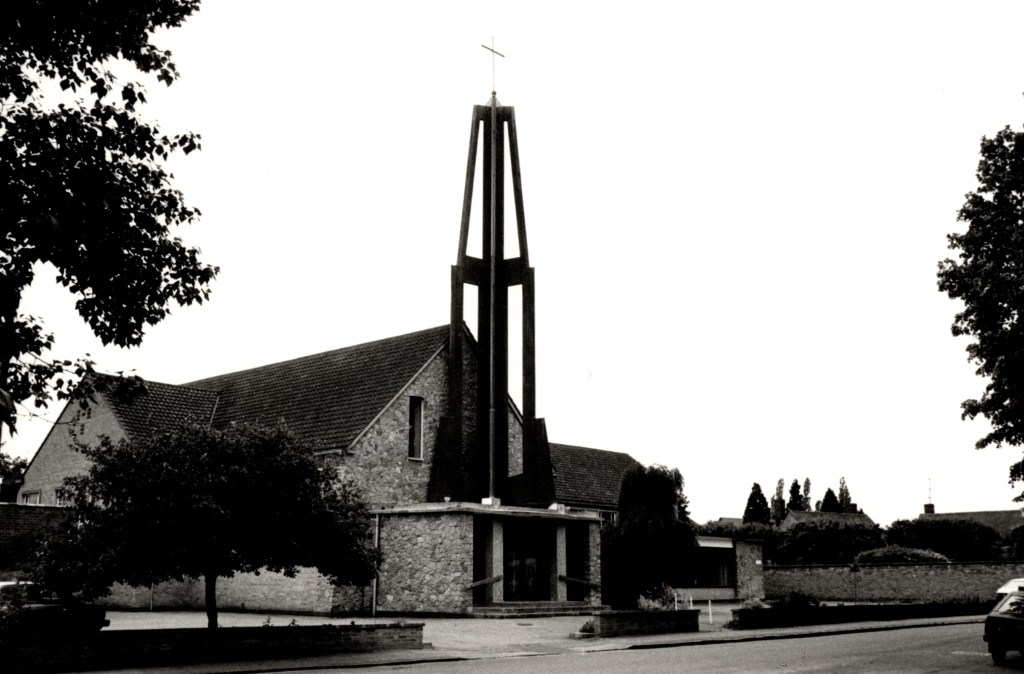
New collection added to British Methodist Buildings

In April 2025, a new collection was added to the British Methodist Buildings project – these 167 photographs originated with the former Home Mission Division of the Methodist Church in Britain. They were discovered during the clearance of Methodist Church House in London and were subsequently deposited with the Oxford Centre for Methodism and Church History.

The first Home Mission committee were formed in 1856 with the aim of confronting distinct challenges in both rural and urban areas. The Home Mission Division was established in 1973 and became part of the Connexional team in 1996.

These high-quality photographs mostly date between the 1960s and 1980s (with some much earlier) and are typically in striking black-and-white. For the most part they are earlier in date than the majority of images already in British Methodist Buildings, so broaden the chronological scope of the project and provide updated views of many churches and chapels – some of which have long since been altered, demolished, or repurposed.

British Methodist Buildings is an unparalleled visual gallery of Methodist buildings in Britain coordinated by the Oxford Westminster Research Network. The project launched in 2019 and features almost 12,000 images that have been viewed over 850,000 times. Explore this new collection now by following this link.

Categories
Uncategorized

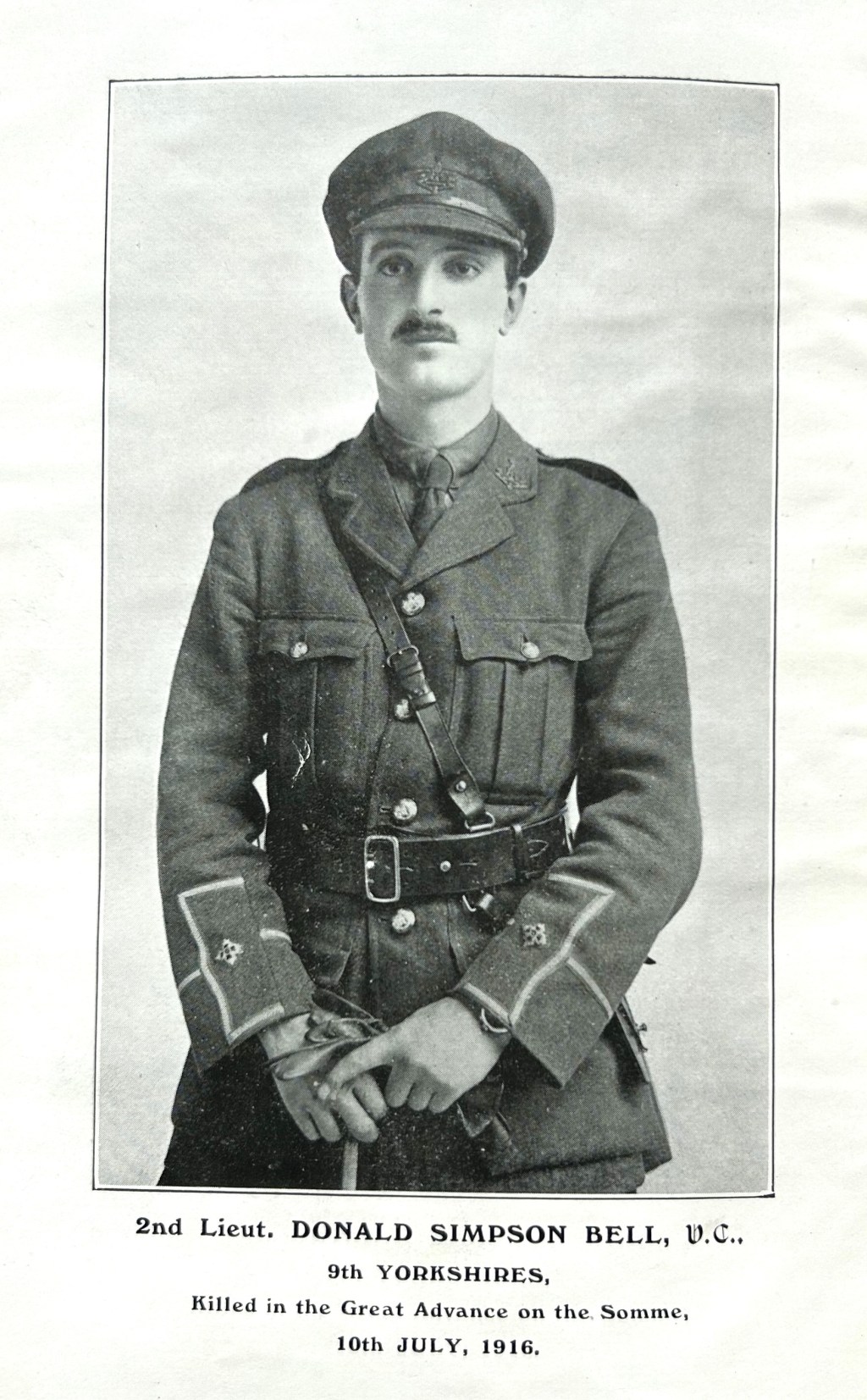
Research – Donald Simpson Bell, VC (1890-1916)

(D. S. Bell at Westminster Training College, 1909-11)

Donald Simpson Bell (1890-1916) was born into a family of Wesleyan Methodists in the North Yorkshire spa town of Harrogate on 3 December 1890. The youngest son of Smith and Annie Bell, he attended St. Peter’s Church of England Primary School as a child before continuing his education at Harrogate Grammar School.

In 1909, Bell left Yorkshire and moved to London to train as a teacher at Westminster College. A naturally gifted athlete, he excelled at many sports and quickly forged a fine reputation for himself in college sporting circles. He was an accomplished cricketer, a lightning quick sprinter and a talented hockey player. Standing over six-feet tall and powerfully built, he was also competitive in the swimming pool and fearsome on the rugby field.

Westminster College 1909-10 colours cap (top left) cutting from principal’s log book,
15 May 1911 (top right) Westminster Training College Fifth Inter-Year Athletics Sports programme, 15 February 1910 (middle) programme, 14 February 1911 (below)

Football was his first love, however, and Bell had already impressed in Yorkshire’s amateur leagues before emerging as one of the stand-out players in the Westminster XI. His talents were also recognised by Southern League side Crystal Palace who gave him the opportunity to turn out for them as an amateur while he studied in the capital.

Bell eventually returned to his native Harrogate in 1911 to take up a teaching role at Starbeck School. Nevertheless, football continued to occupy a significant part of his life and he had brief spells with Newcastle United reserves and Bishop Auckland before helping Mirfield United retain the West Riding Junior Cup in 1912.

Bell’s growing reputation soon caught the attention of Bradford Park Avenue and the second division club were eventually persuaded to offer him his first professional contract, which he signed in October 1912 in order to supplement his modest teaching salary.

After establishing himself in the second string, Bell made his Football League debut against Wolverhampton Wanderers at the end of the 1912/13 season and would go onto play a further four league games the following season as Avenue secured promotion to the English top flight. Although his first team appearances were limited, Bell was a regular fixture in the reserve side and he impressed sufficiently to suggest he had a promising future ahead of him.

Unfortunately, his burgeoning football career was cut short soon after the outbreak of the First World War when he asked Avenue to release him from his contract so he could answer Lord Kitchener’s call to arms. This was duly agreed and Bell enlisted as a private in the 9th West Yorkshire Regiment in November 1914.

Bell was a natural soldier and he was soon persuaded to apply for a temporary commission after a chance meeting with former Harrogate Grammar school friend Archie White, who was then serving as a Lieutenant with the 6th Yorkshire Regiment, also known as the Green Howards. Bell’s application was subsequently approved and, after completing office training, he eventually embarked for France where he joined the 9th Green Howards as a second-lieutenant in December 1915.

Bell’s first taste of life in trenches came in a relatively quiet sector of the line near Armentieres, however, his battalion eventually moved south ahead of the British offensive on the Somme in the summer of 1916. As part of 69th Brigade, 23rd Division, the battalion were held in reserve on the bloody opening day of battle but they were soon thrown into the maelstrom when they were ordered to assault a German position called Horseshoe Trench on 5 July.

Unfortunately, the attack ran into difficulties almost immediately as the exposed Yorkshiremen were raked by withering enemy machine-gun fire soon after clambering from their trenches and quickly began taking losses. At this critical moment, 2/Lt Bell took decisive action and set off towards the machine-gun along a communication trench with two men from his bombing party, Corporal Colwill and Private Batey, following quickly behind. When the trio had closed to within twenty yards of the gun, they suddenly leapt out of cover and made an audacious charge across the open, straight towards the startled enemy.

Bell first managed to kill the soldier firing the gun with his revolver before launching a well-placed Mills bomb that succeeded in destroying both the gun and the remaining members of the gun team. The three men then proceeded to clear out a number of dugouts with the aid of further Mills bombs. With the deadly threat on their flank removed, the Green Howards surged across no-man’s land and down into the German trenches, where they were soon able to secure their objectives.

Bell’s quick-thinking and gallantry proved critical to the eventual success of the British attack on Horseshoe Trench that day and undoubtedly saved the lives of many soldiers. Nevertheless, Bell was a reluctant hero and he was characteristically modest about the incident when he wrote to his mother soon after, telling her dismissively: ‘I must confess that it was the biggest fluke alive and I did nothing… I chucked the bomb and it did the trick.’

Tragically, that letter would prove to be the final correspondence between the pair. Five days after the attack on Horseshoe Trench, Bell was cut down leading a similarly dramatic bombing attack against the enemy during the fight to capture Contalmaison. He was twenty-five-years-old and left a widow, Rhoda, who he only married four weeks earlier during a short period of leave. After his death, the popular subaltern was buried close to where he had fallen at the southeastern end of the village and a wooden cross later placed on his grave. A nearby position was also named Bell’s Redoubt in his honour.

Westminster Training College Monthly War Bulletin, no. 22 (1 August 1916)

News of Bell’s death prompted an enormous outpouring of grief at home and a flurry of emotional tributes soon followed. Among them was one published in the Westminster Training College Monthly War Bulletin which said of their former student:

At college, Bell had been Captain of Athletics, and a member of the first eleven at cricket, Association football, and hockey. He had also represented the College at swimming and Rugby football, and was in fact one of the best all-round athletes that Westminster has ever produced .[i]

Westminster Training College Monthly War Bulletin, no. 24 (1 October 1916)

There were also tributes from his battalion, including one from his commanding officer, Lieutenant-Colonel Holmes, who told Bell’s parents that their son was ‘a great loss to the Battalion and also to me personally, and I consider him one of the finest officers I have ever seen’[ii]

Another officer said Bell ‘knew no fear’ and added ‘he had the courage of a lion, and always seemed to be on the lookout for ways and means of making things easier for his comrades.’[iii]

Archie White, meanwhile, who remarkably would also be awarded the Victoria Cross for deeds at Stuff Trench less than three months after Bell’s death, wrote of his old school friend: ‘Probably no one else on the front could have done what he did… He was a magnificent soldier.’[iv]

On 9 September 1916, the London Gazette announced that Bell had been awarded a posthumous Victoria Cross for his actions at Horseshoe Trench on 5 July. He was the first and only English professional footballer to receive his country’s highest decoration for gallantry during the war. The citation read:

For most conspicuous bravery. During an attack a very heavy enfilade fire was opened on the attacking company by a hostile machine gun. 2nd Lt. Bell immediately, and on his own initiative, crept up a communication trench and then, followed by Corpl. Colwill and Pte. Batey, rushed across the open under very heavy fire and attacked the machine gun, shooting the firer with his revolver, and ‘destroying gun and personnel with bombs. This very brave act saved many lives and ensured the success of the attack. Five days later this gallant officer lost his life performing a very similar act of bravery.[v]

Westminster Training College Monthly War Bulletin, no. 24 (1 October 1916)

On 13 December 1916, Rhoda Bell travelled to Buckingham Palace to receive her late husband’s award from King George V. She was accompanied on her visit to London by his sister, Minnie, and the pair were photographed outside the palace gates following the ceremony. Corporal Colwill and Private Batey, meanwhile, later received the Distinguished Conduct Medal in recognition of their bravery on 5 July. Unlike Bell, both men survived the conflict and lived into old age.

After the War, Bell’s body was moved from its original resting place and reburied at Gordon Dump Cemetery in the valley below the village of La Boisselle. Perhaps fittingly, the gallant young officer now lies just a few hundred yards from the site of his heroic action at Horseshoe Trench.

D. S. Bell VC memorial window in Westminster Chapel, Harcourt Hill Campus

Bell is commemorated on a number of memorials, including one at the Wesleyan Chapel in Harrogate and others at St. Peter’s Church of England Primary School and Harrogate Grammar School. There is also a beautiful stained glass window in the chapel at Oxford Brookes University at Harcourt Hill that honours the former Westminsterian.

In 2000, a memorial sponsored by the Players Football Association (PFA) and the Friends of the Green Howards Museum was erected on the site of Bell’s Redoubt to commemorate the gallant young officer. Almost one decade later, the PFA also bought his Victoria Cross and campaign medals at auction and they are now on display at the National Football Museum in Manchester.

Iain McMullen

Images from the Westminster College Archives provided by OCMCH staff, many of which can be viewed online through our Digital Collections page here


[i]       F. C. Pritchard, The Story of Westminster College, 1851-1951, p. 125

[ii]      Letter to Smith Bell. Bell Family Archive.

[iii]     Harrogate Herald (9 May 1917)

[iv]     R. Leake A Breed Apart, p. 84

[v]      The London Gazette (9 September 1916)

Categories
Uncategorized

Research – Jean De Dieu Mampouya, Bursary Recipient 2023-4

Jean De Dieu Mampouya with OCMCH Research Fellow Dr Peter Forsaith in Oxford

I’m delighted to have been awarded the Oxford Centre for Methodism and Church History’s research bursary in April 2024.

I would first like to thank Prof William Gibson for that marvelous welcome in the research centre. I would be careless and remiss if I failed to thank Drs Peter Forsaith and John Lenton for their precious advice and warm support during this stay. And many thanks to Dr Daniel Reed and Thomas Dobson for their unwavering encouragements.

My research trip was productive, and my thesis has really been boosted positively by this short stay. The first two weeks, I worked on relevant books and documents that I could not find in France, namely, Policy and Politics in British Methodism 1932-1982 by George T. Brake; Conscience and Conflict: Methodism, Peace, and War in the 20th century by Michael Hughes; Drink in Great Britain 1900 to 1979 by Gwylmor P. Williams and George T. Brake; Gambling by Pearson, etc.

Moreover, during my last two weeks I worked on the most valuable documents for my thesis, notably the Minutes of Conference from 1932 to 1999. These documents have widely contributed to the improvement of my thesis. I could not find them out elsewhere than OCMCH. The Minutes of Conferences constitute a matchless asset for following the twentieth-century social, economic, and political events they tackled, knowing that my thesis is based on the Church of England’s and Methodist Church’s commitment to twentieth-century social, political, and economic issues.

So, that is from this perspective that I might confess that my research stay at OCMCH has absolutely been a productive and unforgettable opportunity.

Since launching in 2022, the OCMCH research bursary has supported the work of scholars from around the world

Categories
Uncategorized

Archives Spotlight: Westminster College and the Australian Imperial Forces, 1914-18

On 4 August 1914, Britain declared war on Germany. The First World War raged for over 2,000 days before coming to a halt on 11 November 1918, and killed 880,000 members of the British forces, including 102 alumni of Westminster College. This amounted to 6% of the adult male population of Britain at the time, and it took much of the following decade for the College to recover.[1] Greatly reduced, Westminster was evacuated from London to Richmond College, the Wesleyan theological institution. In the second of our collection highlights, we explore what happened at the Westminster College site during the First World War, and its connections with the Australian armed forces.

Westminster College Archives. A/3/c/2, Principal’s log book, 1911-14.

In July 1914, H. B. Workman closed his Principal’s log for the year by recording that ‘College finally went down’, suggesting that he was pleased to have reached the end of a long term![2] What he did not realise, however, was that he would be summoning groups of College men back to Horseferry Road in a matter of weeks so that students would be together if they chose to enlist.[3] The College continued to operate from London for twelve months, albeit it with a reduced cohort. The following year saw the College re-open in September 1915, only to be relocated to Richmond at the start of term. Workman later recalled,

I had finished my inaugural address to the new students on the morning of Thursday, 23rd September, and was about to go on with the usual routine of the day — the signing of indentures and so forth — when there came an urgent call for me at the telephone. It was from H.M. Office of Works to state that the Government of the Commonwealth of Australia were anxious to take our College as their military headquarters, and that officials would be round within the hour to survey the premises. They came, and before lunch the matter was practically settled: all that was left being the discussion of certain terms and conditions. They asked me to summon at once our various Committees. These duly met on the 30th September and unanimously approved the proposal. The Executive Committee of the Richmond Branch of the Theological Institution also unanimously and, with great graciousness, approved a proposal to hand over Richmond College to us and to transfer their students to Didsbury, Manchester. Within a week of the proposal first being mooted, the Australian Government were already beginning to lay down telephone wires and in other ways to effect the great change.

The College would remain at Richmond, and the Australians at Horseferry Road, until 1919. In his wartime memoirs James Green recorded that ‘Horseferry Road has its special place in our records’, before listing its achievements in both peace and war.[4] As the administrative headquarters for the Australian Imperial Forces, the College buildings were always extremely busy, with thousands of servicemen visiting the College buildings each week. Outside of the main College buildings, a sign labelling them as the ‘Australian Military Offices’ was erected, opposite a YMCA hostel ran by Mrs Workman (also in College buildings).

Westminster College, Victory Bulletin, No. 49, Vol. V, No. 1 (December 1918), p. 10.

A Union Flag was placed in the middle of the Principal’s Quad, and a cannon added in its corner. Inside the buildings, Captain H. C. Smart organised offices which financed the Australian war effort, and also kept track of convalescents being returned from France. Smart ‘organised a records office, employing a few military supervisors with a large number of girls, whose labour was as effective as that of the soldiers, and much cheaper’.[5] They were surrounded by the trappings of College life – ‘working in libraries surrounded by memorial busts and bronzes of old Masters, Tutors, and Scholars. They see hundreds of clerks working in lecture-halls, class-rooms, or College Chapel’.

A parade presentation of Australian Comforts Fund Christmas gifts at the main building of Administrative Headquarters, AIF, Horseferry Road https://www.awm.gov.au/collection/C364528

This flurry of activity did not go unnoticed: George V and Queen Mary visited in October 1917, inspecting a contingent of recovering Australian men.[6] Following the cessation of war in 1918, Westminster College memorialised its former students through a series of panels in its Chapel; the alumni society did the same for its members through the installation of an organ; and the Australians contributed a brass plaque to be set up in the buildings. Today, there is another plaque recording the College’s use by Australian forces, and it was believed that this plaque was long since lost – either during the Second World War, or left behind when Westminster moved to Oxford in the 1950s. But it has recently been rediscovered at the Harcourt Hill campus, hidden for the past twenty-five years.

These College Premises were used as

A.I.F. Administrative Head Quarters

during the Great War 1914-1918

by the

Australian Imperial Forces,

of 330,000 Men.

More poetically, James Green closed the Horseferry Road section of his memoir by noting that, ‘to Horseferry Road the Australian came gladly, leaving it regretfully for war again; and when the war is over it will be a kindly memory. In close proximity to Westminster Abbey and the Houses of Parliament, where so many bonds of Empire are forged, the old Westminster Training College will continue to do its useful part in Empire building’.

ANZAC Day on 25 April is the national day of commemoration of Australia and New Zealand for victims of war and for recognition of the role of their armed forces. You can view more wartime records from the Centre’s collections, here.


[1] https://www.parliament.uk/business/publications/research/olympic-britain/crime-and-defence/the-fallen/

[2] Westminster College Archives. A/3/c/2, Principal’s log book, 1911-14.

[3] Pritchard, The Story of Westminster College (1951), p. 110.

[4] https://www.gutenberg.org/cache/epub/67351/pg67351-images.html

[5]https://www.awm.gov.au/collection/C2130826#:~:text=The%20Horseferry%20Road%20offices%20(formerly,High%20Commissioner%20in%20October%201915.

[6]https://www.google.com/url?q=https://www.awm.gov.au/collection/C364528?image%3D2&sa=D&source=docs&ust=1713886293620759&usg=AOvVaw0QxFkYnJSg98qIPYRWUPMj

Categories
Uncategorized

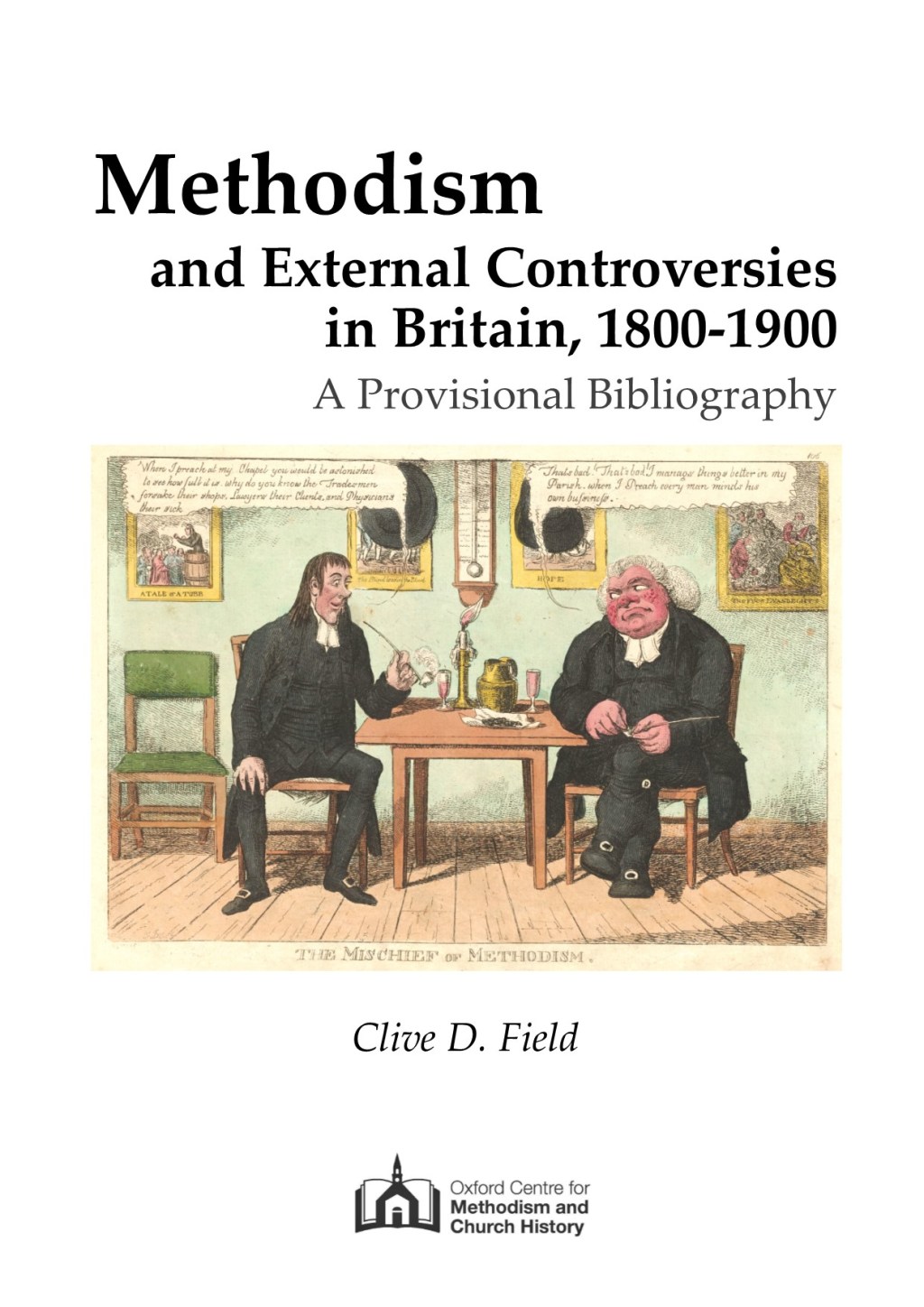
Publication – Methodism and External Controversies in Britain, 1800-1900: A Provisional Bibliography

The Centre is delighted to announce the publication of Methodism and External Controversies in Britain, 1800-1900: A Provisional Biography by Clive D. Field.

Like most new religious movements, Methodism encountered opposition and found itself embroiled in literary controversies with its critics from the outset. The hundreds of anti-Methodist publications issued during the eighteenth century, and Methodist responses thereto, have already been extensively investigated by scholars. Less well-known, however, are the external controversies in which British and Irish Methodism was engaged during the nineteenth century, especially in its first half, and the publications to which they gave rise.

In this work, Clive D. Field offers the first modern (albeit still provisional) bibliography of that literature, comprising 862 books, book chapters, and pamphlets for 1800–1900 in which Methodists either responded to literary attacks from Anglicans, Catholics, Nonconformists, and Freethinkers or initiated attacks on them, for reasons of doctrine, polity, or on other grounds. Many of these disputes were local, rather than national, in nature. The bibliography, preceded by a substantial introduction, is fully annotated, including edition histories and brief biographies of authors and subjects, and fully indexed, by author, date, short title, and place of imprint. The volume will be essential reading for anyone researching Methodist relations with other Churches in this period.

Clive D. Field is Honorary Senior Research Fellow in the School of History and Cultures, University of Birmingham and a former Director of Scholarship and Collections at the British Library. He has researched and published extensively in the social history of British religion from the eighteenth century to the present, with particular reference to statistical sources and the history of Methodism. His most recent book (2022), also from the Oxford Centre for Methodism and Church History, is Methodism in Great Britain and Ireland: A Select Bibliography of Published Local Histories.

This book from OCMCH Publications is available in both paperback. Order your copy now by following this link.

Categories
Uncategorized

Black History Month – Recovering Oxford Brookes University’s black heritage from the archives

For Black History Month, we’re delving into the Centre’s archives to learn more about Oxford Brookes University’s black heritage.

During a recent digitisation project, we made freely-accessible online a photograph album from the Westminster Training College archives dating from 1893 to 1912.1 This belongs to a series that commences in the 1850s and mainly features formal group shots of students, staff, and sports teams arranged chronologically. It is the most important visual record of the college’s earliest history.

What’s remarkable about one Westminster College photograph for 1904-5 is that it is the first to include a black student. He stands prominently in the centre of the group, just behind the college staff and the chairman of the Union Society, and is proudly wearing a form of African dress over his suit. Notes alongside the photograph identify him as ‘Nichols’.2

Corroboration with the Wesleyan Education Committee’s teachers’ register reveals this was the Rev. William G. Nicol of Sierra Leone.3 From a Creole background, Nicol was a graduate of Fourah Bay College in Freetown affiliated with the University of Durham; he matriculated in 1887 and earned his B.A. in 1891.4 Fourah Bay opened in 1827, and was dubbed the ‘Athens of West Africa’. It was the first Sub-Saharan establishment of higher education founded after the collapse of the ancient university of Timbuktu.5

Having earned his degree, Nicol was a tutor at the High School in Freetown. Already prominent in Wesleyan circles in Sierra Leone, in 1892 he was a public speaker during centenary celebrations marking 100 years of Methodism in the country.6 Nicol’s name first appears in the proceedings of the Wesleyan Methodist Conference in 1896, where he is described as a ‘native assistant minister’.7 The ‘assistant’ part was dropped in 1901 when he was ordained. ‘Native’ ministers were equipped for undertaking colonial duties, but were not permitted by the Conference to undertake positions in Britain.8

In 1903, Nicol was promoted to vice-principal of the High School, but he was destined for still greater things.9 £20 was raised by the Wesleyan circuit in Freetown to send Nicol to England to further his training at Westminster College and better qualify himself to succeed as principal.10 This step was supported by the Wesleyan Methodist Missionary Society and the Colonial Office.11

It was not uncommon in this period for Westminster students to go onto careers in the wider Empire. The registers record that they served in Australia, Canada, India, South Africa (and beyond) as teachers, inspectors, ministers, and missionaries.12 But Nicol was the first to come from Africa to England. His arrival was warmly acknowledged in The Westminsterian for May 1904, just as other students were concluding their classes for the year.13

The Westminsterian (May 1904)

Aged around 35-40, Nicol was senior to his Westminster classmates (and even some tutors) in age, academic, and ministerial terms – having been ordained and holding a Durham B.A. That said, it appears that he did engage with student life at the college. On 12 November 1904, Nicol addressed the Senior Debating Society on the subject of ‘Individuality’.14

SOAS. MMS Box 795. File 1905. Item 29, letter from William G. Nicol, 9 August 1905

Surviving letters from Nicol’s time at Westminster mainly concern his accommodation and financial support. He lodged in Medway Street, immediately adjacent to the college site, and was reliant on regular maintenance from his teaching salary and the Wesleyan Methodist Missionary Society. Nicol also requested funds to buy a new set of teeth, having suffered twenty-two extractions(!).15

Nicol also participated in wider Wesleyan life in England, making appearances at local meetings and events. He can be identified as one of several preachers from Sierra Leone to address English congregations in the first years of the twentieth century.16 This sometimes brought cultural attitudes into sharper focus. In May 1904, shortly after his arrival from Sierra Leone, Nicol attended a Missionary Meeting in Guildford where he was described as ‘the centre of interest’. Newspaper coverage seemed as much concerned with describing his appearance in racialised language as providing an account of the speech he gave. Appealing to sensibilities of the time, Nicol addressed the meeting about the progress of missionary work and said,

He stood there that night of living proof of Methodist evangelism and self-sacrifice, by which thousands of his brothers in West Africa had been emancipated from heathenism

In Methodist circles, as elsewhere, attitudes towards people from Africa were still openly caricatured and racially-stereotyped. The June 1904 issue of The Westminsterian referred glowingly to a performance at the college by a blackface minstrel troupe, then still a common form of popular entertainment.17

Yorkshire Evening Press (26 August 1905)

But other appearances by Nicol were reported in less contentious terms. In August 1905 he was a guest preacher at the opening of the new Lecture Hall and Social Rooms at Melbourne Terrace Wesleyan Chapel in York.18 This may have been on his way to or from Durham, where he received a Masters degree for the ‘excellence’ of a paper on Socialism.19

Nicol returned to Sierra Leone at the end of his year at Westminster College, and successfully took up the principalship of the High School and Training Institution in Freetown. He is recorded in that post in the Wesleyan Methodist Conference minutes until 1911 when he left the Connexion.20

Subsequently, Nicol undertook ministerial and teaching work in the Niger Delta.21 By 1914, he was leader of a ‘foreigners church’ in Calabar, in modern-day Nigeria.22 When this interdenominational church became associated with the Niger Delta Pastorate, Nicol and the Wesleyans broke away – but he was soon replaced from Lagos.23 He remained in the area for around a decade before returning to Sierra Leone to teach under the colonial government. Nicol was senior master at the Prince of Wales School in 1930.24

By the turn of the twentieth century, Westminster College had trained almost 5000 teachers.25 Its contribution to the history of education in Britain cannot be underestimated. The identification of William G. Nicol as the first person from Africa to attend the college – and so, the first black student to attend a predecessor institution of Oxford Brookes University – is an important step in recovering black heritage from the archives.

To find out more about Black History Month 2023 celebrations at Oxford Brookes University, click here.


  1. OCMCH. Westminster College Archives, Ph/a/3, college photograph album, 1893-1912. Accessible online, here. ↩︎
  2. We’re grateful to members of the ‘Old Photos of Sierra Leone’ Facebook group for their enthusiasm and input into the research for this blog post. ↩︎
  3. OCMCH. Westminster College Archives, B/1/a/5, register of teachers, 1894-1922. ↩︎
  4. Fourah Bay’s association with Durham began in 1876, with over fifty students earning degrees in its first decade or so. See, Matthew Paul Andrews, ‘Durham University: Last of the Ancient Universities and First of the New (1831-1871)’, unpublished University of Durham PhD thesis (2016). With thanks to Jonathan Bush, University Archivist at Durham, for more information. ↩︎
  5. ‘Old Fourah Bay College’, UNESCO World Heritage Convention [accessed at https://whc.unesco.org/en/tentativelists/5744/ on 16 October 2023]. ↩︎
  6. Charles Marke, Origin of Wesleyan Methodism in Sierra Leone and History of its Missions (1913), p. 130. ↩︎
  7. Minutes of the Wesleyan Methodist Conference. ↩︎
  8. Thanks to Dr John Lenton for advice on this subject. ↩︎
  9. Marke, Origin of Wesleyan Methodism in Sierra Leone and History of its Missions, p. 165. ↩︎
  10. Ibid., p. 168. ↩︎
  11. The Methodist Recorder (29 May 1905). ↩︎
  12. OCMCH. Westminster College Archives, B/1/a/5, register of teachers, 1894-1922. ↩︎
  13. The Westminsterian, vol. XIII, no. 6 (May 1904), p. 2. ↩︎
  14. The Westminsterian, vol. XIV, no. 3 (Christmas 1904), p. 16. ↩︎
  15. SOAS. MMS Box 794. File 1904. Item 22, letter from W. G. Nicol, to, W. H. Findlay, 26 April 1904; MMS Box 795. File 1905. Item 24, letter from W. G. Nicol, 15 July 1905; MMS Box 795. File 1905. Item 29, letter from W. G. Nicol, 9 August 1905. With thanks to Ed Hood at SOAS. ↩︎
  16. In 1901, the Rev. T. T. Campbell spoke in Burnley, and the Rev. C. W. L. Coker in Runcorn. See, Burnley Express (6 March 1901); Runcorn Examiner (3 May 1901). ↩︎
  17. The Westminsterian, vol. XIII, no. 7 (June 1904), p. 4. ↩︎
  18. Yorkshire Evening Press (26 August 1905). ↩︎
  19. The Methodist Recorder (29 May 1905). ↩︎
  20. Minutes of Wesleyan Methodist Conference (1911), p. 152. ↩︎
  21. Mercy Amba Oduyoye, The Wesleyan Presence in Nigeria, 1842-1962, An Exploration of Power, Control and Partnership in Mission (1992), pp. 107-110. ↩︎
  22. Rosalind I. J. Hacket, Religion in Calabar, The Religious Life of a Nigerian Town (1989), p. 79. ↩︎
  23. G. O. M. Tasie, Christian Missionary Enterprise in the Niger Delta, 1864-1918 (1978), p. 220. ↩︎
  24. Sierra Leone Blue Book (1930), p. 99. ↩︎
  25. OCMCH. Westminster College Archives, B/1/a/3, register of teachers, 1861-1896. Note on students figures by J. R. Langler dated 23 March 1898. Accessible online, here. ↩︎
Categories
Uncategorized

Research – OCMCH Research Bursary (January 2023)

Having received several strong applications in the January 2023 funding round for the OCMCH Research Bursary, we’re delighted to announce that we will be supporting the research projects of the following recipients. We look forward to inviting them to Centre and working with them in the coming year.

Alison Butler (Independent)

Emma Cresswell (Oxford Brookes University)

Julia van Duijenvoorde (Heidelberg University & Vrije Universiteit Amsterdam)

Stephen Parker (University of Worcester)

Nathan Travis (University of Chicago)


Previous OCMCH Research Bursary recipient Deborah Hartland reflects on her experiencing working with the Centre over the past six months:

My research project involves an investigation of the way in which evangelicals nurtured faith and a sense of evangelical identity within the family, between the years 1760 and 1830. This involves extensive use of diaries and correspondence, along with journal articles and memoirs from the period. The Centre has a wide selection of books, journals and other material relating to the history of Methodism and more general Church History topics, which is proving helpful to my project. This is particularly useful as I live in a rural area, without access to a library with an extensive selection of books relating to the period, and the Centre contains books unavailable through the main Oxford Brookes Library. The availability of journals such as the Arminian and the Methodist Magazine is a great advantage, and the Centre is a pleasant and peaceful place in which to work. The knowledgeable and friendly staff have made working in the Centre an enjoyable experience. Their interest has made a real difference to my use of the Centre and I have really enjoyed the conversations I have had with them, both about my own project, and about their own research interests. These conversations have helped to extend my knowledge and opened up new areas of interest.

The next OCMCH Research Bursary funding round opens on 1 February 2023

Categories
Uncategorized

Publication – Methodism in Great Britain and Ireland: A Select Bibliography of Published Local Histories

The Centre is delighted to announce the publication of Methodism in Great Britain and Ireland: A Select Bibliography of Published Local Histories by Clive D. Field. This volume is a joint production with the Wesley Historical Society.

Methodism has been a dominant force in the religious landscape of Great Britain and Ireland since its emergence in the eighteenth century. Its development has been richly documented in terms of the careers and achievements of the Wesleys and other connexional leaders. Yet it was at the local level that the ‘lived experience’ (social as well as spiritual) of Methodism was most evidenced, through the members and adherents of individual societies and chapels and in Methodist schools and colleges.

This volume offers the first systematic bibliography of local histories of Methodism. It cannot be comprehensive (for, at its peak, there must have been at least 17,000 chapels and other preaching places in the British Isles) but it does list around 4,000 of the most important publications on local Methodism from the mid-nineteenth century to the present. They are arranged topographically, according to current civil administrative units, and with a cumulative index of place names.

This book from OCMCH Publications is available in both hardback and paperback. Order your copy now by following this link.