The OCMCH has collaborated with Digital Services colleagues at Oxford Brookes University to create 3D models of objects from our collections, allowing researchers to manipulate and explore the items in 360° through RADAR, the university’s institutional repository.
The first digital model to be made available online is of a Coadestone bust of John Wesley, made in London in 1793. Named for it’s inventor, Eleanor Coade (1733-1821), this ‘artificial’ stone was first synthesised in c1770. Over the following decades her company produced hundreds of designs, including coats of arms, sculptures, and interior ornaments and mouldings. The frieze above Wesley’s House in London was also executed in this material.
You can explore this object by following this link;
The 3D models of OCMCH objects were created by Learning Resources staff using photogrammetry. This process involves capturing images of an item from different angles and stitching together the photos to form a 3D shape. A large amount of overlap is required between each image to ensure accurate alignment, resulting in around 150 photos being required for each object. For smaller pieces, we place the item on a turntable which is rotated by a small amount after taking each image. With larger items, like the bust of John Wesley, we walk around the object to capture the image set. The advantages of photogrammetry for 3D model making include the ease of capturing the photos (any digital camera will do, including phones) and the photographic surface displayed on the final model, which makes for a very life-like virtual replica.
Gerard Helmich, Digital Services Developer at OBU
More objects from our collections will be available as 3D models soon. Follow the OCMCH on social media for the latest updates.
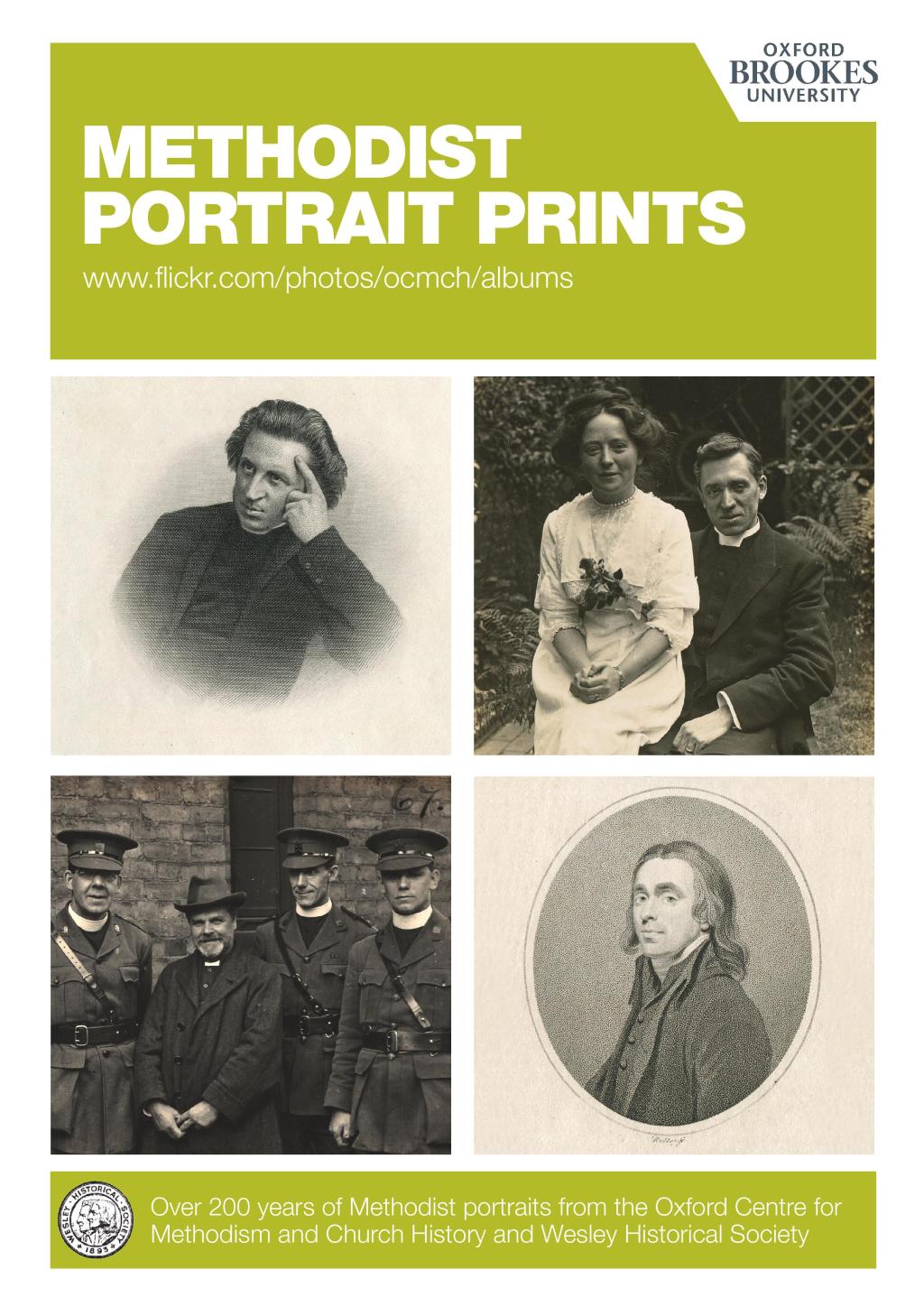
Methodist Portrait Prints provides access to over 2,000 historic portraits dating from the eighteenth to the twentieth centuries. These images chart developments in engraving techniques, to the advent of photography, and beyond. This project draws from the collections of the Wesley Historical Society, and builds on the success of British Methodist Buildings – a digital resource released by the OCMCH in January 2019 that has since been viewed over 300,000 times in less than twelve months
Many of the images in Methodist Portrait Prints are derived from leading Methodist periodicals. From its first publication in 1778, the Arminian Magazine included portrait prints. The Magazine was the initiative and promotional vehicle of John Wesley. In 1798 it became the Methodist Magazine, adding ‘Wesleyan’ to the title from 1822-1932 (when the main British Methodist sub-denominations united), finally closing in 1969. Despite being priced cheaply to achieve wide circulation, the quality of some of the prints is high. These images were often cut out and framed, or mounted into albums, as mementos of the individuals depicted.
Methodist Portrait Prints launched in December 2019. For further updates follow this blog, or find us on Twitter @OCMCHBrookes.
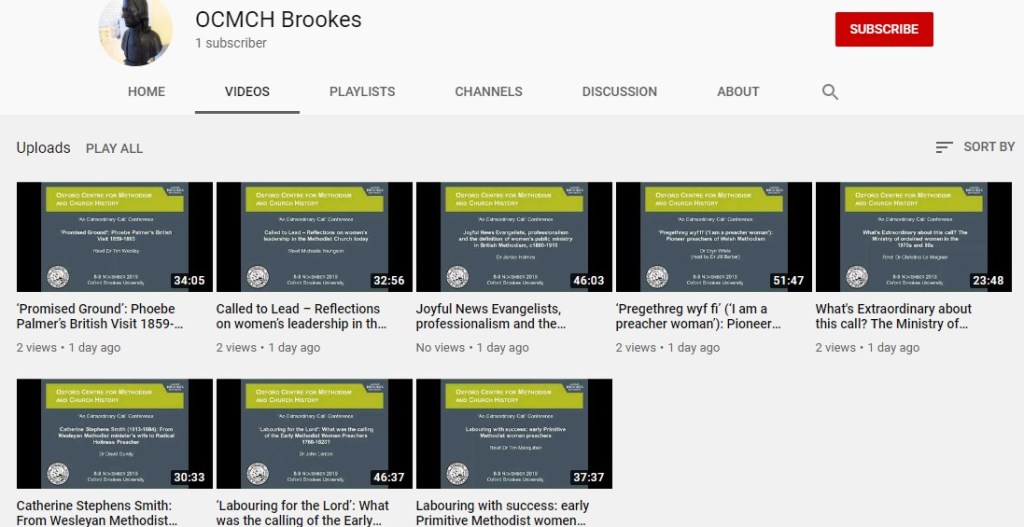
The OCMCH is delighted to announce the launch of our YouTube Channel, accessible here. Look out for recordings of conference papers, lectures, and digitised versions of audio-visual material from our collections.
This launch leads with recordings of a selection of papers from ‘An Extraordinary Call’, a conference on Methodist women preachers in Britain c1740 to the present was held at the Harcourt Hill Campus of Oxford Brookes University on 8-9 November 2019. This event brought together more than 80 people from around Britain, Europe, and the USA. The conference was hosted by the OCMCH, and arranged through the Wesley Historical Society and Susanna Wesley Foundation, being inspired by the 350th anniversary of her birth. Its particular focus was on women who preached, something which was constitutionally forbidden by the Wesleyan Church (except to other women) between 1803-1910.
Recordings are available of papers by Dr David Bundy, Dr Janice Holmes, Revd Dr Christina Le Moignan, Dr John Lenton, Revd Dr Tim Macquiban, Dr Eryn White, Revd Dr Tim Woolley, and the Revd Michaela Youngson.
UK Disability History Month 2019 emphasises the roles of disabled leaders through history and their struggle for acceptance. In this blog post, Professor William Gibson puts the spotlight on an historical figure represented in our Digital Collections who embodies this guiding theme.
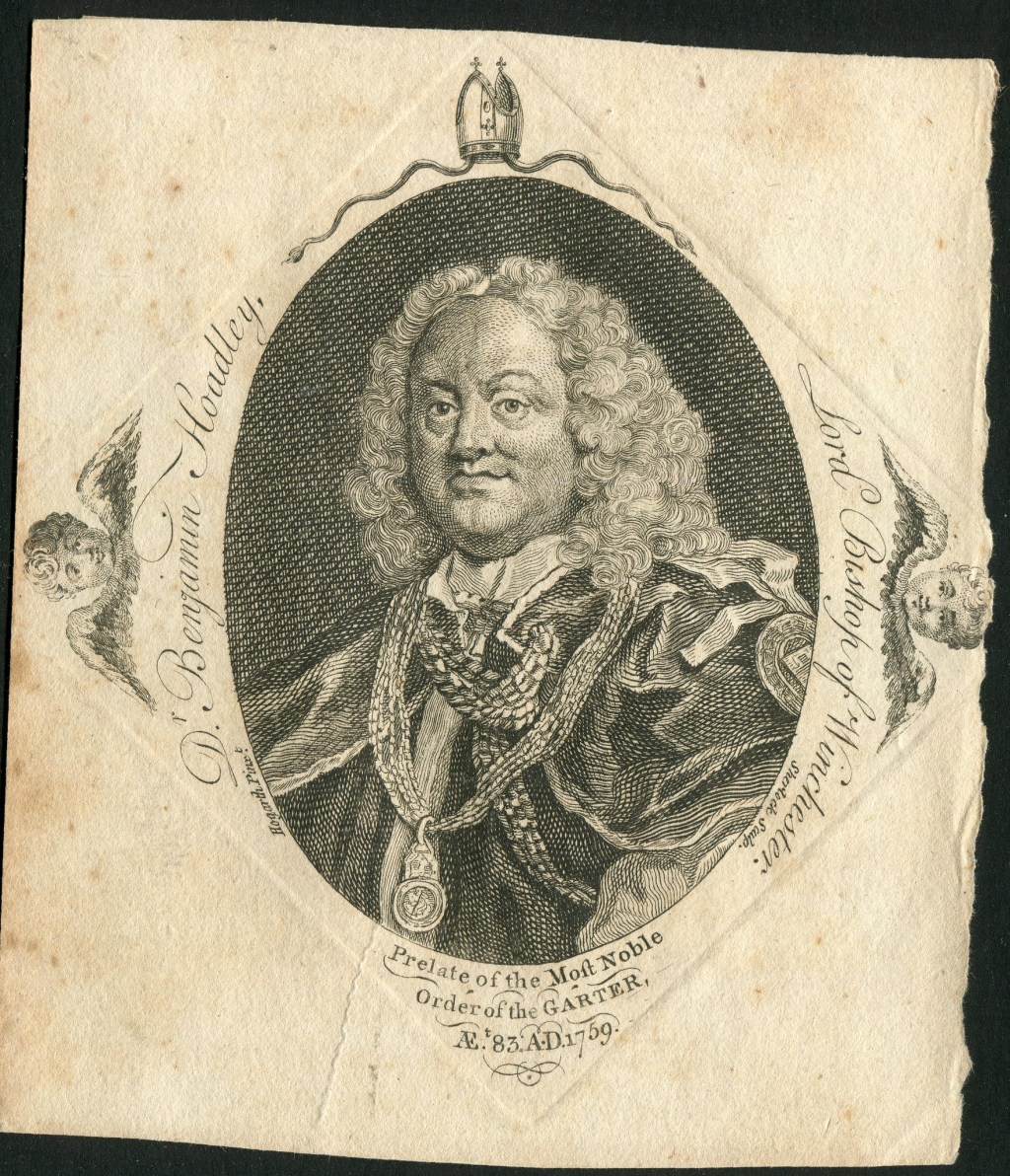
Benjamin Hoadly (1676-1761) is not widely known today, but three hundred years ago he instigated a religious controversy so great that it led to a five-year pamphlet war. The ‘Bangorian Controversy’ (named after Hoadly’s bishopric) focused on the issue of whether the Church could punish clergymen for their views. Hoadly argued it could not, stirring up a fierce debate prompting responses from clergy and lay persons around the country. What was more remarkable about Hoadly as a leading public figure of his time, was that he was disabled.
In 1692, while a student at Cambridge, Hoadly contracted smallpox. The illness was badly treated by an unskillful barber, and it was feared that Hoadly would lose his leg. Fortunately, Charles Barnard (a celebrated surgeon) saved the limb, but Hoadly was left physically disabled for the rest of his life. He used walking sticks in public, and crutches at home; and was forced to pray and preach kneeling on a stool or cushion to relieve strain on his weakened legs. Significantly for the period, this also prevented him from riding a horse. From the time of this illness, Hoadly never enjoyed good health. During his thirties it was feared that he was sinking into consumption. His insistence on taking the air in a chariot, however, which he did every day of his life, helped to keep the deadly respiratory complaint at bay.
Nevertheless, ill-health exerted an influence over much of Hoadly’s adult life. Writing in 1719 to Sarah, Duchess of Marlborough, Hoadly claimed that he had been so ill that his life had been in peril. The following year a bout of fever left Hoadly with red marks on his face so that he could not go out for a week. In 1717 he commented that he was ‘too ill to come out’ of his house, and he seems to have been plagued with colds and headaches. In 1731 he referred to the way he coped with his disability as ‘a man dragging life like a chain behind him’ and thereafter referred to life as ‘the chain.’ Later in life he often foiled requests for preferment on the grounds that he would not live long enough to redeem promises.
Hoadly’s disability was frequently used by his political and religious opponents to satirise him. In 1709, a print titled ‘Guess Att My Meaning’ depicted Hoadly as a follower of Oliver Cromwell, who is shown looking over his shoulder. Hoadly’s crutches are propped against the table, and the text refers to him as a ‘crooked stick’ and a ‘crippled priest’. In the same year, Hoadly (this time carrying a stick) featured in a print that accused him of attacking the Church. And in 1711, Hoadly was depicted with both a walking stick in his hand and a crutch at his feet in ‘The Apparition’.
Despite these deeply personal attacks, Hoadly’s disability did not prevent him from rising to the highest stations of the Church of England. He was a favourite of King George I, and was eventually appointed Bishop of Winchester – one of the most prestigious dioceses in eighteenth-century England and Wales. Remarkably, Hoadly lived until the age of 85 and was pugnacious and controversial to the end. Two years before his death, an attempt was made to defraud the Bishop of £3000, but Hoadly remained wily and sharp, proving in court that the man was a liar.
You can read more about Benjamin Hoadly’s life in William Gibson’s Enlightenment Prelate 1676-1761, Benjamin Hoadly (Cambridge: 2004). To learn about the guiding themes of UK Disability History Month 2019 visit https://ukdhm.org/
This post celebrates the completion of the tagging and labelling of all 4750+ images in the Smith collection on British Methodist Buildings. But who was Bill Smith? And what do we know of his project to photograph Methodist buildings from all over Britain?
British Methodist Buildings: who was Bill Smith?
William Aubrey Smith (1932-2018) was a carpenter and coffin-maker from Dunstable in Bedfordshire. He was a committed Methodist and member of the London and the South-East meeting of the Wesley Historical Society. Other than photography, he also had interests in postcards, philately and coins. Smith did not drive, so all of his photographs were taken having travelled the country by public transport. His voluminous and intricate notes on local bus routes and rail times survive with the collection. Between 1979 and 2007, together with his wife, Jean (who can be seen in many of his photographs), he catalogued and listed churches and chapels he had seen, building up a large card index that accompanies his photo albums.
The Smith Collection at the Oxford Centre for Methodism and Church History
The chronological arrangement of Smith’s photographs allow us to observe his travels, and the expansion of his project over time. Initially, he began documenting buildings in the counties immediately adjacent to his home in Dunstable – Bedfordshire, Buckinghamshire, Greater London and Hertfordshire – all of which are well-represented in British Methodist Buildings.
Smith’s sketch maps and notes on local bus routes
These photographs ‘local’ to Smith are interspersed with shots from his coastal getaways, with buildings appearing from Bournemouth, Brighton, Great Yarmouth, Margate, Portsmouth, and Skegness. Later, Smith toured more extensively through the Midlands and beyond, lending to the strength of the collection in Northamptonshire, Nottinghamshire, Staffordshire, and the West Midlands. The nature of Smith’s travels also explain the bounds of his collection. Aside from a single image for Bowness in the Lake District, Smith’s project took him no further north than Whitby, and only as far west as Somerset.
The completion of work on the Smith collection in British Methodist Buildings marks the first time that this photograph collection of national significance has been made readily-accessible to researchers.
In January 2019, the Oxford Centre for Methodism and Church History will launch an exciting new digitised resource for the study of Methodist heritage.
British Methodist Buildings brings together two major photographic collections from the Centre’s holdings to create an unparalleled visual library of Methodist buildings in Britain. This is the first time these collections have been made fully available, making over 10,000 images freely accessible online.
These photographs represent the labours of two hobbyists: Keith Guyler and Bill Smith. Operating between the 1970s and 2010s (but seemingly unaware of each other’s activities), these two amateur photographers travelled the country documenting many buildings which have since been altered or demolished.
‘Let all preaching-houses be built plain and decent’ – John Wesley
This project showcases Methodist buildings as the vibrant hearts of communities, commemorated by architecture which is sometimes exuberant, at other times plain and functional. The story of each chapel is the story of a community, and whilst some retain an active membership, others have been re-purposed as homes, garages, shops, storehouses, cowsheds, and many other uses.
Central to British Methodist Buildings will be collaboration with our users. We will encourage people to add their personal experiences and recollections to the images. How many do you know? Do you know something of their history? Do you recall a community or family event at a particular building?
British Methodist Buildings will launch in January 2019. For further updates follow this blog, or find us on Twitter @OCMCHBrookes.
The 1930s was a high time for British humour. It was the era of Punch, of 1066 And All That, of saucy seaside postcards, of David Low’s Evening Standard political cartoons: against a backdrop of the rise of Fascism, the Depression and mass unemployment, Britain laughed. It lay the foundation for wartime humour, of I.T.M.A., and humorous propaganda (Fougasse’s ‘Careless Talk Costs Lives’ posters).
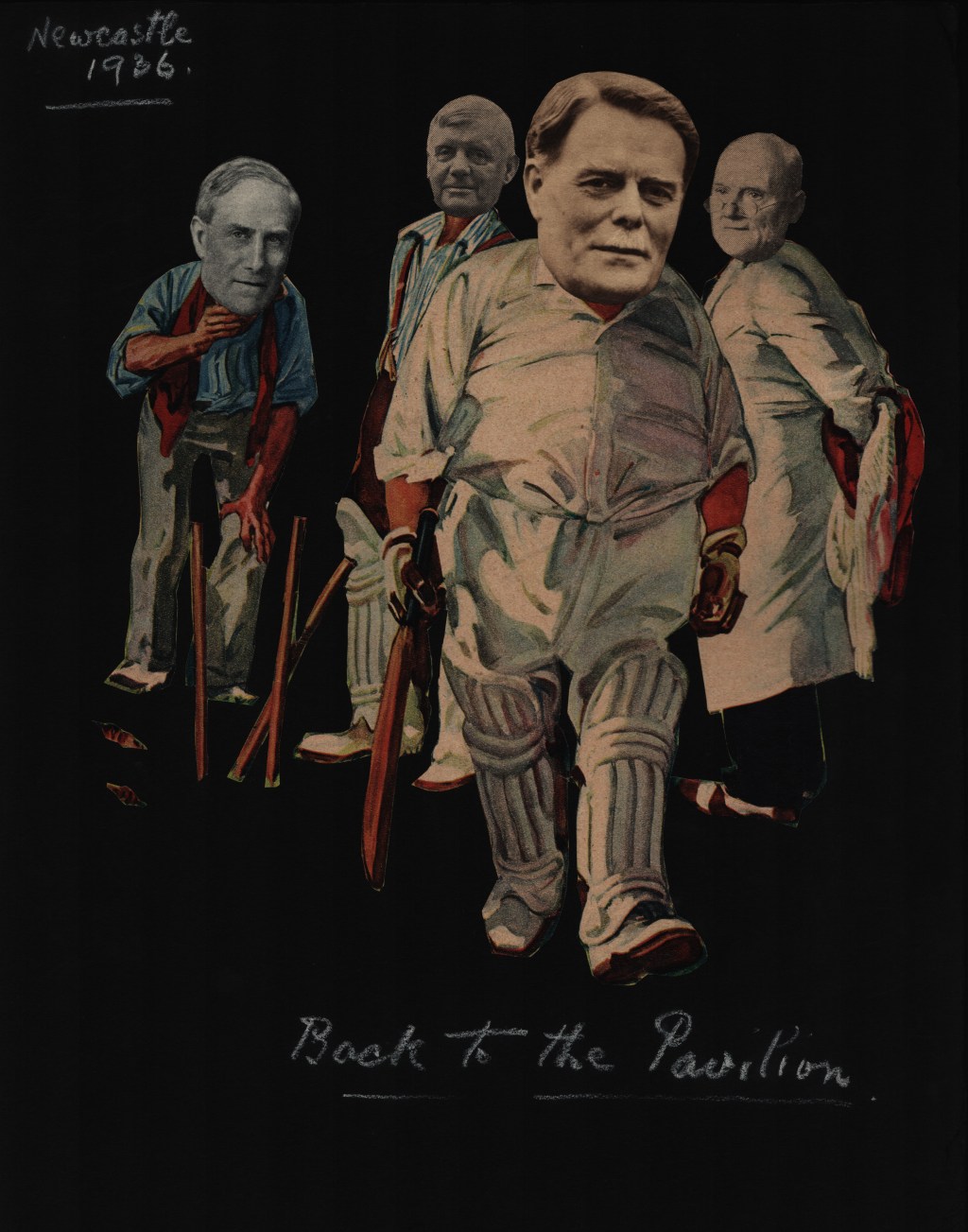
In 1932, the main Methodist denominations in Britain united, trumpeted then – and still – as one of the most successful of church mergers. Although there were dissidents, they were muted. Yet there must have been many who had mixed feelings: one recorded those in a series of over 100 cartoons, now in the Wesley Historical Society library. Some are merely funny, others more barbed and pointedly satirical. The creator is unknown; it seems he (most likely male) was probably a member of the United Methodist Church (itself a merger of three sub-denominations in 1907), then of the Methodist conference until 1936. At least, the internal evidence on the cartoons suggests attendance at the final U.M.C. conference (Bristol, July 1932): the last is dated 1936.
The cartoons comprise (often political) cuttings from newspapers or magazines, with heads of Methodist personages, also cut from publications, superimposed – and then over-drawn if appropriate – and re-captioned. They are mounted on black paper, making them highly visual.
Seems to have forgotten about me. 1933.
They raise all manner of questions: who created them? Were they intended for an audience, and if so, who; or simply for personal pleasure? While many of the Methodist individuals can be identified (such as Presidents or Vice-Presidents of the Conference), many are not so obvious. What were the issues to which the cartoons allude? Where were the original cartoons taken from? One, for instance, from 1933, depicts a Nazi ‘brown shirt’ cudgel raised, with the head of Rev. Dr. Luke Wiseman, incoming President, superimposed. The cudgel (‘Nazism’) is overwritten ‘Presidential Address’ and the (swastika?) armband covered. Nearby are two female figures: ‘Seems to have forgotten about me’ is the caption – women in ministry is a theme of a number of the pieces.
While the cartoons are intriguing in their own right, they open a door to serious research, not only about attitudes to Methodist Union but more broadly about appreciation and use of humour at popular level in society. They hold the potential for contributing to our understanding of grass-roots culture at a time of crisis, perhaps not altogether unlike today.
Dr Peter Forsaith is Research Fellow at the OCMCH. The complete series of Methodist Conference Cartoons form part of the Centre’s digital collections which will be available soon.