Categories
Uncategorized

New collection added to British Methodist Buildings

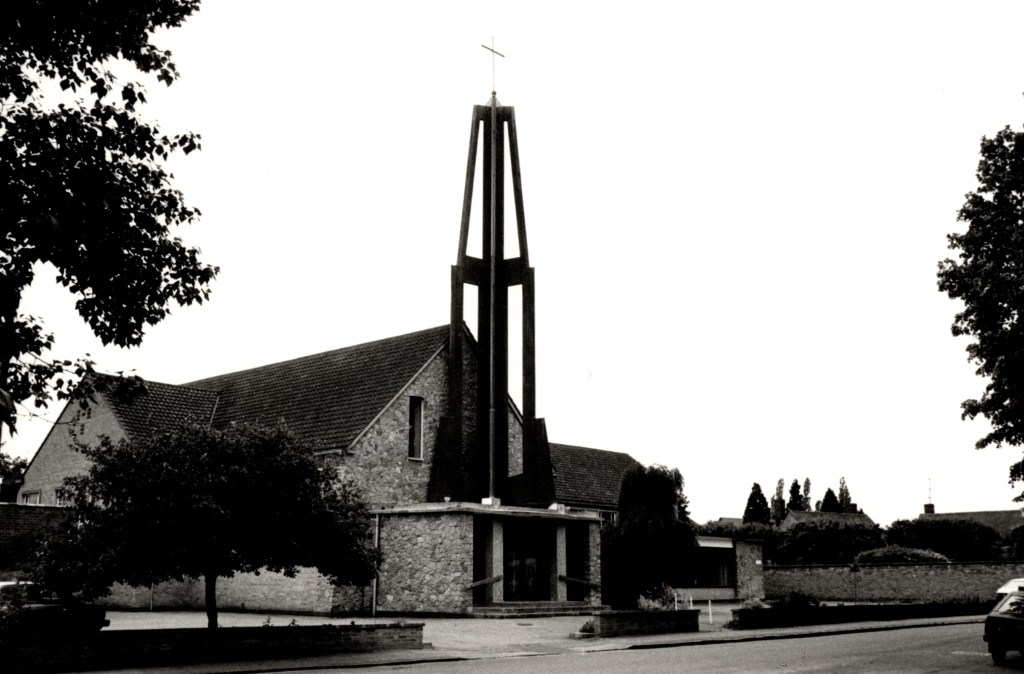
In April 2025, a new collection was added to the British Methodist Buildings project – these 167 photographs originated with the former Home Mission Division of the Methodist Church in Britain. They were discovered during the clearance of Methodist Church House in London and were subsequently deposited with the Oxford Centre for Methodism and Church History.

The first Home Mission committee were formed in 1856 with the aim of confronting distinct challenges in both rural and urban areas. The Home Mission Division was established in 1973 and became part of the Connexional team in 1996.

These high-quality photographs mostly date between the 1960s and 1980s (with some much earlier) and are typically in striking black-and-white. For the most part they are earlier in date than the majority of images already in British Methodist Buildings, so broaden the chronological scope of the project and provide updated views of many churches and chapels – some of which have long since been altered, demolished, or repurposed.

British Methodist Buildings is an unparalleled visual gallery of Methodist buildings in Britain coordinated by the Oxford Westminster Research Network. The project launched in 2019 and features almost 12,000 images that have been viewed over 850,000 times. Explore this new collection now by following this link.

Categories
Uncategorized

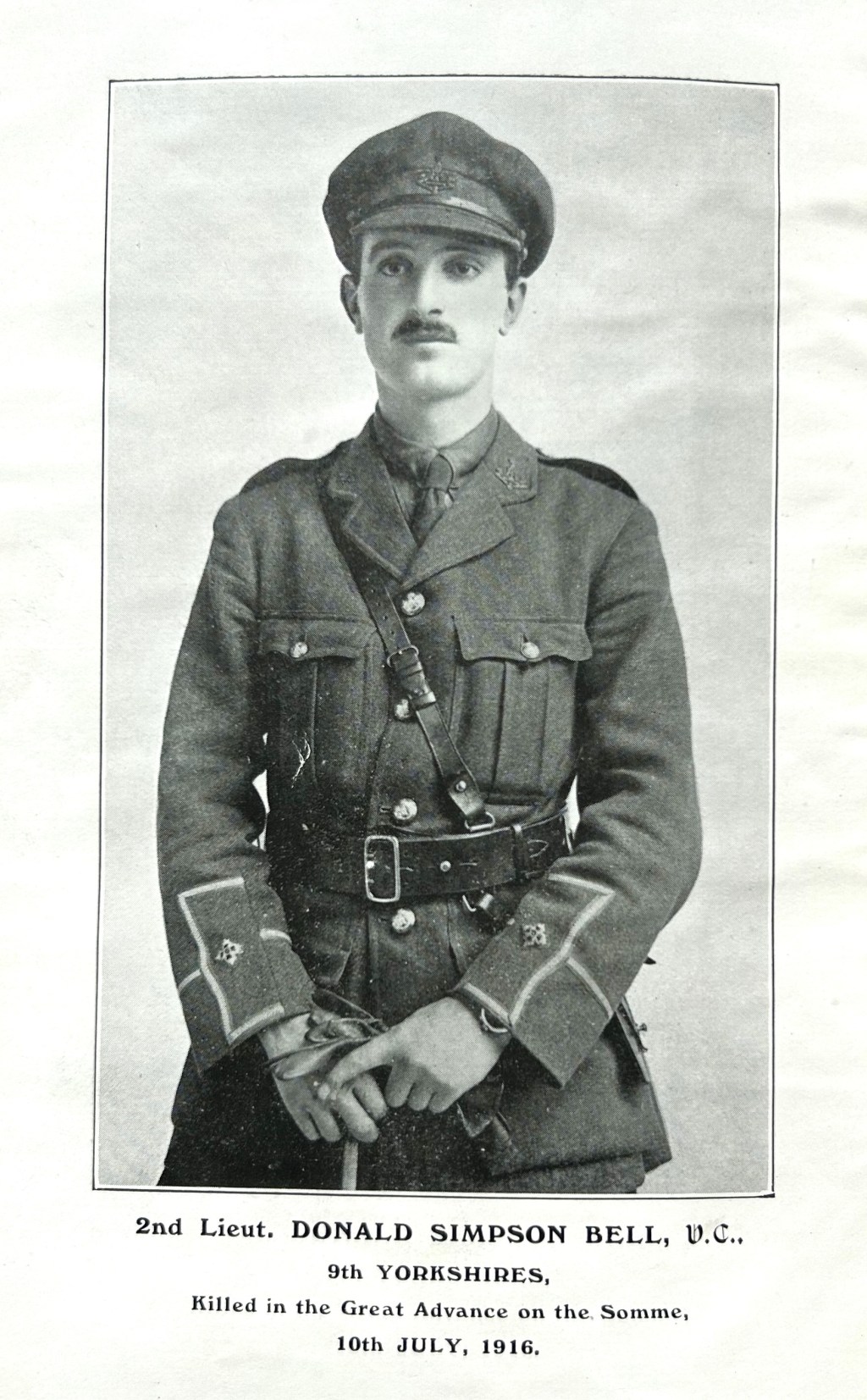
Research – Donald Simpson Bell, VC (1890-1916)

(D. S. Bell at Westminster Training College, 1909-11)

Donald Simpson Bell (1890-1916) was born into a family of Wesleyan Methodists in the North Yorkshire spa town of Harrogate on 3 December 1890. The youngest son of Smith and Annie Bell, he attended St. Peter’s Church of England Primary School as a child before continuing his education at Harrogate Grammar School.

In 1909, Bell left Yorkshire and moved to London to train as a teacher at Westminster College. A naturally gifted athlete, he excelled at many sports and quickly forged a fine reputation for himself in college sporting circles. He was an accomplished cricketer, a lightning quick sprinter and a talented hockey player. Standing over six-feet tall and powerfully built, he was also competitive in the swimming pool and fearsome on the rugby field.

Westminster College 1909-10 colours cap (top left) cutting from principal’s log book,
15 May 1911 (top right) Westminster Training College Fifth Inter-Year Athletics Sports programme, 15 February 1910 (middle) programme, 14 February 1911 (below)

Football was his first love, however, and Bell had already impressed in Yorkshire’s amateur leagues before emerging as one of the stand-out players in the Westminster XI. His talents were also recognised by Southern League side Crystal Palace who gave him the opportunity to turn out for them as an amateur while he studied in the capital.

Bell eventually returned to his native Harrogate in 1911 to take up a teaching role at Starbeck School. Nevertheless, football continued to occupy a significant part of his life and he had brief spells with Newcastle United reserves and Bishop Auckland before helping Mirfield United retain the West Riding Junior Cup in 1912.

Bell’s growing reputation soon caught the attention of Bradford Park Avenue and the second division club were eventually persuaded to offer him his first professional contract, which he signed in October 1912 in order to supplement his modest teaching salary.

After establishing himself in the second string, Bell made his Football League debut against Wolverhampton Wanderers at the end of the 1912/13 season and would go onto play a further four league games the following season as Avenue secured promotion to the English top flight. Although his first team appearances were limited, Bell was a regular fixture in the reserve side and he impressed sufficiently to suggest he had a promising future ahead of him.

Unfortunately, his burgeoning football career was cut short soon after the outbreak of the First World War when he asked Avenue to release him from his contract so he could answer Lord Kitchener’s call to arms. This was duly agreed and Bell enlisted as a private in the 9th West Yorkshire Regiment in November 1914.

Bell was a natural soldier and he was soon persuaded to apply for a temporary commission after a chance meeting with former Harrogate Grammar school friend Archie White, who was then serving as a Lieutenant with the 6th Yorkshire Regiment, also known as the Green Howards. Bell’s application was subsequently approved and, after completing office training, he eventually embarked for France where he joined the 9th Green Howards as a second-lieutenant in December 1915.

Bell’s first taste of life in trenches came in a relatively quiet sector of the line near Armentieres, however, his battalion eventually moved south ahead of the British offensive on the Somme in the summer of 1916. As part of 69th Brigade, 23rd Division, the battalion were held in reserve on the bloody opening day of battle but they were soon thrown into the maelstrom when they were ordered to assault a German position called Horseshoe Trench on 5 July.

Unfortunately, the attack ran into difficulties almost immediately as the exposed Yorkshiremen were raked by withering enemy machine-gun fire soon after clambering from their trenches and quickly began taking losses. At this critical moment, 2/Lt Bell took decisive action and set off towards the machine-gun along a communication trench with two men from his bombing party, Corporal Colwill and Private Batey, following quickly behind. When the trio had closed to within twenty yards of the gun, they suddenly leapt out of cover and made an audacious charge across the open, straight towards the startled enemy.

Bell first managed to kill the soldier firing the gun with his revolver before launching a well-placed Mills bomb that succeeded in destroying both the gun and the remaining members of the gun team. The three men then proceeded to clear out a number of dugouts with the aid of further Mills bombs. With the deadly threat on their flank removed, the Green Howards surged across no-man’s land and down into the German trenches, where they were soon able to secure their objectives.

Bell’s quick-thinking and gallantry proved critical to the eventual success of the British attack on Horseshoe Trench that day and undoubtedly saved the lives of many soldiers. Nevertheless, Bell was a reluctant hero and he was characteristically modest about the incident when he wrote to his mother soon after, telling her dismissively: ‘I must confess that it was the biggest fluke alive and I did nothing… I chucked the bomb and it did the trick.’

Tragically, that letter would prove to be the final correspondence between the pair. Five days after the attack on Horseshoe Trench, Bell was cut down leading a similarly dramatic bombing attack against the enemy during the fight to capture Contalmaison. He was twenty-five-years-old and left a widow, Rhoda, who he only married four weeks earlier during a short period of leave. After his death, the popular subaltern was buried close to where he had fallen at the southeastern end of the village and a wooden cross later placed on his grave. A nearby position was also named Bell’s Redoubt in his honour.

Westminster Training College Monthly War Bulletin, no. 22 (1 August 1916)

News of Bell’s death prompted an enormous outpouring of grief at home and a flurry of emotional tributes soon followed. Among them was one published in the Westminster Training College Monthly War Bulletin which said of their former student:

At college, Bell had been Captain of Athletics, and a member of the first eleven at cricket, Association football, and hockey. He had also represented the College at swimming and Rugby football, and was in fact one of the best all-round athletes that Westminster has ever produced .[i]

Westminster Training College Monthly War Bulletin, no. 24 (1 October 1916)

There were also tributes from his battalion, including one from his commanding officer, Lieutenant-Colonel Holmes, who told Bell’s parents that their son was ‘a great loss to the Battalion and also to me personally, and I consider him one of the finest officers I have ever seen’[ii]

Another officer said Bell ‘knew no fear’ and added ‘he had the courage of a lion, and always seemed to be on the lookout for ways and means of making things easier for his comrades.’[iii]

Archie White, meanwhile, who remarkably would also be awarded the Victoria Cross for deeds at Stuff Trench less than three months after Bell’s death, wrote of his old school friend: ‘Probably no one else on the front could have done what he did… He was a magnificent soldier.’[iv]

On 9 September 1916, the London Gazette announced that Bell had been awarded a posthumous Victoria Cross for his actions at Horseshoe Trench on 5 July. He was the first and only English professional footballer to receive his country’s highest decoration for gallantry during the war. The citation read:

For most conspicuous bravery. During an attack a very heavy enfilade fire was opened on the attacking company by a hostile machine gun. 2nd Lt. Bell immediately, and on his own initiative, crept up a communication trench and then, followed by Corpl. Colwill and Pte. Batey, rushed across the open under very heavy fire and attacked the machine gun, shooting the firer with his revolver, and ‘destroying gun and personnel with bombs. This very brave act saved many lives and ensured the success of the attack. Five days later this gallant officer lost his life performing a very similar act of bravery.[v]

Westminster Training College Monthly War Bulletin, no. 24 (1 October 1916)

On 13 December 1916, Rhoda Bell travelled to Buckingham Palace to receive her late husband’s award from King George V. She was accompanied on her visit to London by his sister, Minnie, and the pair were photographed outside the palace gates following the ceremony. Corporal Colwill and Private Batey, meanwhile, later received the Distinguished Conduct Medal in recognition of their bravery on 5 July. Unlike Bell, both men survived the conflict and lived into old age.

After the War, Bell’s body was moved from its original resting place and reburied at Gordon Dump Cemetery in the valley below the village of La Boisselle. Perhaps fittingly, the gallant young officer now lies just a few hundred yards from the site of his heroic action at Horseshoe Trench.

D. S. Bell VC memorial window in Westminster Chapel, Harcourt Hill Campus

Bell is commemorated on a number of memorials, including one at the Wesleyan Chapel in Harrogate and others at St. Peter’s Church of England Primary School and Harrogate Grammar School. There is also a beautiful stained glass window in the chapel at Oxford Brookes University at Harcourt Hill that honours the former Westminsterian.

In 2000, a memorial sponsored by the Players Football Association (PFA) and the Friends of the Green Howards Museum was erected on the site of Bell’s Redoubt to commemorate the gallant young officer. Almost one decade later, the PFA also bought his Victoria Cross and campaign medals at auction and they are now on display at the National Football Museum in Manchester.

Iain McMullen

Images from the Westminster College Archives provided by OCMCH staff, many of which can be viewed online through our Digital Collections page here


[i]       F. C. Pritchard, The Story of Westminster College, 1851-1951, p. 125

[ii]      Letter to Smith Bell. Bell Family Archive.

[iii]     Harrogate Herald (9 May 1917)

[iv]     R. Leake A Breed Apart, p. 84

[v]      The London Gazette (9 September 1916)

Categories
Uncategorized

Archives Spotlight: Westminster College and the Australian Imperial Forces, 1914-18

On 4 August 1914, Britain declared war on Germany. The First World War raged for over 2,000 days before coming to a halt on 11 November 1918, and killed 880,000 members of the British forces, including 102 alumni of Westminster College. This amounted to 6% of the adult male population of Britain at the time, and it took much of the following decade for the College to recover.[1] Greatly reduced, Westminster was evacuated from London to Richmond College, the Wesleyan theological institution. In the second of our collection highlights, we explore what happened at the Westminster College site during the First World War, and its connections with the Australian armed forces.

Westminster College Archives. A/3/c/2, Principal’s log book, 1911-14.

In July 1914, H. B. Workman closed his Principal’s log for the year by recording that ‘College finally went down’, suggesting that he was pleased to have reached the end of a long term![2] What he did not realise, however, was that he would be summoning groups of College men back to Horseferry Road in a matter of weeks so that students would be together if they chose to enlist.[3] The College continued to operate from London for twelve months, albeit it with a reduced cohort. The following year saw the College re-open in September 1915, only to be relocated to Richmond at the start of term. Workman later recalled,

I had finished my inaugural address to the new students on the morning of Thursday, 23rd September, and was about to go on with the usual routine of the day — the signing of indentures and so forth — when there came an urgent call for me at the telephone. It was from H.M. Office of Works to state that the Government of the Commonwealth of Australia were anxious to take our College as their military headquarters, and that officials would be round within the hour to survey the premises. They came, and before lunch the matter was practically settled: all that was left being the discussion of certain terms and conditions. They asked me to summon at once our various Committees. These duly met on the 30th September and unanimously approved the proposal. The Executive Committee of the Richmond Branch of the Theological Institution also unanimously and, with great graciousness, approved a proposal to hand over Richmond College to us and to transfer their students to Didsbury, Manchester. Within a week of the proposal first being mooted, the Australian Government were already beginning to lay down telephone wires and in other ways to effect the great change.

The College would remain at Richmond, and the Australians at Horseferry Road, until 1919. In his wartime memoirs James Green recorded that ‘Horseferry Road has its special place in our records’, before listing its achievements in both peace and war.[4] As the administrative headquarters for the Australian Imperial Forces, the College buildings were always extremely busy, with thousands of servicemen visiting the College buildings each week. Outside of the main College buildings, a sign labelling them as the ‘Australian Military Offices’ was erected, opposite a YMCA hostel ran by Mrs Workman (also in College buildings).

Westminster College, Victory Bulletin, No. 49, Vol. V, No. 1 (December 1918), p. 10.

A Union Flag was placed in the middle of the Principal’s Quad, and a cannon added in its corner. Inside the buildings, Captain H. C. Smart organised offices which financed the Australian war effort, and also kept track of convalescents being returned from France. Smart ‘organised a records office, employing a few military supervisors with a large number of girls, whose labour was as effective as that of the soldiers, and much cheaper’.[5] They were surrounded by the trappings of College life – ‘working in libraries surrounded by memorial busts and bronzes of old Masters, Tutors, and Scholars. They see hundreds of clerks working in lecture-halls, class-rooms, or College Chapel’.

A parade presentation of Australian Comforts Fund Christmas gifts at the main building of Administrative Headquarters, AIF, Horseferry Road https://www.awm.gov.au/collection/C364528

This flurry of activity did not go unnoticed: George V and Queen Mary visited in October 1917, inspecting a contingent of recovering Australian men.[6] Following the cessation of war in 1918, Westminster College memorialised its former students through a series of panels in its Chapel; the alumni society did the same for its members through the installation of an organ; and the Australians contributed a brass plaque to be set up in the buildings. Today, there is another plaque recording the College’s use by Australian forces, and it was believed that this plaque was long since lost – either during the Second World War, or left behind when Westminster moved to Oxford in the 1950s. But it has recently been rediscovered at the Harcourt Hill campus, hidden for the past twenty-five years.

These College Premises were used as

A.I.F. Administrative Head Quarters

during the Great War 1914-1918

by the

Australian Imperial Forces,

of 330,000 Men.

More poetically, James Green closed the Horseferry Road section of his memoir by noting that, ‘to Horseferry Road the Australian came gladly, leaving it regretfully for war again; and when the war is over it will be a kindly memory. In close proximity to Westminster Abbey and the Houses of Parliament, where so many bonds of Empire are forged, the old Westminster Training College will continue to do its useful part in Empire building’.

ANZAC Day on 25 April is the national day of commemoration of Australia and New Zealand for victims of war and for recognition of the role of their armed forces. You can view more wartime records from the Centre’s collections, here.


[1] https://www.parliament.uk/business/publications/research/olympic-britain/crime-and-defence/the-fallen/

[2] Westminster College Archives. A/3/c/2, Principal’s log book, 1911-14.

[3] Pritchard, The Story of Westminster College (1951), p. 110.

[4] https://www.gutenberg.org/cache/epub/67351/pg67351-images.html

[5]https://www.awm.gov.au/collection/C2130826#:~:text=The%20Horseferry%20Road%20offices%20(formerly,High%20Commissioner%20in%20October%201915.

[6]https://www.google.com/url?q=https://www.awm.gov.au/collection/C364528?image%3D2&sa=D&source=docs&ust=1713886293620759&usg=AOvVaw0QxFkYnJSg98qIPYRWUPMj

Categories
Uncategorized

Archives Spotlight: International Women’s Day profile – Sarah Smetham (1828-1912)

SME/1/13, James Smetham, ‘Sarah Smetham and Baby John’, 1855, oil on canvas

This blog post is the first instalment in a series of regular Archive Spotlights, exploring stories from the Centre’s rich historic collections of archives, artworks, and printed works – and we begin with a International Women’s Day feature.

Sarah Smetham (née Goble) was born in October 1828, and baptised at the Wesleyan chapel in Milton next Gravesend in Kent. Her mother was the first of the family to join the Methodist society in that town, and her earliest quarterly ticket – preserved by Sarah throughout her life – dated to June 1815, the same day as the Battle of Waterloo. The Methodists in Gravesend were much ‘despised’ at that time, and this caused a breach in the family. Sarah’s mother gave up the fancy clothing of her youth and adopted the ‘plain cottage bonnet’ of the class. It was through the society that she met her future husband (Sarah’s father), though her family did not immediately approve of the union.

In Sarah Smetham’s early childhood, the family relocated to the village of Green Street Green some five miles away, where her father established a Sunday School class in their kitchen. They were also friendly with the local Anglican minister, who allowed Sarah to teach a babies’ class from the tender age of eight; ‘so I began the work of my life at a very immature age’. The family returned to Gravesend on her father’s death in 1839, and there she took all opportunities to educate herself by reading philosophy and science. At eighteen, Sarah was considered a strong candidate for further teacher training, and so following preliminary examinations, and with the consent of her mother, she embarked on the long journey to Glasgow to attend the Free Church Training College in preparation for a teaching career. At that time, this was the only option available for Methodist educators.

SME/1/7/1, ‘Letters and Reminiscences’,
[c. 1840s]- [20th cent.]

Sarah soon came to the attention of the Rev. John Scott, who remarked that she gave ‘the best Bible lesson he had ever heard.’ With plans in motion to create a Methodist teaching training college in London, Sarah was appointed to the infants school in Westminster, which in 1851 was attached as a practising school to the newly-established Westminster Training College. She later reflected on her role in the early successes of the College, with Scott at the helm as it’s first principal,

London was crowded with visitors from all parts of the world and many of them found their way to the new College of Methodism … scarcely a day passed in which, without any warning, Mr. Scott would come in with a party, and desirous of showing off his pet schools to advantage would say in his suave way “Now Miss Goble will you kindly put the children in the Gallery and give them a lesson.”

The move to Westminster also quickly brought about the other most significant connection in her life. In that same year, the thirty-year-old artist James Smetham was appointed drawing master to the College. Almost fifty years’ after the event, Sarah recalled their first encounter in reminiscences for her children,

The first time I saw your father was on July 4th 1851. It was about half past four in the afternoon, the children had gone home and I was standing talking with Mr Langler by one of the windows which commanded the school entrance when he entered and crossed the playground to the College (then near its completion)… I little thought I should one day know him so well.

SME/1/7/1, ‘Letters and Reminiscences’,
[c. 1840s]- [20th cent.]

The couple married in 1854, and over the next decade the family grew to include six children. At this time, James Smetham was moving on the periphery of Pre-Raphaelite circles and could count Ford Madox Brown, Gabriel Dante Rossetti, and John Ruskin among his friends. But, James’s art was never consistently financially viable and he struggled with profound mental health issues that affected his ability to work. Sarah remained her husband’s constant supporter and solace during these periods, and it frequently fell to her to provide for the family with her teacher’s salary.

This pattern persisted until the late 1870s, when James Smetham’s mental health collapsed for the final time. He became unable to work, or create artworks, and barely spoke for the final decade of his life. For many years before his death in 1889, he resided away from the family in lodgings where he could receive round the clock care.

Following her husband’s death, Sarah Smetham became a champion for his artistic and creative legacy. She oversaw the publication of James’s letters and literary endeavours, and curated and embellished his partially-realised projects – including a series of Bible Studies that was greatly admired by Ruskin.

SME/1/5/1, ‘Bible Studies by James Smetham’, 1847-1900

This continued into the final years of her life, as a new generation became interested in James Smetham’s artworks. When a series of previously-unpublished letters by her late husband appeared in the Wesleyan-Methodist Magazine in 1903, Sarah reached out to their editor directly,

I presume it is by some relationship to Mr Winders of Selby that the letters have come in to your possession… I am grateful to you for making them public. Had I had them when the volume was in preparation I should have included them

Sarah also permitted the loan of a treasured possession, her husband’s pocket New Testament which he had illustrated with his characteristic ‘squarings’, hoping it would meet with those ‘who have some memory of my dear husband.’ She also added,

I have always regretted that in the volume of the Letters more expression was not given to the Art side of his life. I wanted it at the time but the difficulties were great.

Sarah Smetham died in 1912. She belonged to a generation at the very forefront of Methodist teacher training expansion in the mid-nineteenth century, and – more particularly – was among the very first women to qualify under the new government examinations at that time. Her story is entwined with the first days, and earliest successes of, Westminster Traning College. It was there, of course, that Sarah also met her husband James. And we are indebted to her for the preservation and continued survival of many of his artworks and manuscripts that now form the Smetham Collection at the Centre.

To learn more about the Centre’s Smetham Bicentenary Project, click here

Categories
Uncategorized

Research – Seely and Paget project newsletter

Alongside English Heritage and other partners, Dr Peter Forsaith and Tom Dobson of the OCMCH are leading on a project to celebrate the centenary of Seely and Paget, architects. From the 1920s to the 1960s, the partnership of John Seely (later 2nd Baron Mottistone) and Paul Paget was notable for their close personal relationship as well as for their architectural work. Their melding of traditional and new styles and materials was already becoming unfashionable at the time, and was eclipsed by the modernity of the 1960s onwards. This work is now being re-evaluated, however, including viewing them as early practitioners of conservation architecture. 2026 marks the 100th anniversary of the partnership’s registration with R.I.B.A., and will be a focal point for many of the project’s outcomes.

Download the project newsletter, now:

Seely and Paget, Architects – issue 1 (March 2022)
Seely and Paget, Architects – issue 2 (September 2022)

Categories
Uncategorized

Women’s History Month – Margaret Birchall, Southlands College student in the early 1870s

In 1873, Margaret Birchall received the news that she had been placed 86th in the 1st Class in the results of the Queen’s Scholarship Examination.[1] After a five-year apprenticeship as a pupil-teacher at the Windsor Street Wesleyan and Sunday School, Toxteth, Liverpool, the results of this examination qualified her to take up a place at a teacher training college on a grant if her circumstances allowed.[2] They clearly did, as she was also informed that she should enter Southlands College on 7 February, where she studied between 1873 and 1874.

Windsor Street Wesleyan and Sunday School, Toxteth, Liverpool (photo credit: Helen Watt)

Born in 1852, Margaret was the daughter of James Birchall, who ended his time working for the London and North-Western Railway as Outdoor Superintendent of the Goods Station, Park Lane, Liverpool, and his second wife, Margaret, née Sayer. It is not known when the family had become members of the Methodist Church, but they had certainly done so by 1850, when the couple’s second-eldest daughter was baptised in the local Wesleyan Methodist Chapel.[3]

Hudson Family Collection. Postcard of Southlands College, Battersea, 19th cent.

Therefore, it was probably only natural that Margaret should attend Southlands Training College, founded on 26 February 1872 only around a year before her entrance, as a Methodist teacher training college for women.[4] As the college was then in Battersea, it must have been a big step to travel from Liverpool to London to take up her place.

Westminster College Archives. Wesleyan Education Committee register of teachers (extract, 1873)

Nevertheless, it so happened that John Newton Hudson (1853-1933), a fellow pupil-teacher in Liverpool and her future husband, had been appointed Second Master at Kentish Town Wesleyan School in 1871. He was to stay there until 1874, so that the couple were in London at the same time while she was at college. Also, it is clear that her time at Southlands must have been very important to her, as she kept several items relating to her course and companions there.[5] These include her books of lecture notes on Theology; Domestic Economy, and Paraphrase, as well as books of maps relating to the British Isles and the world, extremely carefully produced, with accompanying details.

Hudson Family Collection. World geography exercise book, 1874 (OCMCH Digital Collections)

Besides these, she retained her ‘Friendship’ Album, containing many inscriptions and drawings by fellow students, including an entry by Rev. G. W. Olver, Principal of Southlands College. Besides a picture of Rev. Olver given to Margaret in 1874, her family photograph album contains many carte de visite-style photographs of young women, probably also dating from the 1870s. Since many were taken at the London Stereoscopic and Photographic Company, which had studios in Regent Street and Cheapside, these images may prove to be portraits of some of those fellow students.

Photograph of the Rev. G. W. Olver, c1874 (OCMCH Digital Collections)

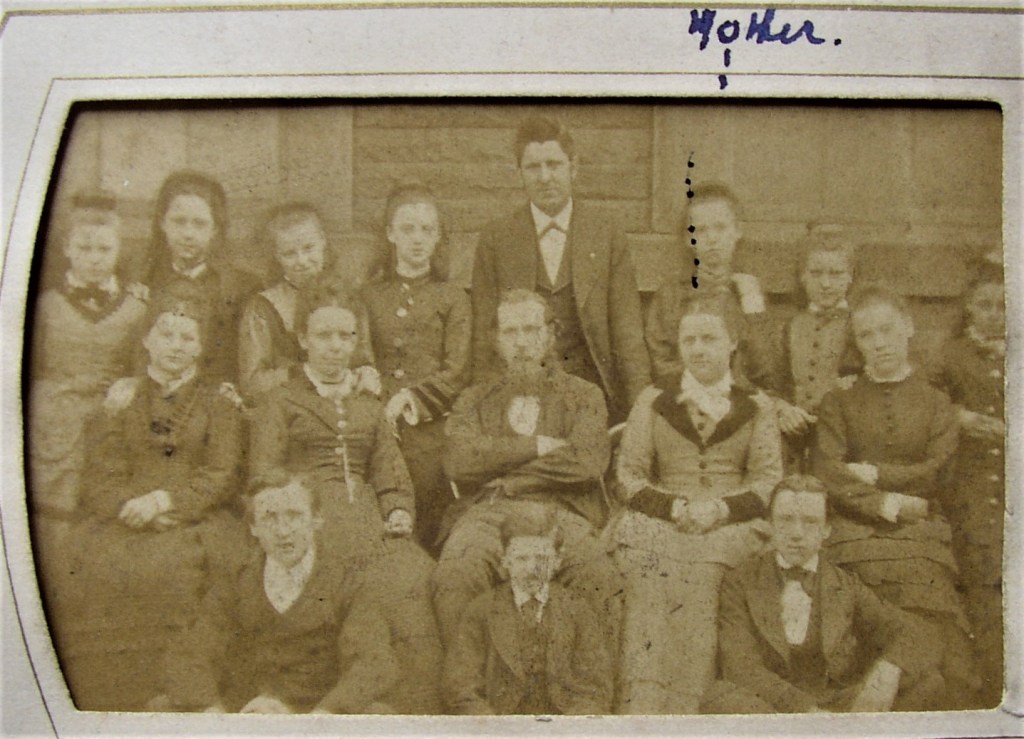
After finishing her training in London, Margaret returned to the north-west. By December 1874, she had passed her probation as a teacher at Mount Pleasant Wesleyan Infant School, Bacup, near Rochdale in Lancashire, and was headmistress there for more than two years.[6] Another family photograph album includes a picture of her, identified by her daughter, Marian Hudson (also a teacher), in a group portrait, perhaps dating from that her time.

Group photograph including Margaret Birchall, c1870s (photo credit: Helen Watt)

While she was still teaching, Margaret kept a diary with entries dating between 1876 and 1877.[7] From these notes, we gain an impression of her life as a teacher, including her satisfaction that ‘all my girls got excellent again’ (entry for 4 February 1877) and her growing relationship with John. We can also see something of her spiritual development, showing perhaps how hard she was on herself in trying to live an upright, Christian life. Also mentioned in the diary are various family members, including her parents and all but one of her sisters: Sarah; Mary; Caroline (Carrie), and Alice, as well as John’s step-sister, Annie Reynolds.

Margaret Birchall Diary, 1876-7 (OCMCH Digital Collections)

However, a connection with Southlands College also appears, as the last note (entry for 5 February 1877) records receiving a postcard for her birthday (the previous October) from Rev. Olver, with a touching reference from the Bible to Numbers VI, 24; 26 (‘The Lord bless thee, and keep thee:’ and ‘The Lord lift up his countenance upon thee, and give thee peace.’).

The diary also notes that Margaret covenanted at Mount Pleasant Wesleyan Chapel in Bacup in 1877. After her marriage to John in April of that year, Bacup is where they made their first home, with John as Headmaster of Bacup Britannia Wesleyan School for the first eleven years of their time there.

Postcard of Mount Pleasant Wesleyan Chapel, Bacup, Lancashire, 19th cent. (photo credit: Helen Watt)

On her marriage, Margaret did not entirely give up teaching, as she taught women in the Sunday School at Mount Pleasant, and was also at one time or another a Junior Class Leader; member of the Leaders’ Meeting; Bacup Circuit Stewardess, and member of the War Relief Committee during the First World War.[8] She may also have kept in touch with at least one friend from Southlands, as can be seen in a letter received from her in 1888.[9]

Hudson family group photograph, 1927 (photo credit: Helen Watt)

Except for a few years in Padiham, Margaret and John continued to live in Bacup with their growing family for a further period until John’s retirement in the early 1920s. They then moved to Manchester where they can been seen in a family photograph taken to celebrate their Golden Wedding Anniversary in 1927. They are surrounded by their five surviving children, three of whom were also teachers, and the remaining two, a Methodist Minister and a doctor respectively. Also present were their two daughters-in-law, one of whom had also been a teacher, and their four young grandchildren. Later, these children would include a Methodist Minister; a Methodist Missionary in China, and a piano teacher. Sadly, Margaret died of a stroke a few months after the anniversary. Although an enduring memory of her was that ‘her influence was always on the side of righteousness’, as Mrs Hudson, she was also remembered with respect and affection in the Bacup Circuit as well as in the town.[10]

Helen Watt, February 2022


[1] Now part of the Hudson Family Collection at the OCMCH.

[2] Jenny Keating, ‘Teacher training – up to the 1960s’, History in Education Project, Institute of Historical Research, University of London, December 2010, available via the website of the IHR web archives https://archives.history.ac.uk/history-in-education/ (accessed 19 Feb 2022).

[3] Baptism of Mary Birchall, 29 December 1850, in the records of Mount Pleasant Wesleyan Methodist Church/Pitt Street Wesleyan Methodist Church, available at https://www.findmypast.co.uk/transcript?id=PRS%2FLIVERPOOL%2FBAP%2F1062357 (accessed 19 Feb 2022).

[4] See the history of the college, available at https://www.roehampton.ac.uk/colleges/southlands-college/history/ (accessed 19 Feb 2022).

[5] Now part of the Hudson Family Collection at the OCMCH.

[6] Parchment certificate of Margaret Birchall in the Hudson Family Collection; Obituary, Mrs Hudson (née Maggie Birchall), 1873-74, from the dates, perhaps in a publication of Southlands College.

[7] Also preserved among the family papers, with later entries by Marian Hudson dating from 1966.

[8] Obituary.

[9] Now part of the Hudson Family Collection at the OCMCH.

[10] Ibid.

The Hudson Family Collection is currently being catalogued and at the Centre. Some items from this collection can be accessed online at OCMCH Digital Collections. For more information about International Women’s Day at Oxford Brookes University, click here.

Categories
Uncategorized

Archives & Library – “Long may She Reign”: Westminster College and its relationship with Royalty 

On 6 February 1952, HRH Princess Elizabeth was proclaimed as Elizabeth II: Queen of Great Britain, its remaining Empire, and the rapidly growing Commonwealth. Westminster College, located as it was in the heart of London, was within earshot of the tolling of Big Ben as part of the King’s funerary procession on the 15th of the month, just nine days later. This February marks seventy years since the Queen’s accession to the throne, and the start of her Platinum Jubilee year. To mark this occasion, we explore the relationship between Westminster College and royalty which, throughout its operation, saw the rule of six monarchs from Queen Victoria to Elizabeth II.

Westminster College first opened its doors at 130 Horseferry Road in October 1851: the year of the Great Exhibition. Writing in The Westminsterian in 1947, one student records that its gatehouse was ‘carved with the Imperial Initials’ of Queen Victoria, physically reminding all students of Westminster who was on the throne when the College was established. These same students later lined the street outside the main gates in a symbol of respect following her death in 1901.

The next reference to royalty in the College archive can be found in the logbooks of Principal H. B. Workman, who records the coronation of George V in June 1911, and its surrounding holiday, in his reflections on that term (above, left). According to College legend, George V later visited Horseferry Road during the First World War. Unfortunately for those who like to shroud the College history in glory, this was to visit the Australian forces stationed at the College during the First World War (above, right), rather than to visit the educational institution whose buildings were situated there.  

Throughout the next half century, relations with the royal family continued to be peripheral, with events throughout the city, but never inside the College walls. John Bridge (later one of Westminster’s most famous alumni), noted that royal events were among some of the most memorable for his time at College, remarking that the ‘period 1934-38 was noteworthy for the number of important Royal events – the 1935 Jubilee celebrations, the Royal Wedding and the King’s funeral.’ The coronation of George VI touched the College similarly – its rear quad was utilised as a car park, presumably because of its closeness to Westminster Abbey.  

The one and only visit by a member of the royal family to Westminster College occurred in 1951, when Princess Elizabeth visited as part of the College centenary programme. As she arrived, the College flag was lowered, and the Royal Standard was raised. The Princess then addressed gathered crowds in the quad before touring the buildings, and meeting some members of staff. In her speech, the Princess commented on the fact that the Wesleyan Methodist Church had chosen to establish the College in a ‘poor and destitute area’, where there was ‘many uncared for children in need of teaching’ rather than in a location which carried an ‘atmosphere of academic calm’, as would have been expected. The Princess’ visit concluded with a rendition of the College Yell – something that is said to have shocked/surprised/scared her, depending on who you believe.  

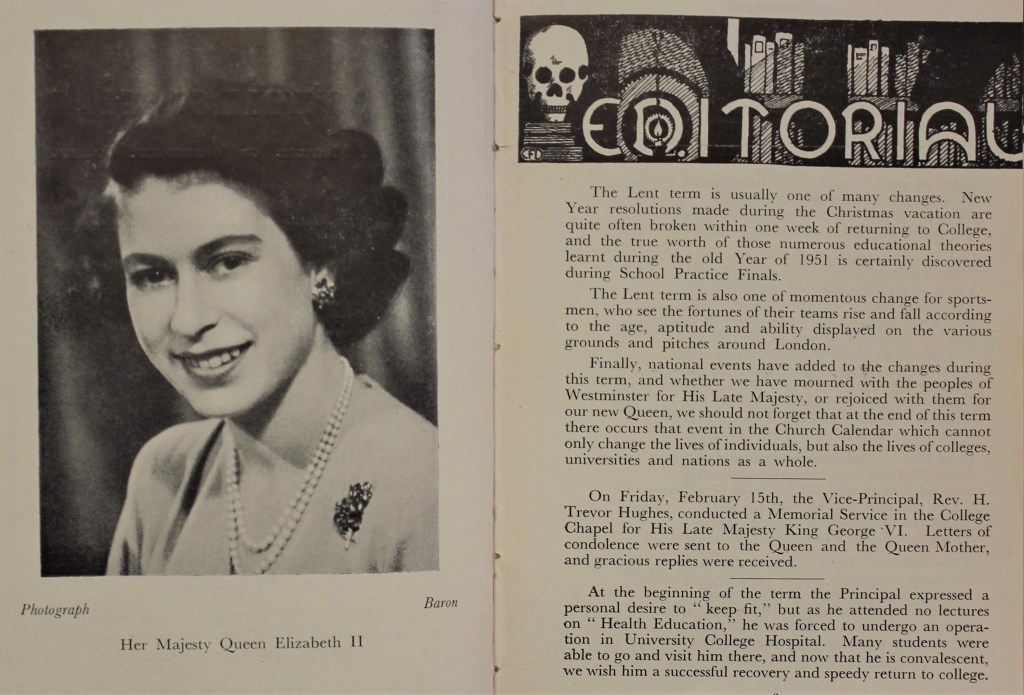
Upon the death of George VI in 1952, Dennis Andrew (President of the Union Society) wrote a letter of condolence on behalf of the students, and a swift response was received, signed by Colonel Martin Charteris. Report of the accession of Elizabeth also featured in the Lent 1952 edition of The Westminsterian, followed by a full page photograph of the new Queen (top of page). Her coronation the following June received a similarly large entry, if only because the College students lined the streets surrounding their buildings and (once again) performed the ‘College Yell’, and were mistaken for the boys of Westminster School!  

When Westminster College relocated to Oxford in 1959, they tried to recruit a member of the royal family to attend its official opening on 21 May 1960 – asking first for The Queen, then the Duke of Edinburgh. The organisers were told first that The Queen could not visit the same institution twice so closely together – even if one visit had been prior to her ascension and to different buildings. The Duke of Edinburgh was apparently busy on the selected date. Despite this, a toast was made to the monarch at the end of lunch, with the menu cards simply noting ‘The Queen’.  

Prior to its merger with Oxford Brookes University in 2000, the only other significant royal event was that of the Queen’s Silver Jubilee in 1977. The College, now devoid of the lively atmosphere of London, did not line the streets and make such a noise that it was reported in national newspapers – as was the case for the Coronation. In fact, the only photographs in the College archive for that year are of sports matches and academic events.  

The seventieth anniversary of the Queen’s ascension this week will pass in similar quietness – if only because of the large-scale national events planned for the beginning of June. Despite this, an exhibition of archive material has been curated on campus, as a small marker of this momentous occasion.  

Thomas Dobson is Collections & Digitisation Officer at the OCMCH. The Westminster College logbooks of Principal H. B. Workman are available online, here.

Categories
Uncategorized

LGBTQ+ History Month – Being Gay at Westminster College, 1963-66: Some Reminiscences

I knew I was homosexual (I don’t remember the word ‘gay’ being used at the time) from about the age of twelve. I also knew – mainly from the jokes about ‘poofs’ and ‘queers’ which were commonplace on TV – that there was something shameful about it, so I kept it to myself and never mentioned it to my parents or friends. During my teens I watched as friends and other contemporaries began to form relationships with the opposite sex, listened as they discussed their exploits, and envied the freedom they had to be themselves.

Around the age of fifteen I attended a meeting of the Student Christian Movement at which the subject of homosexuality was discussed and was appalled at some of the comments made. I sat there thinking ‘they’re talking about me’; but I couldn’t bring myself to respond.

I finally came out at the age of seventeen to my closest friend. I was in love with him but was petrified that, if I told him, he wouldn’t want anything more to do with me and might even tell my parents. In the event he was amazing: he said he wasn’t homosexual himself but had no problem with my being gay and was happy to go on being friends. It’s difficult now (fifty-nine years on!) to find words to describe the sense of relief I felt.

Encouraged by my friend’s reaction, and with my course at Westminster soon to begin, I then told the (young) vicar of my parish church and asked him if he thought it was appropriate that I should go into teaching. His response was mixed: on the one hand, he said he could see no reason why I shouldn’t teach; on the other he gave me a series of jobs to do in the church which kept me busy all through the summer holiday and then declared that he had saved me from ‘going queer’.

The College

As a result, I arrived at Westminster in September 1963 still feeling some anxiety. I decided to ask for an appointment to see the Principal – H. Trevor Hughes – to tell him of my concerns about being a homosexual going into teaching. It seems extraordinary to me, now, that I should have done this. But life was different then: gay sex was still illegal, the papers were full of lurid stories about men being arrested in public toilets, and blackmail was rife. So I was extremely nervous about going to see him. For all I knew, he might say ‘how disgusting – we don’t want your sort here’ and send me down. Drastic change of career and some difficult explaining to do at home. In fact, he was very gentle. He said ‘but you like poetry, don’t you? And you have other interests? I’m not in favour of labelling people. If you have concerns, why not talk to the chaplain?’ And that was that. I came out feeling as though I’d been hit with a tired lettuce. I never did understand the reference to poetry.

I did go and talk to the chaplain, though. Dr Underwood was a young Methodist minister with whom I struck up a friendship. I was reassured by his acceptance of my sexuality and his support for my being a teacher.

All students wishing to do Main Level Divinity had to have an interview with the head of the department, ‘Dutch’ Holland. He was a strange character who seemed to talk in riddles. At one point in the interview he began asking me ‘do you have any perver…‘ I assumed he was going to say ‘perversions’ so I leapt in, saying ‘Oh No, Certainly Not!’ When I’d finished interrupting him, he patiently completed his sentence ‘… any perversities, like boxing for example?’ I blushed deeply and said I didn’t. I was very relieved when the interview was over, convinced that I had let the cat out of the bag – Mr Holland now knew I had something to hide. This conviction was somewhat undermined when I discovered that I had, after all, been accepted for the Main Level Divinity course.

A year later, as part of a course on Health Education, we had a visiting speaker, a woman doctor, who gave us three lectures on sex education. After the first lecture, the chaplain announced that if anyone had a problem which they would like to discuss with her in confidence, he would arrange it. I went to see him and told him I would like to discuss my homosexuality with her. I spent an hour with her in his house one evening after dinner. She was wonderful. She said that nowadays ‘treatment’ was only considered appropriate where the subject was maladjusted and consisted of helping the subject to become a better homosexual rather than trying to turn him into a heterosexual. ‘And’, she said, ‘you seem eminently well-adjusted to me.’ This was an important moment for me – she made me feel, for the first time in my life, good about myself.

At last, it was okay to be me.

Fellow students

I quickly became friends with three of the ten students in my house – another first year and two second years. I came out to one of the second year students – we’ll call him Alec – who was a really nice guy with an equally nice girlfriend. The three of us had lengthy discussions about sexuality. She even offered to come to my room one evening to see if she could seduce me (and thus show that I was really a latent heterosexual). She tried. I wasn’t. On another occasion, Alec asked me if I would accompany his girlfriend to the cinema to see The Sound of Music, as he couldn’t go. ‘I know she’ll be safe with you!’ he added, grinning.

In Conclusion

I hope I haven’t given the impression that I spent the whole of my three years at Westminster discussing my sexuality with staff and students. I didn’t. (And no doubt they wouldn’t have thanked me if I had!) Apart from the incidents mentioned above, I spent my time at the college, like other students, in learning to be a teacher and in making friends and socialising.

I enjoyed my three years at Westminster immensely for all sorts of reasons.

There was a friendly and relaxed atmosphere about the place. The tutors were, overwhelmingly, encouraging and helpful. The lectures were often fascinating and the course was a thorough and wide-ranging preparation for teaching.

Like most of the students, I’d never lived away from home before, so Westminster marked in a very real way my transition from child to adult. It was an exciting time.

It also enabled me to come to terms with myself. I have always been – and continue to be – profoundly grateful to Westminster – to Trevor Hughes, to Dr Underwood, to the woman doctor, and to my fellow students – for their acceptance and support.

It would be more than twenty years after I left Westminster before the Methodist Church adopted a positive attitude to its gay members (the Anglican Church still hasn’t). Yet I can honestly say that not once during my three years at the college did I ever encounter what today would be called homophobia.

Not a bad testimony for a Methodist college in the mid-1960s, I think.

Derek Gillard

Images courtesy of the author. For more on LGBTQ+ History Month at Oxford Brookes University visit https://www.brookes.ac.uk/staff/human-resources/equality-diversity-and-inclusion/lgbtq–history-month/

Categories
Uncategorized

Black History Month – Peering into a life’s work: the Francis L. Bartels Collection

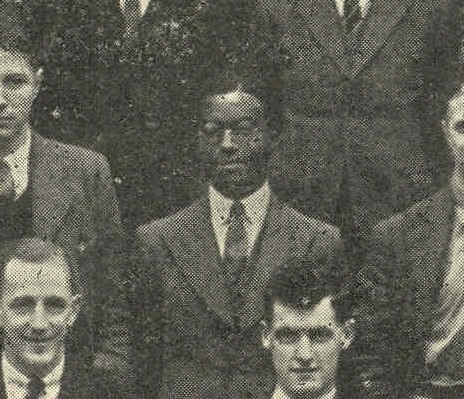
Westminster College Archives. Fourth Year group photograph, 1934 (detail)

Much progress has been made in the Francis L. Bartels Collection since last October’s post. My contribution was discussed as a potential task back in January 2020 as I was about to embark on a placement module in my second year as an Undergraduate, though in the end I worked on a different project – until the placement was cut short. When the first lockdown hit, I still had five weeks left with the Centre. Though I was not penalised in the marking of the module, I certainly felt I had left something unfinished, and yearned to return to the archive to carry out further work. After graduating this July, I reached out to Tom Dobson, to inquire about the possibility of a further voluntary placement over the summer. Throughout August, I listed approximately 600 individual items for the collection.

Dr Peter Forsaith has already discussed Dr Bartels’s biographical details in a previous post at length, for me to repeat them here would be superfluous – I shall instead discuss the impression of Bartels that listing his personal papers has left me.

An incredibly diligent man with a profound attention to detail, many of the documents within the collection are extensively annotated front and back.

Bartels would pass on notes regarding speeches and reports regularly, suggesting changes in phrasing here and there, or provide unrestrained critique if the document in question did not meet his exacting standards.

Peering into Dr Bartels’s collection of newspaper clippings, we may discover a different side of the man. Of the pages he’d kept from The Listener, for example, the majority are printed sermons by Gerald Priestland,[1] indicating an enduring interest in questions of religion and spirituality.

This notion is further reinforced by Bartels’s membership of the Society for African Church History.

The existence of the collection itself also betrays a lot about Bartels. While the original organisation of the collection may have suffered as a result of storage and transport before it made its way to the OCMCH, Bartels clearly had a system in mind as he saved various documents and organised them within it. Correspondence, conference materials, newspaper clippings, and other publications are all collected and labelled in various folders according to their relation to either specific events or broader themes. This is not a collection of all the papers that had been found among Bartels’s effects upon his death, but a system he had evidently been curating throughout his whole life. It is difficult to put into words what it feels like to peer into a life’s work.

Indeed, listing the documents has been more akin to trying to reconstruct a catalogue following the original’s destruction. Dr Forsaith’s ambition is to organise the collection so that were Bartels still alive today, he should still be able to find a specific document in it. This is a worthy goal.

Michael Orsovszki

MA History student at Oxford Brookes


[1] Quaker and BBC religious affairs correspondent between 1977 and 1982

Categories
Uncategorized

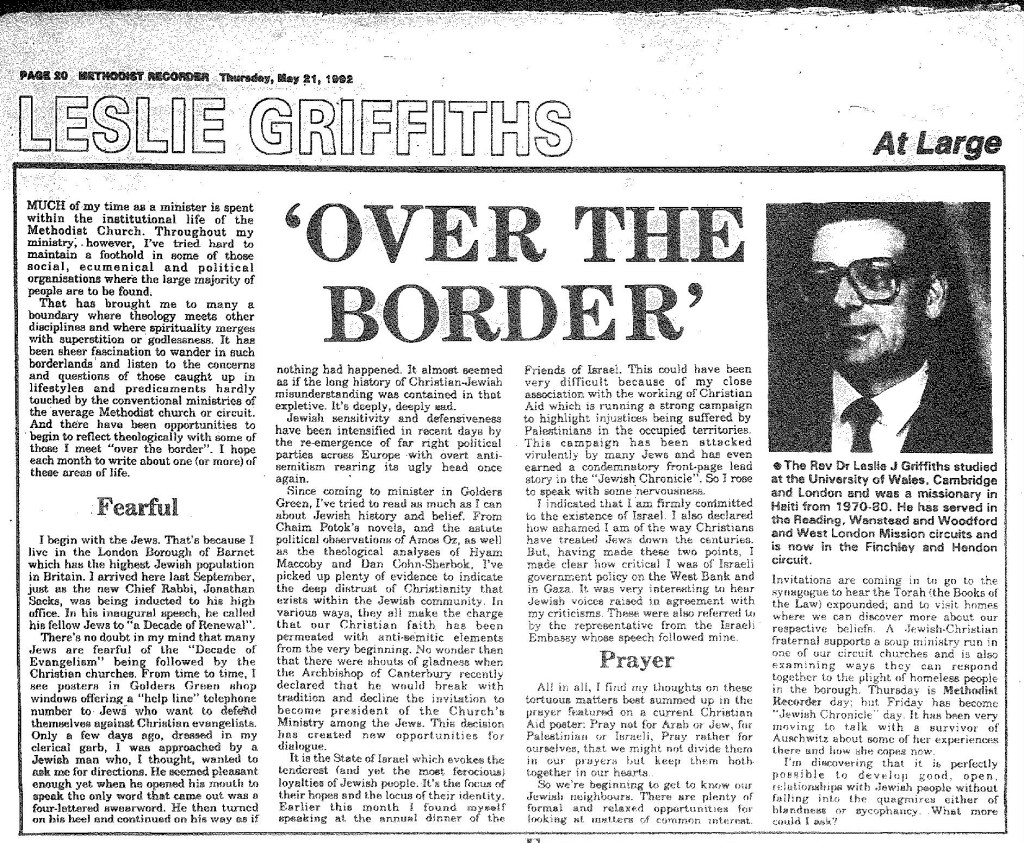
Archives & Library – Leslie Griffiths’s features in the Methodist Recorder online

It was Michael Taylor, the then Editor of the Methodist Recorder, who invited me to contribute a monthly column to the paper under the title “Leslie Griffiths At Large.” The first contribution was published in May 1992. I was already heavily into broadcasting, had just become a board member of Christian Aid, was a Vice President of the Christian Socialist Movement, had long experience in the governance of schools of varying kinds, was Chairperson of the Golders Green branch of The Council for Christians and Jews and, on top of all that, I was the country’s number one Haiti expert whose President, a good friend and Roman Catholic priest named Jean-Bertrand Aristide, had just been ousted from office. I founded the Haiti Support Group and soon wrote a biography of Aristide.

I was asked to be an insider looking out into the various worlds I was moving in and to make gentle theological sense of it all.

During my year as President of the Methodist Conference (1994-1995), I wrote my column weekly rather than monthly in order to develop and maintain a “conversation” with the Methodist people.

When Moira Sleight succeeded Michael Taylor in the editor’s seat, she asked me to continue to write but chose to change the title to the more pedestrian “Leslie Griffiths’ Monthly Column.”

We had no idea that, three decades later, this effort would still be around. We’ve laughed a lot; I’ve prodded a sleepy Methodist establishment in the ribs from time to time; I’ve looked at religious, social, cultural, historical, subjects. There have been pieces about various personalities. Now and again, I’ve taken the gloves off and indulged in a little polemic. Just a little!

All these articles were about subjects that were current and in the news. They have been fun to write and, as far as I can tell, fun to read too.

Leslie Griffiths

21 July 2021

Read now:

Thursday, 21 May 1992

Thursday, 18 June 1992

Thursday, 16 July 1992

Thursday, 20 August 1992

Thursday, 17 September 1992

Thursday, 15 October 1992

Thursday, 19 November 1992

Thursday, 17 December 1992

Thursday, 21 January 1993

Thursday, 18 February 1993

Thursday, 18 March 1993

Thursday, 15 April 1993

Thursday, 20 May 1993

Thursday, 17 June 1993

Thursday, 15 July 1993

Thursday, 19 August 1993

Thursday, 16 September 1993

Thursday, 21 October 1993

Thursday, 18 November 1993

Thursday, 16 December 1993

Thursday, 20 January 1994

Thursday, 17 February 1994

Thursday, 17 March 1994

Thursday, 21 April 1994

Thursday, 19 May 1994

Thursday, 23 June 1994

Thursday, 30 June 1994

Thursday, 30 June 1994 (cont.)

Thursday, 14 July 1994

Thursday, 21 July 1994

Thursday, 28 July 1994

Thursday, 4 August 1994

Thursday, 11 August 1994

Thursday, 18 August 1994

Thursday, 25 August 1994

Thursday, 8 September 1994

Thursday, 15 September 1994

Thursday, 22 September 1994