Categories
Uncategorized

Research – ‘Archives & Research’ series

The Centre is very pleased to announce the launch of ‘Archives & Research’, a new series of introductory guides to our rich collections of archives, artworks, and printed material. Appearing monthly, each instalment of ‘Archives & Research’ will explore thematically different aspects of our holdings with the aim of supporting primary research.

Archives & Research - Copy

The guides draw attention to specific items from the collections that might be of interest to researchers, and will indicate whether this material is available electronically through our Digital Collections.

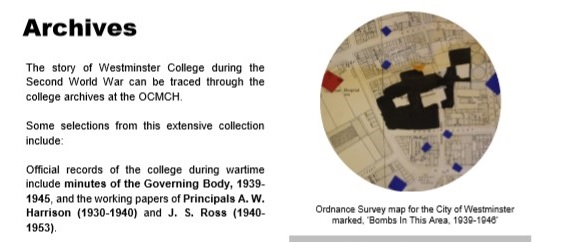
‘Archives & Research’ No. 1 commemorates the 80th anniversary of the outbreak of the Second World War through an exploration of the impact of that conflict on Westminster Training College, and the records that tell its story

With evacuation plans in place for the staff and students of Westminster, attention was turned to the site and contents of the College. Stained glass from the chapel was promptly removed to a secure location, and the organ was relocated to the Principal’s house. Other furnishings were either stored or sold. Much of the College premises was subsequently requisitioned for war use.

To read more, visit the ‘Library & Archives’ page at https://ocmch.wordpress.com/archives/. ‘Archives & Research’ is freely-available to view and download. 

Categories
Uncategorized

Research – Dr. Sarah Prendergast awarded Ph.D.

IMG_3791
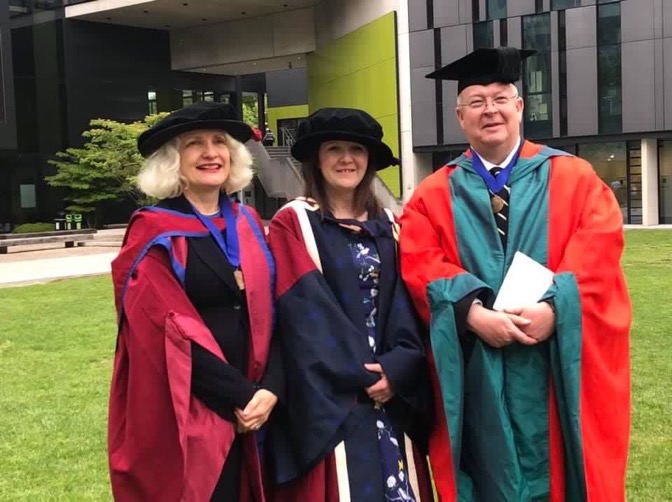
Dr. Sarah Prendergast (centre), with her doctoral supervisors Prof. Beverley Clack and Prof. William Gibson

All at the OCMCH are delighted that Dr. Sarah Prendergast has been awarded her Ph.D. at a ceremony held at the Oxford Brookes University Headington Campus on Friday 21 June 2019.

Dr. Prendergast’s thesis explores the Welsh Revival of 1904-1905, a period of social and religious change throughout Wales. For eighteen months, chapels were filled and public houses emptied as the country was engulfed in an emotional, religious frenzy, which many believed to be the work of God. Previous research has focused on the role of Evan Roberts, the enigmatic revivalist who was portrayed as the Divinely appointed leader of the movement. Whereas, Dr. Prendergast’s thesis focuses on the role of women during the Revival, an aspect of the movement that has remained hitherto unexplored. The thesis examines the role of these women, questioning why so little is known of their wider identities or what happened to them once the Revival ended, following Roberts’s departure from Wales in August 1906. It also considers the afterlife of the Revival, questioning if the way in which the movement enabled women to more beyond the role of wife and mother, assessing its role in the emancipation of Welsh women.

In the completion of her thesis Dr. Prendergast drew extensively from Welsh archival sources, including those held by the National Library of Wales.

Dr. Sarah Prendergast is currently developing her thesis into a book for the University of Wales Press.

Categories
Uncategorized

Archives & Library – Westminster College War Memorial added to National Database

War Memorials Register

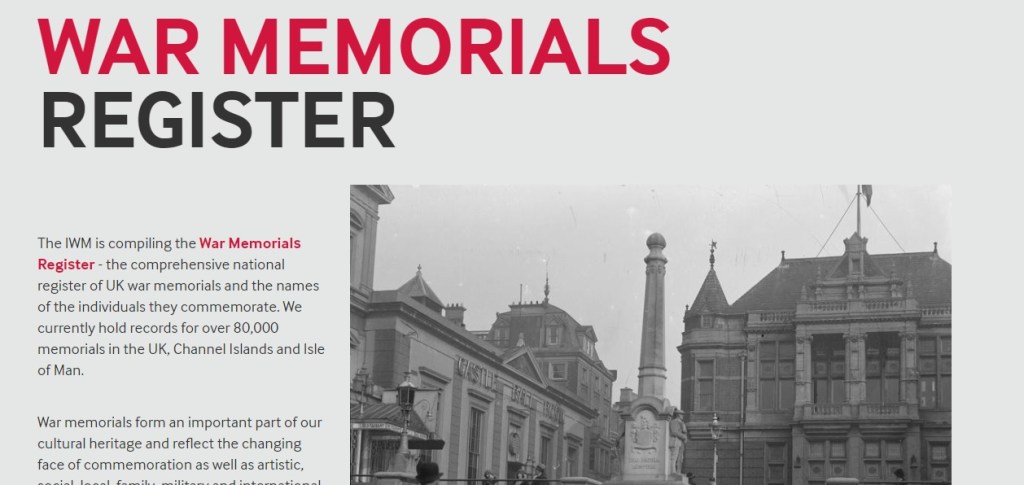
The Westminster College war memorial, located in the chapel at the Harcourt Hill campus of Oxford Brookes University, has been added to the national War Memorials Register. This ambitious project was launched by the Imperial War Museum in 2018 to coincide with the 100th anniversary of the 1918 Spring Offensive during the First World War, and currently holds records of over 80,000 memorials in the UK, Channel Islands, and Isle of Man.

War memorials form an important part of our cultural heritage and reflect the changing face of commemoration as well as artistic, social, local, family, military and international history. The Register includes memorials to members of the armed forces, civilians and animals from all wars and to those who died in service.

https://www.iwm.org.uk/

War Memorial 1921 Jpeg.jpg

Following fundraising efforts by the College that raised in excess of £850, the large oak memorial boards recording the names of the 102 former Westminster men who died during the First World War were dedicated in a ceremony on 10 July 1921, in which the names of the fallen were solemnly read in turn, and thanks given to God,

For men of this College who served their country in her hour of need, and especially for those who gave even their lives

1925 Chapel Boards
The Westminster College war memorial (flanking window) in the chapel at Horseferry Road, 1920s. See more at, https://flic.kr/s/aHsmckGErF

A memorial brass to Henry Andrew Reatchlous, Vice-Principal from 1888-1904, was unveiled during the same ceremony. The Memorial Committee also invested some £750 in National Savings Certificates to support the education of the dependent children of fallen Westminster men.

The subsequent history of the war memorial included rededication and the addition of a further 25 names of Westminsterians who died during the Second World War (achieved through more College fundraising), and the memorial’s removal to its present location in the chapel at Harcourt Hill, where there is also a memorial window to Donald Simpson Bell V.C (see, a former post).

More information about the Westminster College war memorial can be found at https://www.iwm.org.uk/memorials/item/memorial/83821

Categories
Uncategorized

Events – Annual John Wesley Lecture, 2019

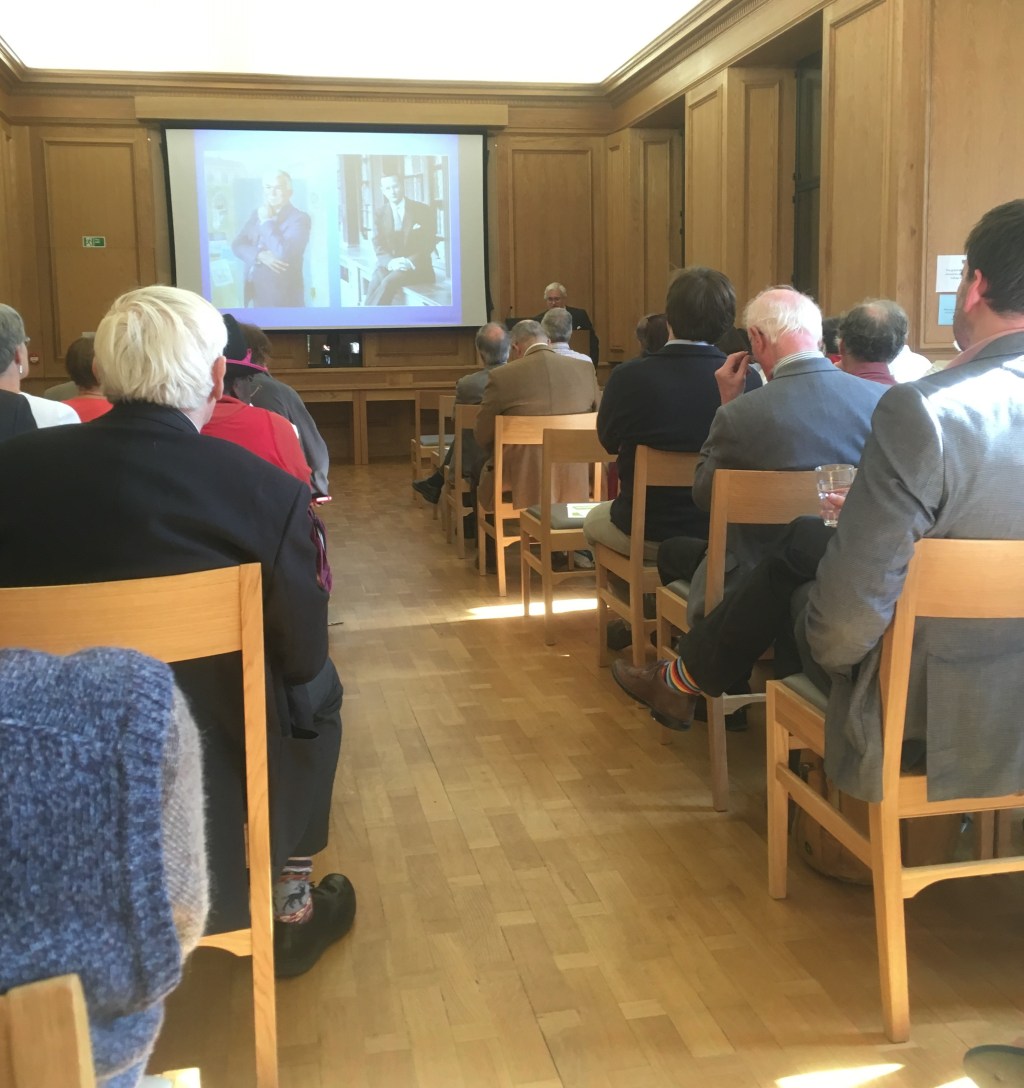
On Tuesday 21 May 2019, this year’s annual John Wesley Lecture was delivered by Dr Colin Haydon on the subject of ‘John Wesley, Roman Catholicism and ‘No Popery!’. Dr Haydon has published extensively on the religious history of eighteenth-century Britain, and is the author of Anti-Catholicism in Eighteenth-Century Britain, c1714-80. The lecture was a great success, as Dr Haydon eruditely contrasted Wesley’s published writings against Popery with his known admiration of certain Catholic devotional works and biographies. These readings were placed in the context of Wesley’s century-spanning lifetime, alongside his personal experiences in Ireland, and literary output during periods of anti-Catholic alarm in Britain.

The event was supported by an exhibition organised by OCMCH and Lincoln College which showcased original manuscripts, objects, and printed works from their collections relating to Wesley, his family, and anti-Catholicism in Britain. We are also grateful to the Angus Library for the loan of a 1722 edition of the Book of Common Prayer for display.

The annual John Wesley Lecture is an event organised by the OCMCH, the Wesley Memorial Church and Lincoln College, Oxford, who also act as hosts. The lecture has been delivered by leading scholars of social and religious history, such as Professors J. Richard Watson , Jeremy Black, Grayson Ditchfield, and J. C. D. Clark.

Categories
Uncategorized

Fellows – Dr Matteo Bonifacio, Visiting Research Fellow 2018-2019

Dr Matteo Bonifacio 2019

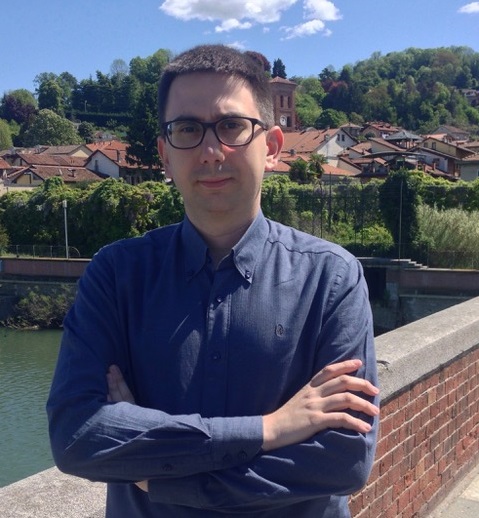
Dr Matteo Bonifacio, visiting Research Fellow in the Oxford Centre for Methodism and Church History for the spring semester 2019.

I completed my doctoral studies at the University of Turin in May 2018, and I am currently Research Fellow at the Luigi Einaudi Foundation (Turin), where I have been extending my researches into eighteenth-century Britain begun when I was an undergraduate.

My post-doctoral project is on modern British political thought. I am particularly concerned with a specific sort of political language widespread in the late eighteenth century, namely the language of the “rights of man”. As is well-known, the American Declaration of Independence in 1776 and the Déclaration des droits de l’homme et du citoyen in 1789 formally recognized these imprescriptible natural rights and marked a turning point in the history of human rights. In the Age of Revolutions those theoretical discussions about natural rights developed in the seventeenth century by seminal philosophers such as Hugo Grotius, Samuel Pufendorf and John Locke found their way into the political arena, epitomized by their codification in the two declarations.

Whilst scholarship is primarily focused on emphasising the emergence of that language in the French Lumières, I aim to investigate the circulation and usage of the rights of man language in late eighteenth-century Britain. I intend to place special attention on important figures such as Price, Priestley, Paine, and Wollstonecraft, but I am keen to browse primary sources in order to discover marginal authors who also took part in those debates. By adopting an historical perspective from below, I will intertwine plays, songs, novels, and the material history to set the rights of man debates in a broader context.

I am delighted to be a Visiting Research Fellow for the spring semester 2019 at the OCMCH, for it gives me the opportunity to discuss my research with leading historians of the long eighteenth century. The emergence of the rights of man in modern age is not infrequently studied from a secularized standpoint that leads to viewing them as one of the key-features of the so-called “radical Enlightenment”. I am going to inquire as to whether this perspective really does give us a complete understanding of the rights of man in the British context, where religious and political spheres were peculiarly intertwined.

Categories
Uncategorized

Archives & Library – ‘Floreat Westminsteriensis’ and ‘Be Prepared’

Westminster Rovers
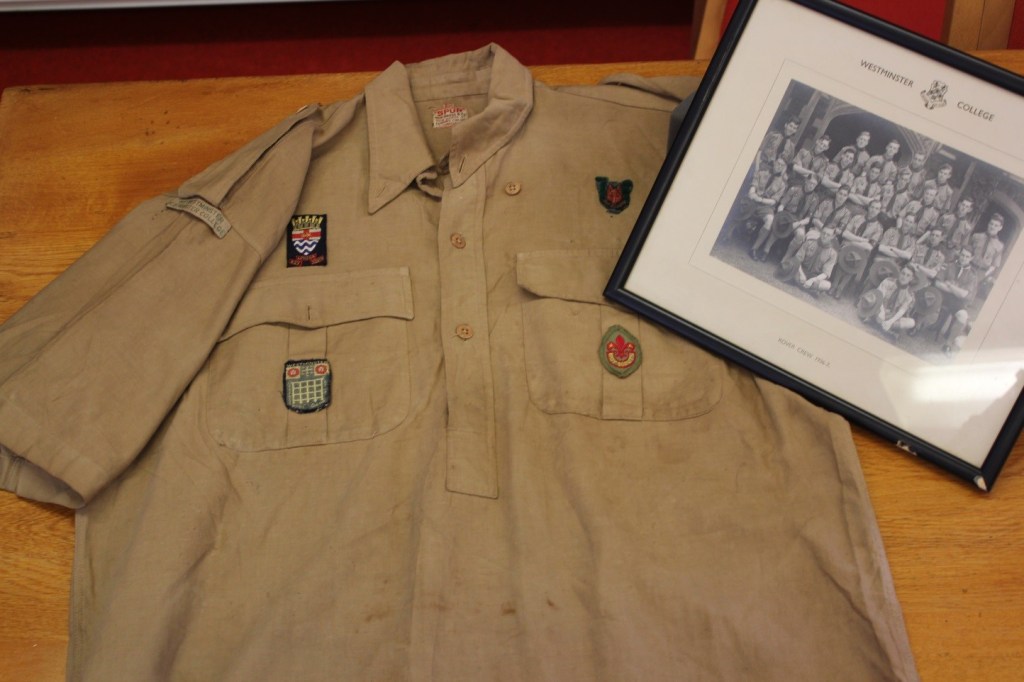
The Scout shirt of Frank Wright (1934-37) and a photograph of the 41st Westminster Rovers while he was a member.

In the days before national student Scout movements it is often believed that universities and Scouting operated entirely separately from one another. Recent finds in the Westminster College archives, however, help to show otherwise. Photographs, letters, and even a contemporary Scout shirt have helped to trace the story of Rover Scouting at Westminster College.

Founded between 1918 (the establishment of Rover Scout Crews) and 1934 (the first entry in the College’s Rover log book) Westminster College staff and students founded the 41st Westminster (Westminster College) Rover Scout Crew. 

Operating under the leadership of one of the college tutors and a ‘court of honour’ consisting of all the members who were in their final year at college, and running out of ‘Hostel 1’, this Rover Crew closely mirrors a modern Network (Scouting for members aged 18-25) or SSAGO (Student Scout and Guide Organisation) group. The single surviving log book details, among other things, the activities of the Rover Crew – regularly mentioning games nights, hikes, knot tying, first aid, camping… all activities which are still enjoyed by all ages of Scouts today!

The similarities between Scouts then and Scouts now don’t end there. The Rover Scout shirt is so similar to an adult Scouting shirt today; the same colour, the same basic badges. Even if the style and placement of badges have changed, the foundation of modern student Scouting can clearly be seen through every aspect of the 41st Westminster group – in the activities, the uniform, even in the ideals.

Westminster Rovers 2
41st Westminster Rovers in 1936-37

Despite the log having been lost between the outbreak of war in 1939 and its rediscovery in 1958, photographs of the Rover Crews show that the 41st Westminster group kept running, showing its popularity endured regardless of the challenges facing the College: dispersal of students during the Second World War, and the College’s relocation to Oxford in 1959.

Westminster Rovers 3
41st Westminster Rovers in 1951

Following the move to Oxford, the Westminster College Rover Scout group was reformed as 51st Oxford (Westminster College), and continued to thrive and enjoy Scouting activities – making use of the now nearby campsite at Youlbury in the place of Gilwell Scout Centre. Whilst the log book finishes in 1961, the Scouting presence continued at Westminster College, being mentioned in the Students’ Union executive committee minutes in the 1970s.

Today, the students of Oxford Brookes University continue to be involved in Scouting as members of OUSGG (Oxford University Scouts and Guide Group) or as leaders for local scout groups, just like the first members of the 41st Westminster Rovers did, showing just how closely united ‘Floreat Westminsteriensis’ and ‘Be Prepared’ are.

Thomas Dobson, Collections and Digitisation Officer

Categories
Uncategorized

Digital – British Methodist Buildings: Who Was Bill Smith?

This post celebrates the completion of the tagging and labelling of all 4750+ images in the Smith collection on British Methodist Buildings. But who was Bill Smith? And what do we know of his project to photograph Methodist buildings from all over Britain?

WhoIsBillSmithBMBS3212
British Methodist Buildings: who was Bill Smith?

William Aubrey Smith (1932-2018) was a carpenter and coffin-maker from Dunstable in Bedfordshire. He was a committed Methodist and member of the London and the South-East meeting of the Wesley Historical Society. Other than photography, he also had interests in postcards, philately and coins. Smith did not drive, so all of his photographs were taken having travelled the country by public transport. His voluminous and intricate notes on local bus routes and rail times survive with the collection. Between 1979 and 2007, together with his wife, Jean (who can be seen in many of his photographs), he catalogued and listed churches and chapels he had seen, building up a large card index that accompanies his photo albums.

img_1060.jpg
The Smith Collection at the Oxford Centre for Methodism and Church History

The chronological arrangement of Smith’s photographs allow us to observe his travels, and the expansion of his project over time. Initially, he began documenting buildings in the counties immediately adjacent to his home in Dunstable – Bedfordshire, Buckinghamshire, Greater London and Hertfordshire – all of which are well-represented in British Methodist Buildings.

IMG_1052
Smith’s sketch maps and notes on local bus routes

These photographs ‘local’ to Smith are interspersed with shots from his coastal getaways, with buildings appearing from Bournemouth, Brighton, Great Yarmouth, Margate, Portsmouth, and Skegness. Later, Smith toured more extensively through the Midlands and beyond, lending to the strength of the collection in Northamptonshire, Nottinghamshire, Staffordshire, and the West Midlands. The nature of Smith’s travels also explain the bounds of his collection. Aside from a single image for Bowness in the Lake District, Smith’s project took him no further north than Whitby, and only as far west as Somerset.

The completion of work on the Smith collection in British Methodist Buildings marks the first time that this photograph collection of national significance has been made readily-accessible to researchers.

Visit BMB now at: https://www.flickr.com/photos/britishmethodistbuildings/albums


Categories
Uncategorized

Research – William Gibson on the History of Lambeth Degrees

lambeth degrees book - copy

The Burgon Society has announced the publication of The History of Lambeth Degrees: Sources and Studies, edited by Professor William Gibson.

This book examines the history of degrees awarded by the Archbishops of Canterbury from 1539 to the present day. ‘Lambeth degrees’ have a history rich in controversy. It brings together an important series of primary source material and articles, including the complete text of Bishop Francis Gastrell’s legal claim in 1717 that Lambeth degrees were not the equivalent to university degrees; a complete list of Lambeth degree recipients 1539-1995; an examination of Charles Franklyn’s claim that the degrees are really ‘state’ or royal degrees; and reprints of articles by Noel Cox FBS, and by Graham Zellick FBS (the President of the Burgon Society), on the robes for the degrees.

http://www.burgon.org.uk/society/shop/index.php

Table of contents

SOURCES

W. Gibson, ‘‘What Kind of Hood doth he use?’:The Challenge to the Validity ofLambeth Degrees in 1717-25.

[F. Gastrell],The Bishop of Chester’s Case With Relation to the Wardenship of Manchester, in Which is Shewn that No Other Degrees But Such As Are Taken in the Universities Can Be Deemed Legal Qualification for Any Ecclesiastical Preferment, Oxford, 1721.

Principal Manuscript holdings relating to Lambeth degrees in British Archives by William Gibson.

Chronological List of Lambeth degrees by Melanie Barber

A Miscellany of articles on Lambeth Degrees:

‘The Correspondence of Sylvanus Urban’: Lambeth Degrees [Gentleman’s Magazine, May & June, 1864]

‘Nova et Vereta’: The Lambeth Degrees by Cecil Wall [British Medical Journal, Nov 2, 1935.]

The Lambeth Degrees, Charles H. Franklyn, [British Medical Journal, Oct. 12, 1935.]

Lambeth Degrees, L. A. Parry, [British Medical Journal, Sept. 28, 1935.]

STUDIES

William Gibson: ‘Charles Franklyn on Lambeth Degrees.’

Noel Cox, ‘Dispensations, Privileges, and the Conferment of Graduate Status: With Special Reference to Lambeth Degrees’ from Journal of Law and Religion, Vol. 18, No. 1 (2002 – 2003).

Noel Cox, ‘Lambeth Degree Academical Dress’, Transactions of the Burgon Society, 5 (2005).

Noel Cox, ‘The Centenary Eucharist and Presentation of the Lambeth Diploma and MA Degrees’, Transactions of the Burgon Society, 14 (2014).

Graham Zellick, ‘Lambeth Academic Dress and the University of London’, Transactions of the Burgon Society, 7 (2007), pp. 39-47.

William Gibson is Professor of Ecclesiastical History at Oxford Brookes University, and Director of the Oxford Centre for Methodism and Church History. 

Categories
Uncategorized

Digital – British Methodist Buildings to launch in January 2019

This slideshow requires JavaScript.

In January 2019, the Oxford Centre for Methodism and Church History will launch an exciting new digitised resource for the study of Methodist heritage.

British Methodist Buildings brings together two major photographic collections from the Centre’s holdings to create an unparalleled visual library of Methodist buildings in Britain. This is the first time these collections have been made fully available, making over 10,000 images freely accessible online.

These photographs represent the labours of two hobbyists: Keith Guyler and Bill Smith. Operating between the 1970s and 2010s (but seemingly unaware of each other’s activities), these two amateur photographers travelled the country documenting many buildings which have since been altered or demolished.

‘Let all preaching-houses be built plain and decent’ – John Wesley

This project showcases Methodist buildings as the vibrant hearts of communities, commemorated by architecture which is sometimes exuberant, at other times plain and functional. The story of each chapel is the story of a community, and whilst some retain an active membership, others have been re-purposed as homes, garages, shops, storehouses, cowsheds, and many other uses.

Central to British Methodist Buildings will be collaboration with our users. We will encourage people to add their personal experiences and recollections to the images. How many do you know? Do you know something of their history? Do you recall a community or family event at a particular building?

British Methodist Buildings will launch in January 2019. For further updates follow this blog, or find us on Twitter @OCMCHBrookes.

Categories
Uncategorized

Research – Art History student gains curatorial experience at OCMCH

Daria in the Art Store
Daria Chuikova inspects the sketches of A. G. Hellier at the Harcourt Hill art store

This semester during my independent study module I was given the opportunity to work with Dr Peter Forsaith, Research Fellow at the Oxford Centre for Methodism and Church History. I was delighted to be given the opportunity to get to know the art collections better as I had become very interested in them during my Curatorial Practice module the previous year. I was surprised that my university held such a diverse collection of artworks. These are spread throughout the university campuses, but a significant number are located at Harcourt Hill. One of the main tasks for this module was to check the descriptive information for the artworks from the Methodist Modern Art collection, and amend them on the Art UK website. Fortunately, I was able to find and modify most of these records digitally.

During my visits to Harcourt Hill I was given the opportunity to explore the art store and examine artworks from other collections, such as the Methodist Church House, Smetham, and Westminster College collections. It became another task to check whether these artworks were described correctly on the Art UK website. I also helped to measure a collection of sketches of everyday life in South India created by A. G. Hellier in the 1920s-1950s, and arranged a list to match together with the digitised images of these pieces. Working directly with the artworks and their digital versions gave me a much better understanding of how museum cataloguing functions, and I also acquired necessary cataloguing skills which will be essential for my future in the curating field. I really enjoyed this module and the time I spent at the Oxford Centre for Methodism and Church History.

Daria Chuikova is a third-year undergraduate student in the History of Art at Oxford Brookes University.