Categories
Uncategorized

Research – New book on prayer in the Early Modern World.

Layout 1
The latest issue of the Journal of Religious History, Literature and Culture, which is edited from the Centre, will be published in November and is a special themed issue on prayer in the Early Modern period.

The essays in this book aim to answer the following questions: What was the place of prayer in the early modern world? What did it look and sound like? Of what aesthetic and political structures did it partake, and how did prayer affect art, literature and politics? How did the activities, expressions and texts we might group under the term prayer serve to bind disparate peoples together, or, in turn, to create friction and fissures within communities? What roles did prayer play in intercultural contact, including violence, conquest and resistance? How can we use the prayers of those centuries (roughly 1500–1800) imprecisely termed the ‘early modern’ era to understand the peoples, polities and cultures of that time?

The essays included in the collection are:

Introduction by William Gibson, Laura M. Stevens and Sabine Volk-Birke.
Denise M. Kohn: ‘Rowlandson’s “Cover Story”: The Revision of Private Devotional Practice into Public Narrative.’
Elena Marasinova: ‘The Prayer of an Empress and the Eighteenth Century Russian Death Penalty Moratorium’
Linda Meditz: ‘The Captive at Prayer: Cross-Cultural Trauma as Revealed in the Diary of Stephen Williams’.
Penny Pritchard: ‘The Eye of a Needle: Commemorating the ‘Godly Merchant’ in the Early Modern Funeral Sermon.’
Laura M. Stevens: ‘Mary’s Magnificat in Eighteenth Century Britain’
Sabine Volk-Birke: ‘“The Order and Methods of Nosegays”: Imagining Readers in François de Sales’s Introduction à la vie dévote (1609) and its eighteenth century English adaptations.’

For information on the version of the special issue as a book see http://www.uwp.co.uk/book/early-modern-prayer-paperback/

Categories
Uncategorized

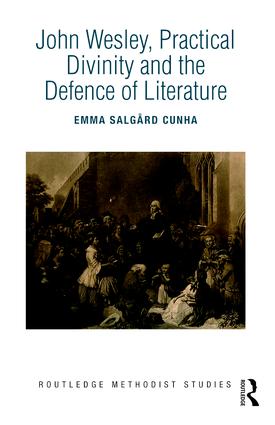
Research – John Wesley, Practical Divinity and the Defence of Literature, by Emma Salgård Cunha

9781138305021
John Wesley (1703-1791), leader of British Methodism, was one of the most prolific literary figures of the eighteenth century, responsible for creating and disseminating a massive corpus of religious literature and for instigating a sophisticated programme of reading, writing and publishing within his Methodist Societies. John Wesley, Practical Divinity and the Defence of Literature takes the influential genre of practical divinity as a framework for understanding Wesley’s role as an author, editor and critic of popular religious writing. It asks why he advocated the literary arts as a valid aspect of his evangelical theology, and how his Christian poetics impacted upon the religious experience of his followers.

Table of Contents

Methodism and the Defence of Literature: An Introduction

1 Methodist Literary Culture: Literacy and Grace

2 Wesley’s Christian Library: Practicality, Controversy and the Methodist Canon

3 Wesley in the Literary Sphere: The Methodist Miscellany

4 Wesleyan Poetics: Practical Divinity and the Function of Literature

5 Negotiating Nonconformity: Practical Divinity and the Politics of Methodist Hymnody

6 Experience, Experiment and Wesley’s Spiritual Autobiography

Conclusion

Emma Salgård Cunha is Lecturer in English at Middlebury College’s Oxford Humanities Program and College Lecturer in Theology at Keble College, Oxford. Her research focuses on the relationship between religion and literature in the long eighteenth century.

Categories
Uncategorized

Research – New book on Wesley and Children’s Education by Linda A. Ryan

9781138092365

Scholars have historically associated John Wesley’s educational endeavours with the boarding school he established at Kingswood, near Bristol, in 1746, primarily because of the importance he himself placed on it. Nevertheless, his educational endeavors extended well beyond this single institution, since they were based not just on a desire for academic advancement, but were motivated by individualistic, familial and evangelical considerations. By examining all aspects of his work, this book sets out Wesley’s thinking and practice concerning child-rearing and education, particularly in relation to gender and class, in its broader eighteenth-century social and cultural context.

Drawing on writings from Churchmen, Dissenters, economists, philosophers and reformers as well as educationalists, this study demonstrates that the political, religious and ideological backdrop to Wesley’s work was neither static nor consistent. It also highlights Wesley’s eighteenth-century fellow Evangelicals including Lady Huntingdon, John Fletcher, Hannah More and Robert Raikes to demonstrate whether Wesley’s thinking and practice around schooling was in any way unique.

This study sheds light on the attitude of Wesley and his contemporaries to children, child-rearing, piety and education and demonstrates how Wesley’s attitude to education was influencing and influenced by the society in which he lived and worked. As such, it will not only be useful to academics with an interest in Methodism, but to those interested in broader aspects of eighteenth-century education and schooling, as well as those concerned with attitudes towards children, gender, class, and religiosity.

Dr Linda Ryan was a PhD student in the Oxford Centre for Methodism and Church History and is currently writing an article on teleology and Wesley’s views on childhood.

Categories
Uncategorized

Research – New book on Methodist identity

The Routledge Methodist Studies series has just published Brian E. Beck’s new book, Methodist Heritage and Identity, a collection of essays exploring the nature of Methodism in Britain in the twentieth and twenty-first centuries. The articles in the collection are:

Part I: Heritage

1 John Wesley: Encounter or Embarrassment?

2 Rattenbury Revisited: The Theology of Charles Wesley’s Hymns

3 The Eucharistic Hymns: An Appreciation

4 Reflections on Methodism Post-Wesley

5 Reflections on Connexionalism

6 Connexion and Koinonia: Wesley’s Legacy and the Ecumenical Ideal

7 The “Large Minutes”: Ecclesiological Implications

8 Conference Episcope: History and Theology

9 Richard Matthews: A Layman Overlooked


Part II: Identity

10 Who Are We? The Elusive Methodist Identity

11 A Methodist Theological System?

12 World Methodist Theology? The Oxford Institute of Methodist Theological Studies

13 The Idea of a National Church

14 Unity and Conscience

15 ‘Until We All Attain…’: Eschatology and the Goal of Unity

16 The Porvoo Common Statement: A Methodist Response

17 A Reflection on Structural Change

18 What is a Divinity School For?

Brian Beck has had a long and distinguished career in Methodist studies, having additionally served as President of the UK Methodist Conference and helped lead the international Oxford Institute of Methodist Theological Studies. This book is the first time that Beck’s seminal work on Methodism has been gathered together. It includes eighteen essays from the last twenty-five years, covering many different aspects of Methodist thought and practice.

Categories
Uncategorized

Research – New book on Methodist hymnody published

Martin Clarke’s new book on Methodist hymnody has been published in the Routledge Methodist Studies series, edited from the Oxford Centre for Methodism and Church History.

Hymnody is widely recognised as a central tenet of Methodism’s theological, doctrinal, spiritual, and liturgical identity. Theologically and doctrinally, the content of the hymns has traditionally been a primary vehicle for expressing Methodism’s emphasis on salvation for all, social holiness, and personal commitment, while particular hymns and the communal act of participating in hymn singing have been key elements in the spiritual lives of Methodists.

An important contribution to the history of Methodism, British Methodist Hymnody argues that the significance of hymnody in British Methodism is best understood as a combination of its official status, spiritual expression, popular appeal, and practical application. Seeking to consider what, when, how, and why Methodists sing, British Methodist Hymnody examines the history, perception, and practice of hymnody from Methodism’s small-scale eighteenth-century origins to its place as a worldwide denomination today.

For details of the book and to order a copy go to https://www.routledge.com/British-Methodist-Hymnody-Theology-Heritage-and-Experience/Clarke/p/book/9781472469298

Categories
Uncategorized

Research – New issue of the Journal of Religious History, Literature and Culture is published.

The June 2017 issue of the Journal of Religious History, Literature and Culture has been published (vol 3 no 1). In addition to a wide range of book reviews, it includes the following articles:

British Great War Remembrance: Imaging the Biblical Easter Narrative
John Hammond

Reassessing the Impact of Lurianic Kabbalah upon the Sabbatian Movement
Kirk R. MacGregor

Crossovers – Bristol and South Wales: Glimpses of an Independent Culture
Keith Robbins

Alexander Duff’s 1854 North American Tour and the International Church Militant
James R. Rohrer

The War in Heaven: Milton’s Apotheosis of Epic Catabasis
Timothy Windsor

The special issue for 2017 will be published later this year and is on the theme of Early Modern Prayer.

For information on how to subscribe to the journal, see http://www.uwp.co.uk/journal/the-journal-of-religious-history-literature-and-culture/

Categories
Uncategorized

Research – New issue of Wesley and Methodist Studies is published

The new issue of Wesley and Methodist Studies has been issued (volume 9 No 2). In addition to a wide range of book reviews, it includes the following articles:

‘The Method of John Wesley’s Practical Theology Reconsidered’ by
Kenneth J. Collins
‘Early Moravian Spirituality and Missionary Vision’ by
Ian Randall
‘”Have Our People Been Sufficiently Cautious?”: Wesleyan Responses
to Lorenzo Dow in England and Ireland, 1799–1819’ by
Tim Woolley
‘Wesleyan Chaplaincy on the Western Front during the First World War’ by
Andrew Nelson Pickering

‘John Wesley on ‘Patriotism’’ by
Randy L. Maddox


Categories
Uncategorized

Events – Annual Ecclesiastical History Colloquium

On Thursday 22 June, the Oxford Centre for Methodism and Church History will hold its annual Ecclesiastical History Colloquium. This year the Colloquium is being held in conjunction with Brigham Young University’s London Centre and Wheatley Institution. Brigham Young University had supported the travel costs of Dr Matthew Holland, President, Utah Valley University, Utah and of Dr Michael Breidenbach of Ave Maria University, Florida, both of whom will speak at the event.

The full programme is:

Clive Norris Research Associate, OCMCH: The Financing of John Wesley’s Methodism, c. 1740-1800.

William Gibson, Director of the OCMCH, Oxford Brookes University: The Church and Sex in the Eighteenth Century

Peter Forsaith, Research Fellow, OCMCH:  Image and Identity – John Wesley: A study in portraiture.

Matthew Holland, President, Utah Valley University, Utah, USA: ‘Biblical Charity and Public Virtue in the Making of America’

Jamie Latham, University of Cambridge: ‘A Statistical Survey of Clerical Publishing in the English Short-Title Catalogue, 1660-1800.’

Michael Breidenbach, Assistant Professor, Ave Maria University, Florida, USA: ‘Republican Bishops in the Atlantic World’.

Categories
Uncategorized

Research – Dr Clive Norris writes on early Methodist financing.

This post is featured on the LSE Business Review blog at: http://blogs.lse.ac.uk/businessreview/2017/05/16/sophisticated-financial-management-underpinned-18th-century-methodism/

‘Are our people good economists?’ the Methodist leader John Wesley asked his assembled preachers in 1765. He continued: ‘In public and private, enlarge on economy as a branch of religion.’

His efforts to spread the Gospel throughout the British Isles and beyond in the later eighteenth century relied on resources generated and managed using a wide range of techniques. The evangelistic energy and personal austerity of Methodist preachers and members was complemented by a distinctive organisational approach to financial management. There was a constant struggle between Methodists’ ambitions to recruit new members and expand their work, and the reality of the practical constraints faced by a movement with an increasing scale and range of activities, but a predominantly working-class membership and a fear of acquiring excessive debt.

Wesley’s Methodist ‘Connexion’ began on a small scale in the late 1730s, but by 1800 was a substantial operation, active throughout the British Isles and abroad, employing hundreds of staff and running hundreds of properties. It was a mass voluntary organisation, with no landed endowment and few wealthy patrons.

From the outset, therefore, its leaders thought carefully about what they called ‘temporal matters’, and they acted frequently to try to ensure that their evangelical and other activities remained affordable, perhaps fearful of repeating the mistakes which led to the spectacular financial collapse of the Moravian Brethren in 1753. At every level, lay stewards and other officials, sometimes substantial businesspeople in their own right, supported the spiritual leadership in trying to keep the Connexion within budget and managing its accumulating debts.

Preaching costs

The Connexion’s central priority was to supply enough preachers to meet the needs of the membership and attract new converts. The modest obligatory members’ dues provided the core financing for the growing cadre of travelling preachers, while tools such as central grants channelled resources from richer to poorer areas. Although the increasing number of married preachers with children raised per capita costs, the annual preachers’ Conference tried to keep the deployment of preachers within the envelope of the resources available. By 1800 preaching costs probably exceeded £40,000 a year (the equivalent of around £40 million today*), met by some 110,000 members.

Cost of maintaining chapels

A second preoccupation was the capital and revenue funding of the expanding network of Wesleyan chapels, which numbered almost 1,000 by 1800, costing perhaps £9,000 (some £9 million today*) in annual debt interest alone. From the 1760s, increasing use was made of an essentially commercial model, overseen by a central committee of business advisers. Loans at attractive interest rates were offered to wealthier members and supporters, and these both financed chapel construction and offered a good home for their surplus funds. Interest costs were met by renting out seats in chapel, though some seats were always made available free to the poor. Chapels also enabled the Connexion to draw in voluntary financial contributions from non-members, who typically outnumbered members by three to one in congregations. Proposals for new chapels were reviewed annually by the Wesleyan Conference, and although many were built without its approval, the resulting pressure on the movement’s finances became marked only after 1800.

Publication costs

Third, Wesleyan Methodists sought also to spread the Gospel through the publication and distribution of cheap and readable publications, including Charles Wesley’s hymnals. From the 1750s the so-called Book Room became increasingly profitable, primarily because by 1780 it had largely withdrawn from the commercial book trade and brought most aspects of production and distribution in-house. In particular, Wesleyan preachers were exhorted to market the publications to their members and congregations, and received 10 per cent commission on sales. By 1800 the Book Room’s annual profits—typically approaching £2,000 or £2 million today—were making a significant contribution to overall Connexional finances.

Funding activities

Fourth, the Connexion developed a portfolio of other activities, including educational services such as Sunday schools, poor relief programmes, and overseas missions, especially in the West Indies. Most of these activities were not financed directly by the membership. A key approach was to appeal for public subscriptions, which were widely used outside Methodism to fund public buildings and services such as hospitals, but there were many variations. In the West Indies, for example, some Wesleyan missionaries supplied spiritual services to slave-owners under contract.

In response to growing financial pressures, the Wesleyan Methodist leadership resorted to a wide range of financial expedients, including forced loans from the preachers’ pension fund and deferred payment of their pensions. And overall the movement became increasingly dependent on its richer members and supporters. For example, though its areas of greatest membership strength were Yorkshire and the South West of England, subscription income came disproportionately from wealthy London.

However, until well into the nineteenth century, this seems not to have blunted its expansion: membership almost doubled between 1800 and 1820. Indeed, the complex and flexible financial policies and practices which underpinned the movement were crucially important in enabling it to respond to the spiritual and (to an extent) material needs of Britain’s growing and geographically shifting population during the Industrial Revolution.

*Estimates of today’s equivalents of financial estimates use the average earnings comparators at MeasuringWorth.com.

♣♣♣

Notes:


Categories
Uncategorized

Archives and Library – Kingsley Barrett Papers

Dr Jane Platt, Visiting Research Fellow, writes on an aspect of her work cataloging papers related to the Anglican-Methodist Union talks.

Barratt
Charles Kingsley Barrett by Walter Bird, 19 September 1961. National Portrait Gallery x163921

Charles Kingsley Barrett, Professor of Divinity at Durham University from 1958 to 1982, was an internationally renowned biblical commentator whose most enduring works were on John, Paul and the Acts of the Apostles. He was also a Methodist minister, combining his work in academia with regular preaching in the small chapels of the Durham circuit until he was into his nineties. The son of a United Methodist minister, and named after the Christian-socialist, Charles Kingsley, he attended the former Bible-Christian school, Shebbear, in Devon, and it was these influences which guided his views on proposed Anglican-Methodist union during the 1950s and 60s. Having spoken out against union at the Methodist Conference in 1958, he was invited to join the ‘Conversations’ group, and when, with three others of like mind, he openly dissented from the ‘Conversations’ Interim Report, he was catapulted into the leadership of a growing wave of concern at all levels of Methodism. Though the majority of Methodists finally accepted the union scheme, it failed when put to the Church of England, though ways to achieve unity continue to be explored at parish and circuit level.

In the early 1990s Dr Peter Catterall began to research the failed union talks. His papers, collected from several different sources – Methodist and Anglican, pro and anti-union – are now housed at the Centre for Methodist and Church History at Oxford Brookes University, where they are listed as the Documents of the Anglican-Methodist Union Collection (DAMUC). The collection includes Catterall’s tape-recordings of conversations with some of the Anglicans and Methodists involved in the union talks.

During the course of Peter Catterall’s taped interview with Professor Barrett, made on 5 June 1991, Catterall was offered Barrett’s collected papers on the Anglican-Methodist union scheme. This included not only Barrett’s vast correspondence but also a collection of Barrett’s draft documents and the correspondence and minutes of the anti-union committee of which Barrett had been chairman: the National Liaison Committee. Barrett’s typescripts relate to the Conversations, ordination, episcopacy, the sacraments, the Service of Reconciliation, Protestantism, evangelicals, union attempts in countries outside England, and much more. In his letters and papers he combines warmth and kindness with a brilliant mind and a steely determination to uphold the Protestant beliefs he had held from boyhood. He was greatly liked and admired, even by those who disagreed with his views, as those scholars who wish to explore the DAMUC collection will discover for themselves.

Information for this post came from the DAMUC collection, The Times, 8 Sept. 2011, p. 58, and the Epworth Review, Vol. 20 no. 1 (1993), pp. 25-31.