“Sexuality is God’s good gift to all persons”[1]
“The Joy of human sexuality as God’s gift and the place of every human being within the grace of God”[2]
Two fairly similar statements made by two Methodist churches. The first by the United Methodist Church, the second by the Methodist Church of Great Britain. On the nature of sexuality, and that it is within God’s gift, these two churches agree. Beyond this, the two stances could not be more different. For LGBT+ History Month 2021, this blog posts traces the attitude of the Methodist Church in Britain, using material from across our collections to see how they have adapted with the times, from a place of disapproval, to a place of acceptance within the Church.
The attitudes of both churches stems from the Bible which, it was argued, has some very clear teachings on homosexuality. The Book of Romans (1:26-7) describes homosexuals as ‘shameless’. 1 Corinthians (6:9-10) lists homosexuals alongside thieves and murderers. The Book of Leviticus (18:22 and 20:13) refers to acts of homosexuality as ‘an abomination’, and even goes as far as to state that anyone caught committing an act of homosexuality should “surely be put to death”. The problem faced by many, however, is that the Bible also argues that all of mankind is made in the image of God, and that God loves everyone.
Homosexuality was partially de-criminalised in Britain in 1967. This partial decriminalisation allowed for ‘acts of homosexuality’ to occur in private, and only between two adults over the age of 21. A step towards equality, but not yet equal. The law continued to change, albeit it slowly. In 2001, laws regarding the legal age of consent were adjusted so that there was parity, regardless of gender or sexuality. In 2004, LGBT+ couples were granted the right to a civil partnership. Finally, in 2013, the ‘Marriage (Same Sex Couples) Act’ allowed LGBT+ couples to marry. Changes within the Methodist Church have been slower, and do not yet fully permit equality.
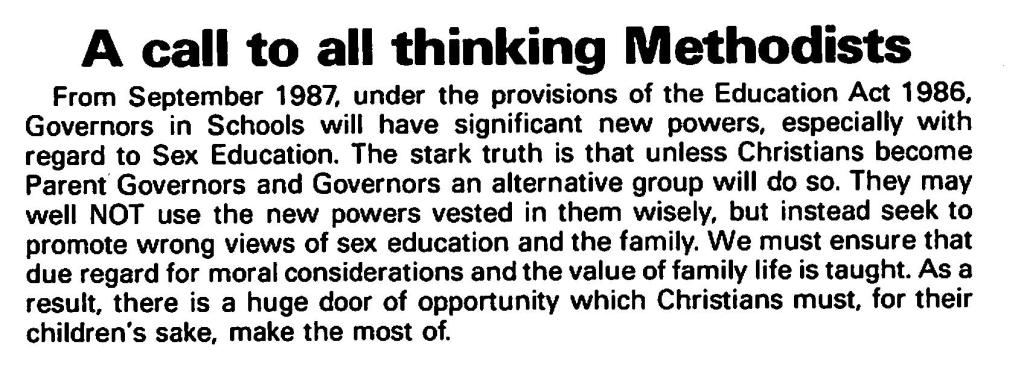
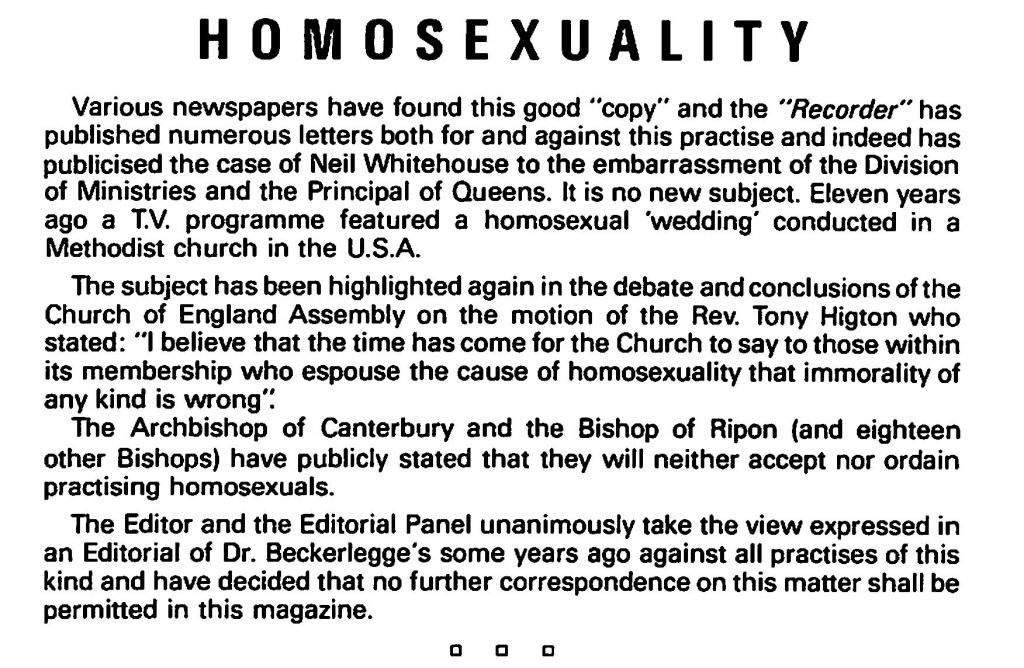
Among the more vocal opponents of LGBT+ rights were members of the Voice of Methodism movement, who expressed their views through the association’s magazine which was published from 1964-1996. Their complaints included that in light of the 1986 Education Act schools would have the right to ‘promote wrong views of sex education and the family’ (December 1987), and further discussion of ‘practices of this kind’ was banned (March 1988). This statement held firm throughout the rest of the magazine’s run, apart from in reference to decisions made at Methodist Conference. Following a report at the 1990 Conference, the magazine went so far as to remark that they believed that ‘the business of ‘human sexuality would be an unfortunate interlude happily forgotten in Methodist history’. This was far from the case.
The primary evidence of a shift in Methodist attitudes towards accepting LGBT+ individuals can be seen from the early 1990s.[3] In 1993, Conference formally accepted a set of resolutions which would shape Methodist policy over the decades that followed. The Derby Resolutions, as they came to be known, affirmed ‘the joy of human sexuality as God’s gift and the place of every human being within the grace of God.’ They went on to state that ‘a person shall not be debarred from the church on the grounds of sexual orientation in itself,’ and that ‘Conference recognizes, affirms and celebrates the participation and ministry of lesbians and gay men in the church.’ These resolutions finished by stating that ‘Conference calls on the Methodist people to begin a pilgrimage of faith to combat repression and discrimination, to work for justice and human rights and to give dignity and worth to people whatever their sexuality’. These resolutions accepted the LGBT+ community and separated the Methodist Church from the traditional view of homosexuality as a sin. A later letter from the President of Conference, Rev. Brian Beck, also stated that ‘homosexual orientation of itself is [not] a sinful state’. The Derby Resolutions did, however, state that Conference reaffirmed ‘the traditional teaching of the Church on human sexuality; namely chastity for all outside marriage and fidelity within it’.
This remained the official attitude of the Methodist Church throughout the 1990s, and into the twenty-first century. In 2019, the Methodist Church published the report of its Marriage and Relationships Taskforce. This taskforce had been appointed to review, and update, the attitude of the Church towards marriage and relationships. The resolutions of this report, therefore, would be the first changes to the Church’s position since 1993. Resolution 10/8 promises the greatest change, stating that ‘The Conference consents in principle to the marriage of same-sex couples on Methodist premises throughout the Connexion and by Methodist ministers’.
Whether this ‘in principle’ decision becomes actuality remains to be seen, with the final vote on this report (and its resolutions) due at this year’s Conference (June – July 2021). Regardless, an ‘in principle’ acceptance of LGBT+ marriages on Methodist premises, and by Methodist preachers, shows just how far acceptance and equality within the Methodist Church has grown in the past half a century. The Methodist Church is also the only Church in Britain to, even hesitantly, accept the proposal of LGBT+ marriage. Conversely, the United Methodist Church has stated that ‘sexual relations are affirmed only with the covenant of monogamous, heterosexual marriage’, finishing its statement by reaffirming that ‘The United Methodist Church does not condone the practice of homosexuality and considers this practice incompatible with Christian teaching’, [4] demonstrating the distance on this issue between two of the leading Methodist bodies either side of the Atlantic.
LGBT+ History Month provides a time, a space, and a platform for us all to recognise the history of the LGBT+ community. For more information about events at Oxford Brookes University this month visit https://www.brookes.ac.uk/staff/human-resources/equality-diversity-and-inclusion/lgbtq–history-month/
[1] https://www.umc.org/en/what-we-believe/umc-topics/social-issues/human-sexuality
[2] https://www.methodist.org.uk/downloads/ne_derbyresolutionsmethrec_130207.pdf
[3] https://www.methodist.org.uk/downloads/ne_derbyresolutionsmethrec_130207.pdf
[4] https://www.umc.org/en/content/the-nurturing-community#human-sexuality
 Westminster College Oxford - Research
Leave a comment