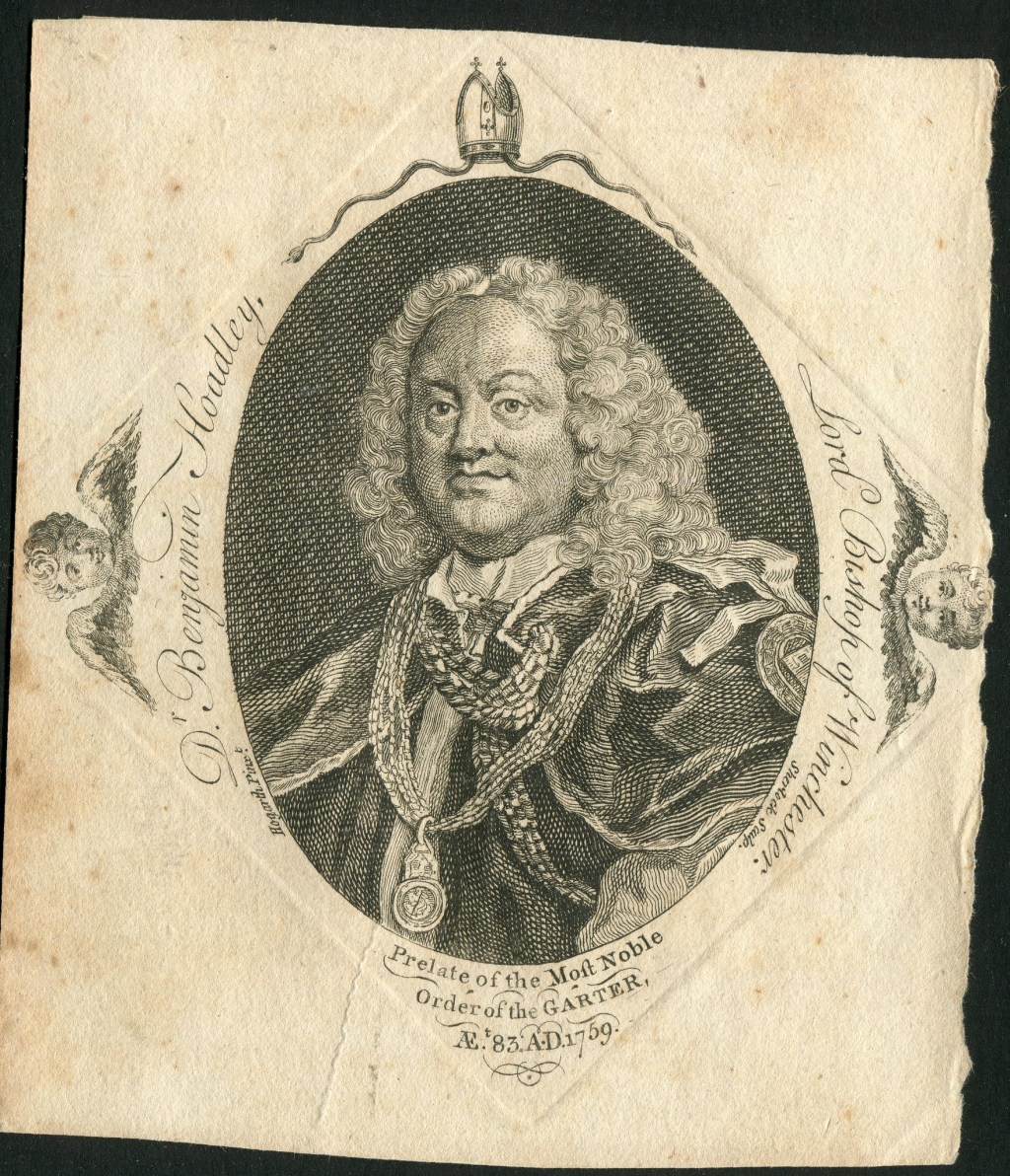
UK Disability History Month 2019 emphasises the roles of disabled leaders through history and their struggle for acceptance. In this blog post, Professor William Gibson puts the spotlight on an historical figure represented in our Digital Collections who embodies this guiding theme.

Benjamin Hoadly (1676-1761) is not widely known today, but three hundred years ago he instigated a religious controversy so great that it led to a five-year pamphlet war. The ‘Bangorian Controversy’ (named after Hoadly’s bishopric) focused on the issue of whether the Church could punish clergymen for their views. Hoadly argued it could not, stirring up a fierce debate prompting responses from clergy and lay persons around the country. What was more remarkable about Hoadly as a leading public figure of his time, was that he was disabled.
In 1692, while a student at Cambridge, Hoadly contracted smallpox. The illness was badly treated by an unskillful barber, and it was feared that Hoadly would lose his leg. Fortunately, Charles Barnard (a celebrated surgeon) saved the limb, but Hoadly was left physically disabled for the rest of his life. He used walking sticks in public, and crutches at home; and was forced to pray and preach kneeling on a stool or cushion to relieve strain on his weakened legs. Significantly for the period, this also prevented him from riding a horse. From the time of this illness, Hoadly never enjoyed good health. During his thirties it was feared that he was sinking into consumption. His insistence on taking the air in a chariot, however, which he did every day of his life, helped to keep the deadly respiratory complaint at bay.
Nevertheless, ill-health exerted an influence over much of Hoadly’s adult life. Writing in 1719 to Sarah, Duchess of Marlborough, Hoadly claimed that he had been so ill that his life had been in peril. The following year a bout of fever left Hoadly with red marks on his face so that he could not go out for a week. In 1717 he commented that he was ‘too ill to come out’ of his house, and he seems to have been plagued with colds and headaches. In 1731 he referred to the way he coped with his disability as ‘a man dragging life like a chain behind him’ and thereafter referred to life as ‘the chain.’ Later in life he often foiled requests for preferment on the grounds that he would not live long enough to redeem promises.
Hoadly’s disability was frequently used by his political and religious opponents to satirise him. In 1709, a print titled ‘Guess Att My Meaning’ depicted Hoadly as a follower of Oliver Cromwell, who is shown looking over his shoulder. Hoadly’s crutches are propped against the table, and the text refers to him as a ‘crooked stick’ and a ‘crippled priest’. In the same year, Hoadly (this time carrying a stick) featured in a print that accused him of attacking the Church. And in 1711, Hoadly was depicted with both a walking stick in his hand and a crutch at his feet in ‘The Apparition’.


Despite these deeply personal attacks, Hoadly’s disability did not prevent him from rising to the highest stations of the Church of England. He was a favourite of King George I, and was eventually appointed Bishop of Winchester – one of the most prestigious dioceses in eighteenth-century England and Wales. Remarkably, Hoadly lived until the age of 85 and was pugnacious and controversial to the end. Two years before his death, an attempt was made to defraud the Bishop of £3000, but Hoadly remained wily and sharp, proving in court that the man was a liar.
You can read more about Benjamin Hoadly’s life in William Gibson’s Enlightenment Prelate 1676-1761, Benjamin Hoadly (Cambridge: 2004). To learn about the guiding themes of UK Disability History Month 2019 visit https://ukdhm.org/
 Westminster College Oxford - Research
Leave a comment