

By Peter Forsaith.
Across Europe, Britain included, the huge (and accelerating) decline in traditional churchgoing over the last 50 years has left a legacy of redundant and deserted church buildings. Some are important historically, most still have symbolic value for families or local communities. What is to become of them? How can they be used or recycled?
The ‘Future of Religious Heritage in Europe’ conference (http://www.frh-europe.org/events/frh-biannual-conference-vicenza-2016/) brought together influential policymakers and practitioners from across Europe: Transylvania to Ireland, Norway to Turkey, to consider this, not as a problem but a series of opportunities, emerging themes and successful projects.
For alongside church decline sits an upsurge in other kinds of spirituality. In the 1970s only a handful of pilgrims trod the ‘way of St. James’ to Santiago de Compostella: in 2014 it was over 200,000. What are they seeking? Not religious devotion in a traditional sense but some less easily defined fulfilment. ‘Tourists, travellers, pilgrims’ was the conference title (‘pilgrim’ is the current religious heritage buzz-word) but which is which, and how to appeal to different sectors?
Yet this trend is breathing new life into some old churches: from the familiar – art galleries, museums, community spaces, to the innovative – ‘champing’ (church camping) or pop-up rock music venues. What was only 2 or 3 years back seen as a peripheral matter for tourism authorities is now centre stage, and attracting public funding.
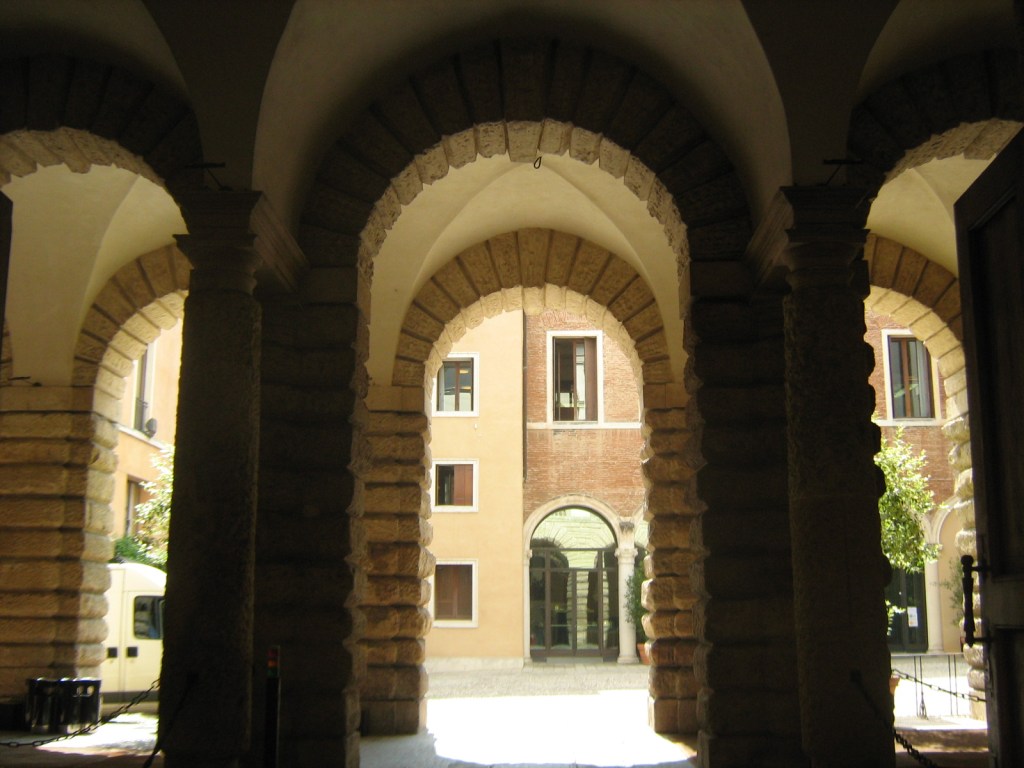
In Vicenza I stayed ‘airbnb’: my host turned out, fittingly, to be a travel writer and photographer with special interest in southeast Asian Buddhism. Vicenza is a kind of pilgrimage for me: Andrea Palladio was arguably the greatest European architect and this was his home town. His influence is seen in every street, his finest buildings are here. My last morning I made time, on my way to the station, for a coffee in the Piazza Basilica, sitting outside with the crisp, clear Italian sun picking out the colours of the stonework and exquisitely satisfying proportions of Palladio’s colonnade. Tourist, traveller, pilgrim – or all three?
Dr. Peter Forsaith is Research Fellow of the Oxford Centre for Methodism and Church History. Currently, the main focus of his research is on images of John Wesley: his major critical study ‘Image, identity and John Wesley: a study in portraiture’ is to be published by Routledge in 2017.
 Westminster College Oxford - Research
Leave a comment